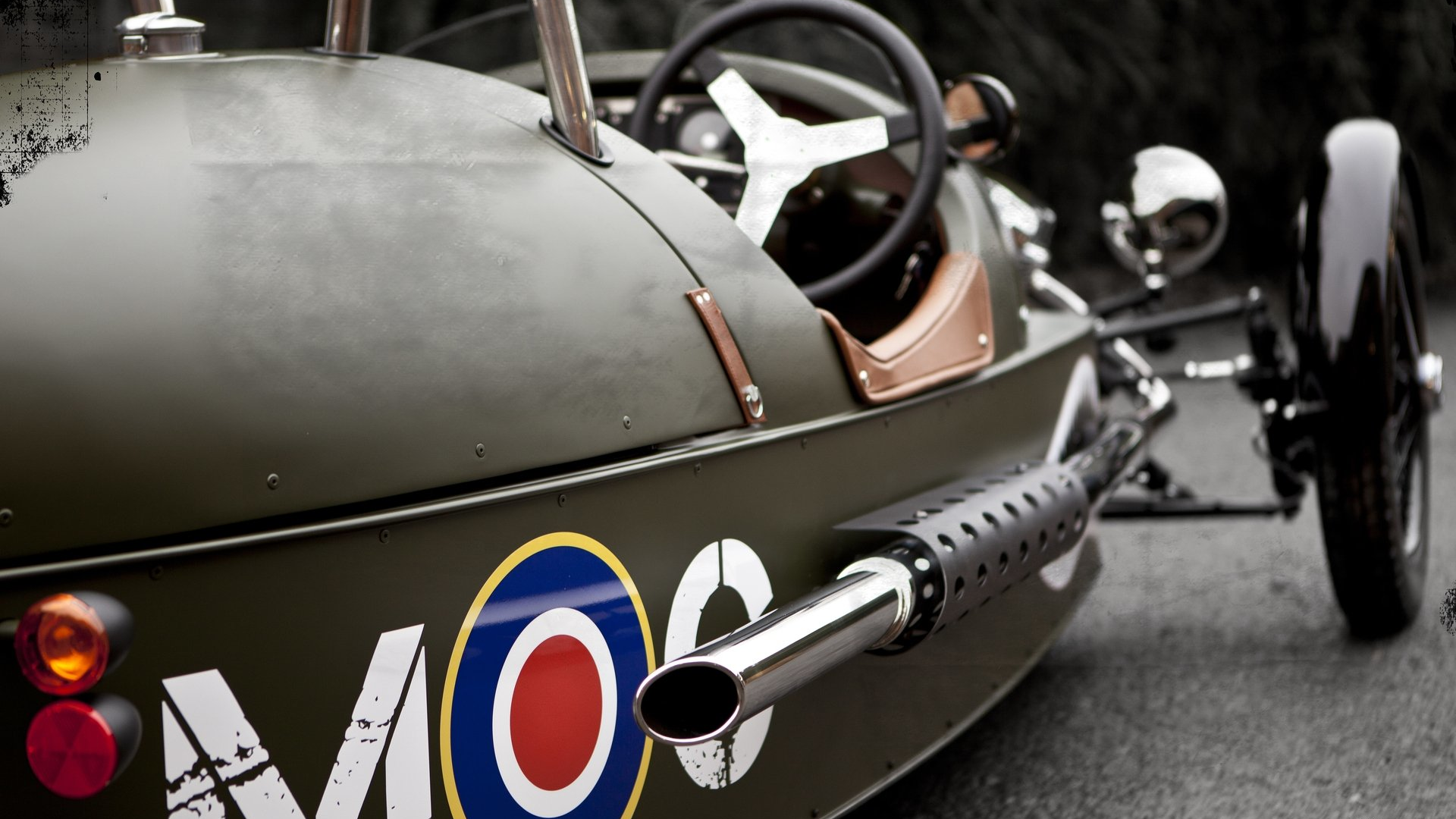
Automotive history is peppered with quirky creations: some cars have unusual engines, others have unusual body shapes, others have both. The Morgan 3-Wheeler is part of the latter category: not only does this diminutive, retro-inspired sports car have a motorbike-derived V-Twin engine (which already makes it fairly unusual on its own), but, as the name suggests, it also has one fewer wheel than you would expect to find on a car.
Its design is a throwback to the early history of the small British firm that produced it: the Morgan Motor Company started out with three-wheelers in the pre-war period, and paid homage to this part of their design history with the 3-Wheeler in 2011. The 3-Wheeler is now out of production, having been replaced by the Super 3; Morgan has since brought out other models as well, such as the Plus Four with its B48 BMW engine.
You can, however, find a few used examples of the 3-Wheeler for sale in the US. The car was imported to the States for a few lucky customers. Let’s explore the history that brought us this quirky sports car, and what came afterward.
BMW
- Founded
-
1916
- Founder
-
Karl Rapp
- Headquarters
-
Munich, Germany
This article focuses on the history and features of the Morgan 3-Wheeler. All information has been obtained from reputable sources.
Meet The Morgan 3-Wheeler
|
The Morgan 3-Wheeler In Numbers |
|
|
Engine |
2.0-liter V-Twin |
|
Horsepower |
81 hp |
|
Torque |
103 lb-ft |
|
Transmission |
5-speed manual |
|
0-60 |
4.5 seconds |
|
Top Speed |
115 mph |
The Morgan 3-Wheeler was first unveiled in 2011 at the Geneva Motor Show. The first 3-Wheeler to be imported to the US arrived in the summer of 2012, and was showcased at the Greenwich Concours d’Elegance in Connecticut. Its design was heavily inspired by Morgans of the past, with a simple, pre-war-style body, exposed front wheels, and leather interior. Thanks to a legal quirk, it was classified as a motorbike in the US due to its three-wheeled layout.
Production came to an end in 2021, with a final edition called the P101. A few months later, in February 2022, the Super 3 was introduced as the 3-Wheeler’s replacement; it is still in production today, and like its predecessor, it is also available in the US.
An Unusual Collaboration: The 3-Wheeler’s Motorbike Engine
One of the most unusual defining characteristics of the Morgan 3-Wheeler is its motorbike-derived engine. Before the car was introduced to the world, the automotive press believed it would be powered by a Harley-Davidson Screaming Eagle V-twin engine, producing around 115 hp and paired with a Mazda 5-speed manual transmission. However, this proved not to be the case.
The 3-Wheeler did have a V-Twin motorcycle engine, but it didn’t come from Harley-Davidson. Instead, it was an 81-hp unit sourced from another American motorcycle company, S&S. The rumors, however, did have the right idea when it came to the car’s transmission: the V-Twin’s power was delivered through the Mazda 5-speed as predicted.
Morgan’s Early History: Pre-War Three-Wheelers
The 3-Wheeler’s design was inspired by iconic models from Morgan’s past: throughout the company’s early history, up until 1936, it exclusively produced three-wheeled cars. The very first car designed by H.F.S. Morgan, founder of the company, was a three-wheeled runabout he used as his own personal vehicle. It was powered by a Peugeot two-cylinder engine that produced 7 hp; this engine was originally designed for a motorbike, starting the trend of cars with motorbike engines that would continue all the way to the modern 3-Wheeler.
The design caught the interest of customers and investors; soon, a production three-wheeled Morgan was in the works, with the number of seats going from one to two to make it more appealing to prospective buyers. The new Morgan car was even showcased in Harrods, London’s famous department store, becoming the only car ever to appear in its shop windows. The company grew rapidly, and its cars gained several victories in the world of motorsport, further contributing to its good reputation. Morgan continued to produce three-wheeled cars powered by V-Twin engines until 1939.

Related
10 Reasons Why You Should Care About Morgan’s Return To The USA
Morgan is set to return to the US market, and this is why the news is immensely exciting for sports car fans.
In the last few years of production for the V-Twin three-wheelers, a new series of cars began to emerge: the F-Series, which remained in production between 1932 and 1952. F-Series cars also had three wheels, but departed from the previous models in the engine department, opting for Ford sidevalve engines (already used in the Ford Model Y) as their sources of propulsion rather than motorcycle engines.
Not long after the F-Series had made its debut, a different model joined the Morgan lineup: the 4/4, Morgan’s very first four-wheeled vehicle. The 4/4 radically changed the company’s vision, taking it in a different direction: all following models produced by Morgan would have four wheels, until the modern 3-Wheeler arrived in 2011.

Add CarBuzz to your Google News feed.
An Electric Prototype: The Morgan EV3
In 2016, Morgan began announcing plans to produce an electric version of the 3-Wheeler called the EV3. The EV3 was due to be powered by a single electric motor producing 100 hp, paired with a battery that would give the vehicle a 150-mile range.
The demise of the EV3 marked the start of a long pause in Morgan’s electrification plans. At the time, managing director Steve Morris told Autocar that the company remained “absolutely committed to an electric future”; however, after the EV3 was shelved for good, it would be a few years before Morgan would introduce another electric prototype. This finally materialized in 2023 with the XP-1, an innovative all-electric prototype set to “preface all future Morgan sports cars”. All we can do is watch this space and see which direction the company takes when it comes to electrification.
What Came Next: The Morgan Super 3
The 3-Wheeler was succeeded by the Super 3, which was released in 2022 and is still being produced today. The Super 3 is available in both Europe and the US. While, like its predecessor, the Super 3 also has three wheels, it is based on a modified version of the CX aluminum platform also used by four-wheeled Morgans, such as the Plus Four and the Plus Six. The updated design makes the passenger experience more comfortable by allowing extra space for occupants, as well as increasing stability.
In keeping with other Morgan models, the Super 3 continues the tradition of blending classic design elements with modern tech. The look and feel of a pre-war car is combined with modern mechanical components and digital instruments (disguised as old-fashioned ones, of course). The V-Twin that had powered the 3-Wheeler has been replaced. The Super 3 uses a 1.5-liter Ford three-cylinder engine. As was the case with the 3-Wheeler, power is sent out through a Mazda five-speed manual transmission.
Other Cars Powered By Motorbike Engines
The 3-Wheeler’s motorbike engine might make it unusual, but not unique: there are several other examples of cars powered by motorbike engines from across automotive history. Let’s take a look at a few of them.
Peel P50

The smallest production car ever built, the pocket-sized Peel P50 first arrived on the market in 1962, marketed as big enough to fit “one adult and a shopping bag”. Its name derived from the town of Peel, on the Isle of Man, where it was manufactured. It had three wheels, and was powered by a motorcycle engine sourced from German firm DKW. In 2011, Peel enthusiast Gary Hillman resurrected the brand with a modern version of the P50. Only 50 units of the reborn P50 were produced, with a choice of either a 49-cc engine (similar to that of the original) or an all-electric powertrain for a modern twist.
Honda N360/N600

Honda’s first mass-produced car, the N360 kei car, arrived in 1967, remaining in production for five years. It was powered by a modified version of a Honda “parallel twin” inline-two motorcycle engine. Its export-market counterpart, the N600, was powered by a slightly larger version of the same engine. In a similar fashion to the Peel P50, the N360 also had a modern successor: in 2012, the N-One microcar was created by Honda as a tribute to the N360. Its small dimensions, as well as its vintage-inspired styling cues, evoked the N360’s design.
Ariel Atom 500 V8

Most car enthusiasts are familiar with the Ariel Atom, the stripped-down track toy that packs a lot of fun in a lightweight package. One particular variant of the model, the Atom 500, was powered by not one, but two motorcycle engines. Its V8 was a one-of-a-kind creation, made by grafting two Suzuki motorcycle engines together; the complex process that resulted in a functioning engine involved lots of structural changes, but a dose of motorcycle DNA remained in the final product. The Atom 500 was a very rare variant, with only 25 units ever built.
Sources: Morgan Motor Company, Peel, Ariel Motor Company, Honda, Autocar