The automotive industry often finds itself at the forefront of new technology; the design and manufacturing of cars is a highly complex process, where new types of software and machinery are put to the test.
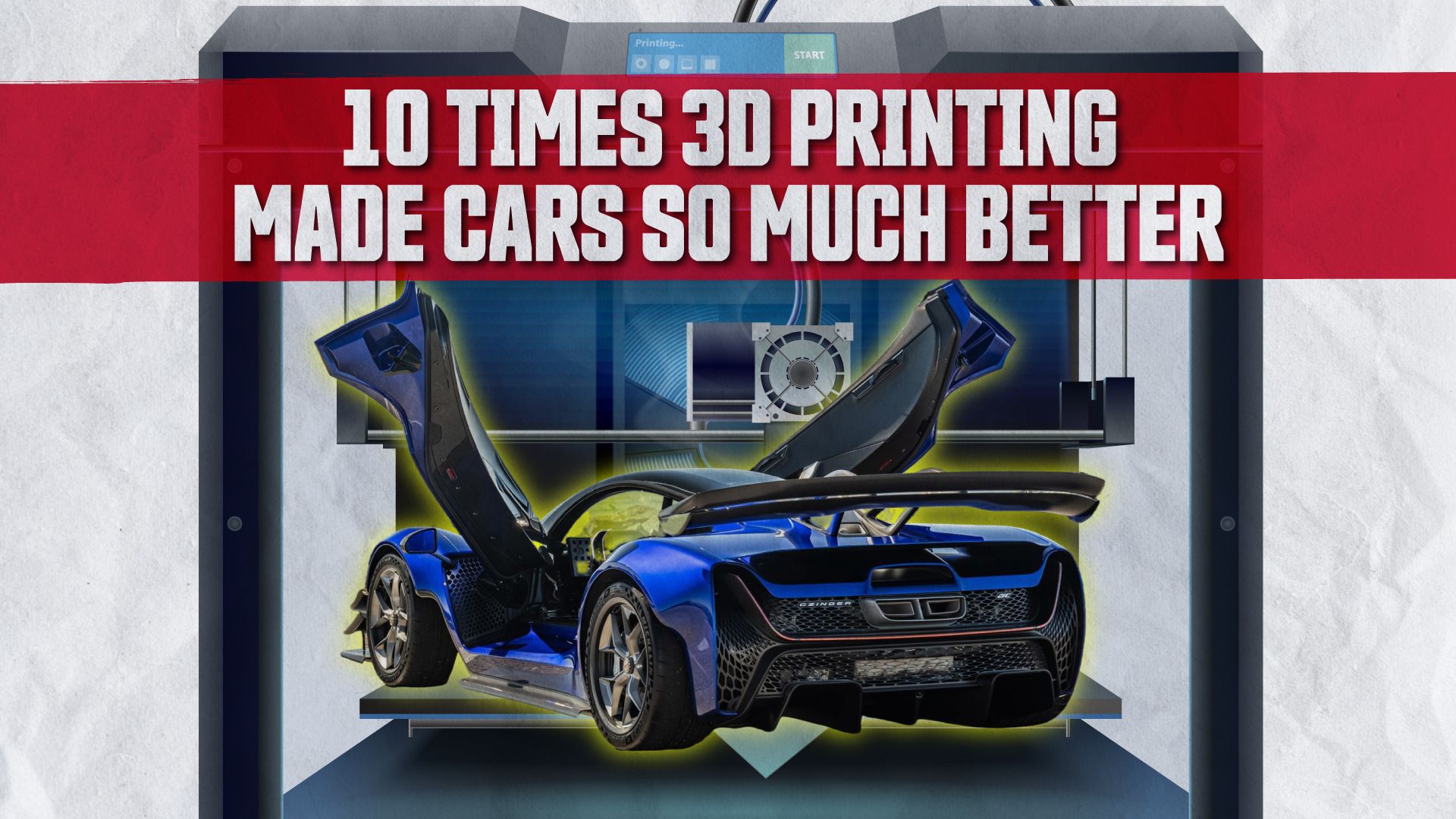
One type of technology that has found several applications in the car world is 3D printing: far from the early days of small plastic artifacts, 3D printing has now evolved into a complex art with the ability to create elaborate components in several types of material. From interior trim to brake calipers and beyond, there are countless automotive parts that can be created through its use. While 3D printing is sometimes used in one-off concept cars simply to showcase new technology, there are also examples of it being used in production models such as the BMW M3 CS Touring. Here are 10 times automakers have used 3D printing to give their cars an extra edge.
M3 CS
- Model
-
M3
- Segment
-
Compact Luxury Performance Sedan
- Base MSRP
-
$118,700
Items are listed in no particular order. All information has been obtained from reputable sources.
1
The “3D Printed Supercar” (Multiple Components)
Czinger 21C
|
Engine |
2.9-liter twin-turbocharged V8 |
|---|---|
|
Horsepower |
950 hp |
|
Torque |
550 lb-ft |
|
0-60 |
1.9 seconds |
We start off the list with a car that has an abundance of 3D printed components. The Czinger 21C was launched in 2020 and immediately made waves in the automotive world for its innovative, high-tech design process: the company used a production system that blended human input with AI.
The 21C was given the nickname “3D printed supercar” due to the extensive use of 3D printing technology during its manufacturing process: highly advanced printers were employed to build over 350 of the car’s metal components. The Czinger team used AI technology to optimize the shape of each part; the final design was subsequently sent to the 3D printers, which used 12 lasers to create each component quickly and efficiently.

Related
5 Times America’s Newest Hypercar Beat The World’s Best
The Czinger 21C has well and truly proven its credentials as a hypercar. Let’s explore some of the records it has broken.
2
Cylinder Head Core
BMW M3 CS Touring
|
Engine |
3.0-liter twin-turbo inline-six |
|---|---|
|
Horsepower |
543 hp |
|
Torque |
479 lb-ft |
|
0-60 |
3.5 seconds |
The 2025 M3 CS Touring is, sadly, not for sale in the US, but that doesn’t stop us from admiring its qualities from afar. These include a host of mechanical upgrades inspired by the world of racing, from new turbochargers to upgraded cooling and oiling systems: the result is eye-watering, track-ready performance.
A high-tech design and manufacturing process was used to carry out all these upgrades: one feature that jumps out is the use of 3D printing technology, which was employed to create the M3 CS Touring’s cylinder head core. The final result of all these upgrades is a 41-hp power boost, going up to 543 hp against the M3 CS Competition’s 502.
3
Interior Motif
Cadillac Opulent Velocity
The Cadillac Opulent Velocity is an innovative concept car introduced in 2024 at the Monterey Car Week, built to push the boundaries of design beyond what you would typically find in production cars. As suggested by its name, the Opulent Velocity blends speed with high luxury; although details on its powertrain and performance are unclear, we know it is fully electric and incorporates elements of autonomous driving.
The interior is where the 3D printing element comes in: the Opulent Velocity’s cabin is decorated with a motif that incorporates elements of embroidery and light-reflecting prisms, all created through 3D printing technology.
4
Gear Shifter Medallion
Cadillac CT5-V Blackwing Le Monstre / CT4-V Blackwing Petit Pataud
|
CT5-V Blackwing “Le Monstre” |
CT4-V Blackwing “Petit Pataud” |
|
|
Engine |
6.2-liter supercharged V8 |
3.6-liter turbocharged V6 |
|
Horsepower |
668 hp |
472 hp |
|
Torque |
659 lb-ft |
445 lb-ft |
|
0-60 |
3.6 seconds |
3.9 seconds |
The next entry is about not one, but two unique Cadillacs: in 2024 the brand unveiled a special edition of the CT5-V Blackwing and the CT4-V Blackwing, created to celebrate the two cars entered by the brand in the 1950 edition of the legendary 24 Hours of Le Mans.
Cadillac entered two Series 61 Coupes in that race; one was stock, and referred to by the nickname “Petit Pataud” (French for “little clumsy”), while the other was a bizarre creation dubbed “Le Monstre” (“The Monster”). Their modern counterparts kept the nicknames: the CT4-V Blackwing pays homage to the Petit Pataud, while the CT5-V is a tribute to Le Monstre. Both cars feature a 3D printed medallion decorating the gear shifter, as well as a number of other unique cosmetic touches.
Bentley Blower Continuation
|
Engine |
4.5-liter supercharged inline-four |
|---|---|
|
Horsepower |
240 hp |
|
Torque |
N/A |
|
0-60 |
~12 seconds |
Although Bentley has used 3D printing extensively to build car parts (like the Batur, coming up in the next entry), in the case of the legendary Blower’s modern incarnation, the company used 3D printing to build tooling equipment instead.
When Bentley set out to create a period-correct (“continuation”) version of the legendary Bentley Blower in 2020, 3D printing proved to be the answer to the dilemma of how to recreate the tooling equipment used in workshops a century ago. The results speak for themselves: the continuation series brings the spirit of the original Blower back to life in the most accurate way possible.
6
Interior Trim
Bentley Batur
|
Engine |
6.0-liter twin-turbo W12 |
|---|---|
|
Horsepower |
730 hp |
|
Torque |
738 lb-ft |
|
0-60 |
3.3 seconds |
When thinking of materials used in 3D printing, plastic is typically the first one that comes to mind. Gold, however, is not commonly associated with this type of tech; not unless you’re Bentley, anyway. In 2023, the British marque introduced the limited-run Batur, only 18 examples of which were built with an eye-watering price tag of $2 million each.
The Batur is an ultra-luxury grand tourer, whose interior offers countless decor options tailored to each customer’s preference. One of the items on the menu is 3D printed solid gold trim: in what the company described as a “ground-breaking process”, up to 210 grams of gold are used to 3D print small components for the interior, such as dials.

Related
This Bentley Batur Has Something No Other Luxury Car Has
Sometimes what glitters really is gold.
7
Interior Accessories
Ford Maverick
|
Engine |
2.0-liter turbocharged inline-four |
|---|---|
|
Horsepower |
250 hp |
|
Torque |
277 lb-ft |
|
0-60 |
~6.0 seconds |
(specs refer to base trim)
Ford takes a slightly different approach to 3D printing than other car brands: rather than handling the manufacturing process itself, it lets customers take charge of creating their very own accessories for the Maverick. Maverick owners can choose from a catalogue of 3D printer-compatible files, creating accessories that are compatible with Ford’s Integrated Tether System (FITS).
Aside from downloading existing accessory templates, Maverick owners who are skilled in 3D printing can also design their own accessories, as the slot geometry of the FITS system is open-source. This opens the Maverick up to unlimited personalization and creativity, making each vehicle unique.
8
Brake Calipers
Bugatti Chiron
|
Engine |
8.0-liter quad-turbo W16 |
|---|---|
|
Horsepower |
1,500 hp |
|
Torque |
1,180 lb-ft |
|
0-60 |
under 2.5 seconds |
Technological advancement has always played a part in Bugatti’s design and manufacturing process; the brand’s cars, famous for their level of luxury and performance, have always been at the forefront of innovation in the automotive industry. In 2018, the brand proudly showcased its latest achievement: having built a fully functioning, high-performance brake caliper through 3D printing.
The brake caliper was made from titanium (another first, as titanium usually requires highly complex processing), and gained the title of largest functional component made of titanium using 3D printing. Bugatti worked extensively with Laser Zentrum Nord, a German tech and manufacturing company, to complete this highly ambitious project.
9
Seats
Porsche (Multiple Models)
Porsche takes great pride in being at the forefront of innovation; the company is always looking for ways to improve the performance and quality of its vehicles, using a number of state-of-the-art technologies. 3D printing is one of the avenues the German marque has explored in recent years, using it to create race-inspired sport seats that can be fitted to most of its models.
The 3D printed seats were first used in Porsche’s motorsport endeavors, as well as being showcased in the Mission R concept; a few months later, they became available for purchase by private customers for their road cars. In most Porsche models, the 3D printed seats can only be used for the driver, but in a handful of cars (such as the 981-generation Boxster and Cayman, as well as the 991-generation 911) they can be fitted on both the driver and passenger side.
10
Body Kit
“Altimaniac” Nissan Altima Drift Car
|
Engine |
4.1-liter twin-turbo V6 |
|---|---|
|
Horsepower |
1,300-2,000 |
|
Torque |
N/A |
|
0-60 |
N/A |
The last entry on the list is something of a wild card. Instead of being a production car, it’s a bonkers one-off project, curated by Formula Drift champion Chris Forsberg. The “Altimaniac” started out in life as a regular Nissan Altima, but was extensively modified to become a drift-ready monster.
One of the modifications carried out as part of the Altimaniac project was the creation of a 3D printed body kit. This part of the process was carried out by engineering firm Tekk Consulting and fabricator Rob Parson, who assisted Forsberg in bringing the ultimate drift car to life. A custom livery inspired by the world of motorsport completes the look.
Sources: Czinger, BMW, Cadillac, Bentley, Ford, Bugatti, Porsche, Chris Forsberg