Drag racing was a big deal in 1964. More than 400 drag strips were scattered around the USA, and around 200,000 drag racing cars competed on those tracks. At the time, long before fancy live television broadcasts and social media, it was said that five million followed the sport. In other words, they were at drag racing strips, seeing the action live, and taking in the smell of burning rubber and high-octane fuel. Winning a drag race on a Saturday translated into selling a car on Monday.
And this was exactly why Ford went all-in with their 1964 drag racing effort, building no fewer than 100 race-ready Valiant Thunderbolts. Light in weight and big on power, the Thunderbolt won the 1964 championship.
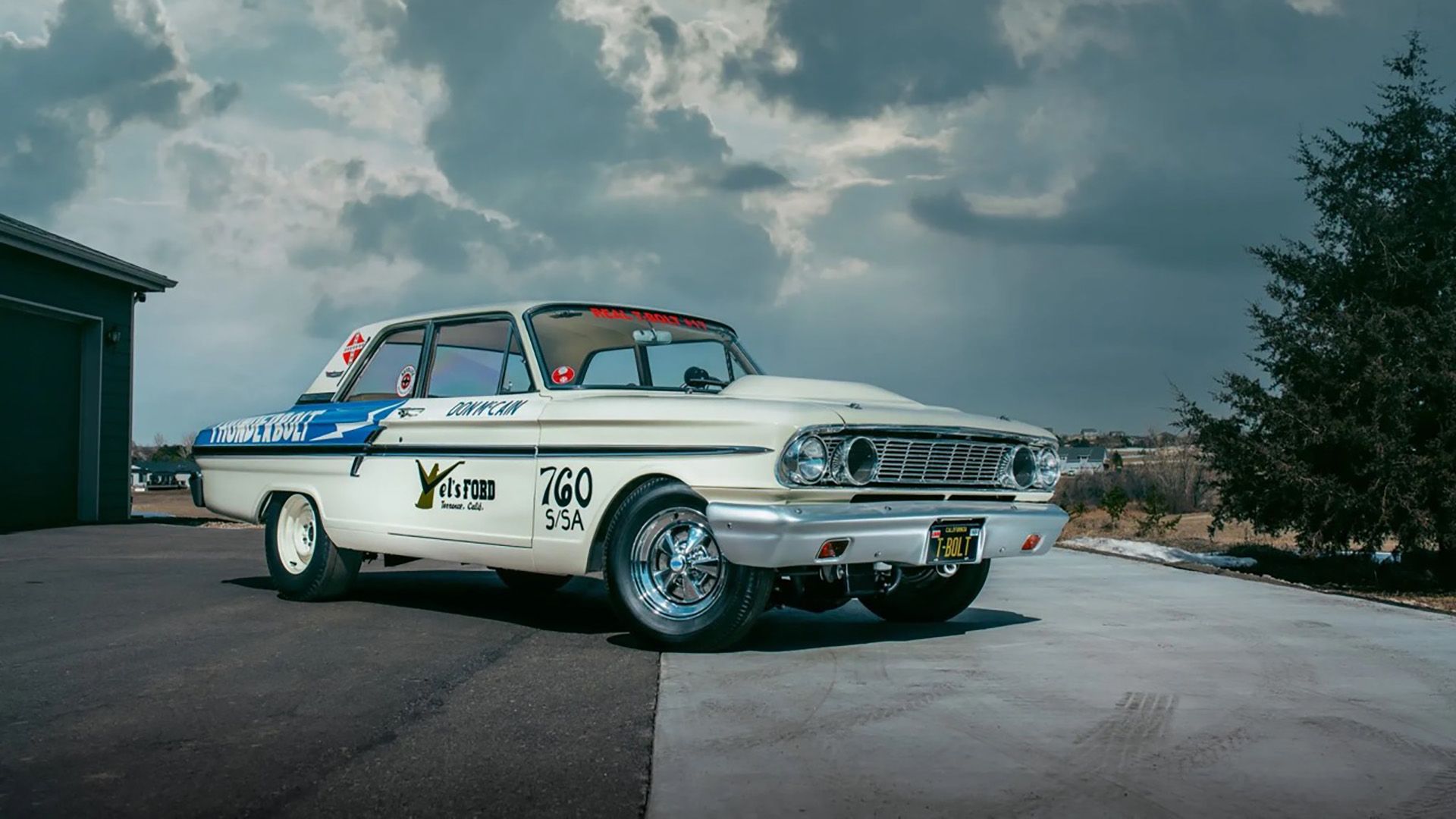
The 1964 Ford Fairlane Thunderbolt has become a highly collectible piece of Americana. This is the story behind the creation of the “425-hp Thunderbolt”, which actually had closer to 600 hp.
Ford
- Founded
-
June 16, 1903
- Founder
-
Henry Ford
- Headquarters
-
Dearborn, Michigan, USA
- Owned By
-
Publicly Traded
- Current CEO
-
Jim Farley
The Ford Fairlane Thunderbolt came with an official notice from Ford that it does not conform to the company’s fit and finish standards. Ford also said it made 425 hp, but it was actually closer to 600 hp. This is the story of the amazing Thunderbolt.
Ford Makes A 600 Hp Engine
|
1964 Ford Fairlane 4.7 V8 |
|
|
Engine |
4.7-liter V8 |
|
Power |
195 hp |
|
Torque |
300 lb-ft |
|
0-60 mph |
8.7 seconds (estimated) |
|
Top speed |
125 mph (estimated) |
In the early 60s, Ford built a seven-liter V8 engine. It was known as the “427 High Riser”, and fitted to Ford’s halo Galaxie model. The Galaxie, with lightness added, competed in the NASCAR series. But Ford also realized the nearly 3,900-lb vehicle was too heavy and barge-like to be competitive against Chrysler and General Motors’ offerings competing in drag racing. At the time, drag racing was very much in vogue, with literally hundreds of thousands of spectators taking in the action at national drag racing events, and Ford was not going to rock up with a contender that was too slow to bring home the silverware.
So a plan was hatched: make that 427 engine fit into the more compact and much lighter Ford Valiant, which, in stock trim, weighed around 3,000 lbs. When every ounce makes a difference, a saving of around 1,000 lbs represents a massive saving. The transformation was no small feat, and included major modifications. Getting the 7.0-liter V8 with its dual four-barrel Holley carburetors into the Fairlane engine bay – which was never designed to accommodate such a big lump of engine – required a major operation. This includes relocating the independent front suspension parts and strengthening all the suspension mounting points.
The car also came standard with fiberglass doors, front fenders and a hood with the iconic ram-air scoop, designed to extract hot air from the engine bay. Some of the first models apparently also had a fiberglass front bumper and Plexiglass side and rear windows. However, the car later came standard with an aluminum front bumper to conform with homologation regulations.
Ford’s new experimental drag racing contender was soon christened Thunderbolt. And it was, truth be told, a highly modified drag racer with only one aim: to beat Chrysler and General Motors’ offerings on any which drag strip, on any which day of the week.
450 hp? Not even close…
|
1964 Ford Fairlane Thunderbolt |
|
|
Engine |
7.0-liter V8 |
|
Power |
425 hp (claimed) |
|
Torque |
480 lb-ft (claimed) |
|
0-60 mph |
4.7 seconds |
|
Top speed |
120 mph (estimated) |
In 1964, Ford did not cut any corners to ensure the Thunderbolt had what was needed to win. Any and all additional weight was removed from the car. This includes the radio, heater, arm rests, all sound-deadening materials, rear window winders, mirrors, all the carpets (even in the trunk), and the spare tire and all the tools required to change a flat wheel. Going the extra mile, even the sunvisors and windshield wiper on the passenger side were thrown out. The front seats were lightweight items from Ford’s famed police package, or very basic bucket seats.
The weight-saving measures continued on the outside. The high-beam headlights were removed, and replaced by ram air-intakes which fed the custom air cleaner that lived on top of the 7.0-liter V8. The engine also featured tubular exhaust headers and the engine was fed fuel via a high-performance, electric fuel pump. With no spare space in the engine bay, the heavy-duty battery was relocated to the trunk. Other modifications included a highly modified rear suspension with upgraded, asymmetrical leaf springs, and a special aluminum shield for the clutch, in case it disintegrated under the massive loads exerted during drag racing launches.
The Thunderbolt also had special, lightweight racing rims, shod with specialist Goodyear or Mickey Thompson drag racing tires. Drag racer legend and team owner Thompson received one of the first hand-built units to roll out of the Dearborn Steel Tubing workshop, the company contracted by Ford to build the Thunderbolts.
In an unprecedented move, Ford added a small plaque to the glovebox door, stating: ‘This car is specially built as a lightweight competitive car and includes certain fiberglass and aluminum components. Because of the specialized purpose for which this car has been built and in order to achieve maximum weight reduction, normal quality standards of the Ford Motor Company in terms of exterior panel fit and surface appearance are not met with this vehicle.’
Interestingly, Ford built a limited number of manual Thunderbolts, fitted with a Borg-Warner four-speed gearbox. A heavy-duty, three-speed Lincoln automatic gearbox was the more regular option. Both the manual and automatic cars came with final drive ratios for maximum acceleration performance, which rendered them highly unpractical to use on the road. Amazingly – and even with all the deletions like the main-beam headlights – the Thunderbolt was technically legal to use on the road, as impractical as that may have been.
But it did its best work on the drag racing track.
To The Championship, And Beyond!
The Ford Fairlane Thunderbolt was fast, straight out of the box, easily turning in 11-second passes. Interestingly, most punters seem to agree that Ford’s claim of ‘425 hp’ was a prime example of sand-bagging… the 7.0-liter V8 engine was believed to actually produce as much as 600 hp. Some sources even claim 650 hp.
Driver Butch Leal, also known as the California Flash and who would later be inducted into the National Hot Rod Association (NHRA) drag racing Hall of Fame, was a dominant force in the 1964 NHRA Super Stock Class in a Mickey Thompson-owned Ford Fairlane Thunderbolt (car number seven). In the same year, the NHRA hosted the Winter Nationals. The Top Stock class finals featured a major showdown between legends Gas Ronda and Butch Leal… both in Ford Fairlane Thunderbolts. Ronda won that round, with a run of 11.78 seconds (at 123,4 mph).
Ford’s audacious plan to make that big engine fit in the Fairlane’s relatively small engine bay paid off, and the Thunderbolt became a legend in its own time, winning drag races across the USA. And winning on a Saturday equated to selling a car on Monday.
It is no surprise that there are many Ford Fairlane Thunderbolt tribute units doing the rounds, selling at an average price of about $40,100. Once in a blue moon, the real McCoy also goes up for sale. The real deal will set you back more than $200,000.
In 1964, Ford apparently made a loss of around $1,500 per Thunderbolt, with the cost of all the modifications, the engine and the hand-built manufacturing process taken into account. Considering the asking price was $4,000, that’s a big chunk. But, the marketing value of two Thunderbolts facing off in the final of a top drag racing event is absolutely priceless, with hundreds of thousands of spectators looking on. And winning the 1964 NHRA manufacturers’ championship also did its part.
Check out this cool blast from the past to get a taste of how big the business of drag racing was back in the Sixties.
Ford Is Still At It…
|
2018 Ford Mustang Cobra Jet |
|
|
Engine |
5.2-liter supercharged V8 |
|
Power |
1,000 hp |
|
1/4 Mile time |
8.5 seconds @ 150 mph |
In 1968, the Ford Mustang Cobra Jet became the brand’s main drag racing weapon. At the time, the company produced 50 lightweight and road-legal Mustangs, powered by Ford’s 428 engine, rated at 335 hp. Like the Thunderbolt, the cars were sold to professional and amateur racers alike, taking on drag races across the USA.
To celebrate 50 years of the Cobra Jet, Ford introduced a modern version of the Mustang Cobra Jet in 2018. It is a limited-edition, ready-to-drag car of which only 68 units were made. The 2018 version was powered by Ford’s well-known Coyota engine, modified, strengthened and stretched to 5.2-liter, and fitted with a massive three-liter Whipple supercharger. The power was sent to the rear wheels via a nine-inch solid rear axle, and it had two-way coil-over shocks with adjustable ride height, a bespoke four-link rear suspension with anti-roll and Panhard bars, and a high-performance, low-drag disc brake system.
Unlike the Thunderbolt and the original Mustang Cobra Jet, the latest version was never intended for road use, so it has no VIN number, and is illegal to use on public roads.
Since then, Ford created an all-electric Ford Mustang Cobra Jet. Cool, yes. But not nearly as cool as the Ford drag racing specials fitted with good old V8 engines.
Sources: Ford Muscle, Ford, Ford Performance, Bring A Trailer