When VE Day arrived in May 1945, Germany lay in ruins. The country was facing devastation on almost every front and its once-proud industrial base lay in tatters. Mercedes-Benz was one of the wounded commercial titans here and a company that was once a symbol of precision, luxury, and innovation was left scrambling. Company bosses needed to find a spark or even a new identity and, thankfully, one of its new platforms came to its rescue.
Mercedes-Benz
- Founded
-
June 1926
- Founder
-
Karl Benz, Gottlieb Daimler, Wilhelm Maybach, and Emil Jellinek
- Headquarters
-
Stuttgart, Germany
- Owned By
-
Daimler AG
- Current CEO
-
Ola Källenius
This is the story of the Turtleback W120 platform, which represented a forward-thinking breakthrough and that would help to usher in a new era. It was Mercedes-Benz’s post-WWII sedan that would eventually lay the foundation of what we know today as the mid-size E-Class and full-size S-Class sedans.
We looked at the Mercedes-Benz W120 platform from the 1950s, commonly called either “Ponton” or “Turtleback.” We found out how the platform helped the company recover from the Second World War and create the foundations for the dominant S Class. The figures in the table relate to the 1957 Mercedes-Benz 190 “Ponton.”
The W120 Helps Mercedes Emerge from the Wreckage
|
1957 Mercedes-Benz 190 Ponton Turtleback Specifications |
|
|---|---|
|
Engine |
1.9L NA I4 |
|
Transmission |
4-speed manual |
|
Drivetrain |
RWD |
|
Power |
75 hp |
|
Torque |
87 lb-ft |
As Mercedes-Benz started to piece together a future from the wreckage of the recent past, it knew that it had two major challenges ahead. Firstly, the company had to rebuild all the physical infrastructure that was damaged during the war, but it also needed to restore its reputation. In the W120, it told the rest of the world that Mercedes-Benz was back. After all, this new platform, which launched in 1953, wasn’t simply a new design, but more of a symbol. Yes, it was the basis for a range of modest vehicles in the grand scheme of things, but the new cars had plenty of innovative features and were a marked departure from the prewar automotive design ethos.
Mercedes Goes All-In with a New Approach
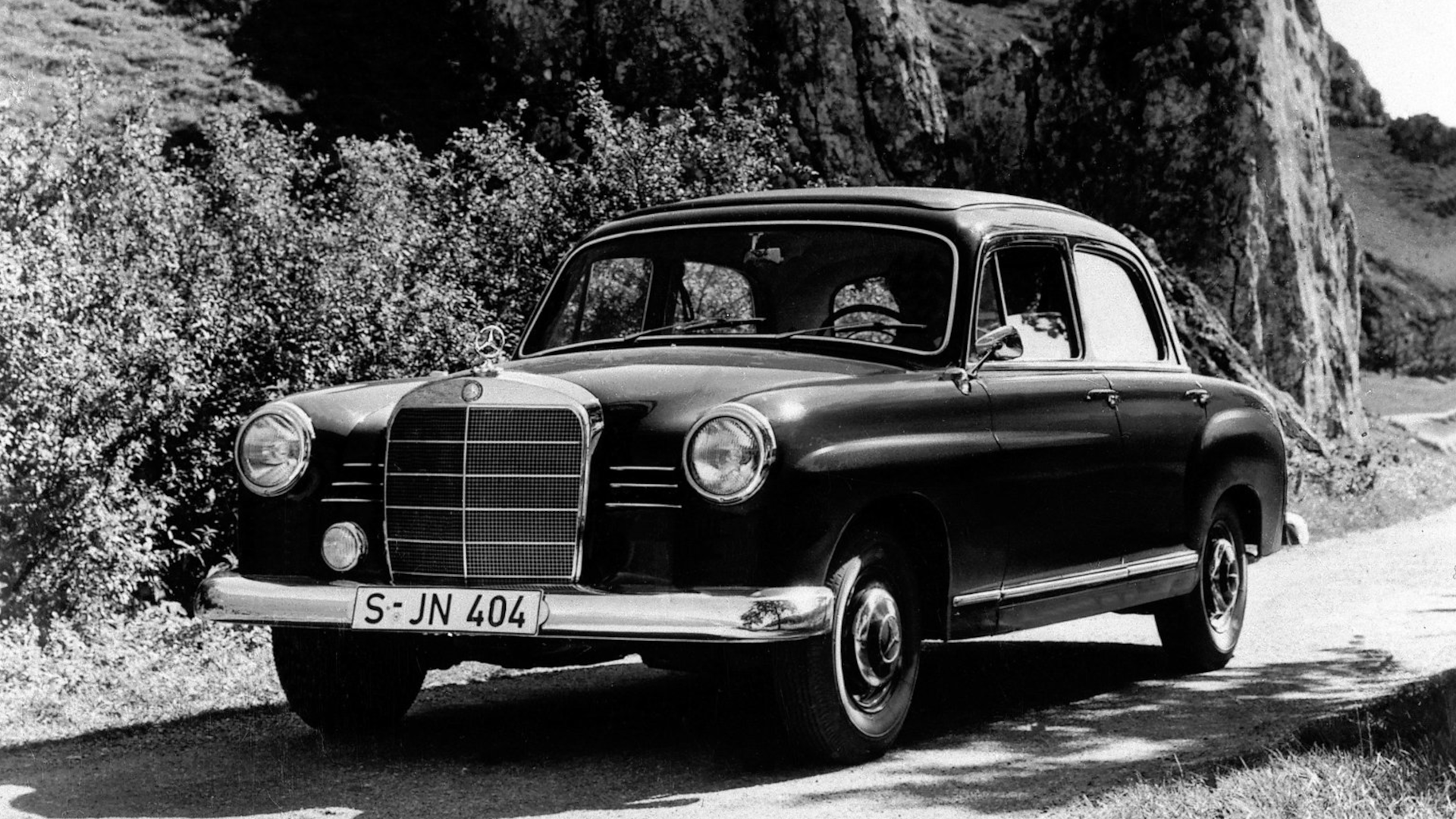
The W120 gave birth to the 180 and 190 ranges, which were compact sedans and practical workhorses, meant to help society heal and move forward. These cars featured a flowing and round shape that was nothing like its boxier predecessors and a pontoon-like, uninterrupted body front to rear, free from running boards, resulting in it becoming known as the “Ponton.” This term also described the way that the rounded and pontoon-like front fenders seamlessly flowed into the body. While people in the US thought it looked more like a turtle’s back, the vehicle was nevertheless aerodynamic, modern, and sturdy. It had this unusual appearance that was somehow dependable and strong, very important qualities in those re-formative years.

Related
10 Important Technologies That Debuted In The Mercedes-Benz S-Class
The S-Class has a long history of introducing technological innovations. Here are some of the features that made their debut on this model.
Mercedes-Benz began work on these cars soon after the end of the war and the prototypes came out in early 1951. The 180 had a 1.8-liter inline-four gas engine, with diesel versions and a slightly more powerful 1.9L 190 model emerging in the years that followed. The company’s strategy was simple and successful in that it had some new sedans that were accessible and reliable, while being advanced enough to stabilize the company’s operations.
A New Style of Construction Appears
These cars featured a groundbreaking monocoque or unibody construction. Remember that this was a time when most American cars featured traditional body-on-frame construction, but now, Mercedes had a car which combined the chassis and body into a single rigid shell. So, they were lighter and more fuel efficient, but also stronger. In the event of a crash, this type of design would help to distribute the impact forces. The Turtleback may have had a soft and rounded exterior, but underneath, Mercedes-Benz had designed this car to last and protect its occupants.
Underneath the Turtleback
With the Turtleback, Mercedes-Benz made some great strides in the suspension department. The cars had an independent front suspension with a swing axle at the rear, so you could expect a more comfortable ride than some of its rivals, as well as superior handling. The company also fitted robust drum brakes and, as a package, the car felt very confident and balanced on the road. Feedback from consumers was excellent, especially when it came to maintenance.

Related
The Biggest Engine Ever In A Series Production Mercedes S-Class
The Mercedes-Benz S-Class is one of the most respected luxury cars on the road, but the version with the largest engine came long ago.
Everything was accessible, and you could even service the entire drivetrain with relative ease. Remember, this was a time when Europe was rebuilding, and it wasn’t always easy to access parts or professional mechanics. In other words, simplicity was important, and the W120-platform cars delivered.
The W120 Range in the USA
In America, the W120-based cars may have been modest or even plain, but they were nevertheless welcomed. Some returning American GIs brought these cars with them and the press drew attention to how their style was in stark contrast to America’s status quo. After all, America was filled with huge, chrome-heavy land yachts with huge tail fins that seemed increasingly out of place in the new era. Although the Mercedes newcomers may have been lacking in the horsepower department compared to their rivals, they nevertheless found their niche and built up a loyal clientele. Many people felt that they represented a solid form of transportation and were built for precision rather than brute strength. They may not have sold in Ford- or Chevy-like volumes, but they nevertheless put Mercedes-Benz on the US map, as a serious, desirable, and reliable brand.
The Turtleback Grows in Stature
The Turtleback created a legion of fans around the world and became a legend in its own lifetime. You’d find these cars in use as police vehicles in Berlin and taxis in Beirut, and they just kept going, and going, and going. Mechanics loved the vehicle’s straightforward maintenance and owners couldn’t fault it. There are stories that some vehicles racked up more than 500,000 miles while still retaining the original powertrain, and in developing countries, the diesel version of the 190 became something of a family heirloom. People would hand them down from one generation to the next and this is a major testament to just how well they were built.

Related
The Mercedes-Benz Coupe Worth $142 Million
The 300 SLR Uhlenhaut Coupe is one of Mercedes-Benz’s rarest cars, with only two examples in existence. Here’s why it commands such a price tag.
How the Ponton Spawned a Dynasty
The Ponton was certainly more of a company savior rather than a luxury flagship, but nevertheless, its DNA would eventually be carried forward into the S-Class, a real Mercedes-Benz dynasty. The original cars had all the hallmarks of what a Mercedes-Benz sedan would become in terms of a quiet and comfortable cabin, a focus on safety with structural integrity, and mechanical sophistication. And as the car was so successful in markets around the world, the Turtleback would help Mercedes-Benz to develop in some critical areas, including its dealer network, export strategies, and quality control processes. Even though the S-Class – officially called that from the W116 generation – you can certainly trace the lineage through the larger Ponton models and back to the W120.
The Turtleback in the Modern Era
Today, the Turtleback has plenty of fans. You’ll find several restoration communities as well as forums and Facebook groups that are all dedicated to bringing these old vehicles back to life. Many buyers are especially drawn to the diesel variants as they last so long, while the manual transmission models are also in demand. Certainly, they’re not as flashy as some of those 1960s muscle cars, but nevertheless represent a historically significant classic that is likely to last.
This Turtle Wasn’t Slow
The W120 platform and its 180 and 190 derivatives may be unsung heroes of post-war motoring, and did tend to fly beneath the radar to an extent. After all, these cars didn’t have mind-blowing performance or boast exotic styling, but they still told their own, important tale. Remember, this was a world that was desperately looking for consistency, hope, and trust, and the W120 cars had all of these in spades. Mercedes-Benz was helping to carry Germany back toward respectability and even though the Turtleback design looked as if it was slow and steady, it still won the race. Indeed, it helped Mercedes-Benz become the business it is today, as one of the leaders in the automotive world and a real symbol of four-wheeled excellence.
Sources: Bring a Trailer, Mercedes-Benz.