Today, BMW is a multinational corporation with manufacturing facilities all over the world. But in the early 1990s, it was a different story – every single car with the blue and white badge was assembled in Germany. In fact, in June 1992, the automaker announced that it would build its very first factory outside its home country, and BMW selected Spartanburg County, South Carolina, as its home away from home. Just 18 months later, the first American-built Bimmer, a 3 Series sedan, rolled off the production line at BMW Group Plant Spartanburg, which has become a crucial part of the company’s global operations in the intervening 30-plus years. As a result, there have been some pretty interesting vehicles assembled there, including these 10 that you may not have known about before.
BMW
- Founded
-
1916
- Founder
-
Karl Rapp
- Headquarters
-
Munich, Germany
- Owned By
-
Publicly Traded
- Current CEO
-
Oliver Zipse
Arranged in chronological order, this is a list of some of the lesser-known BMWs that were manufactured at Plant Spartanburg, the assembly facility in Greer, Spartanburg County, South Carolina.
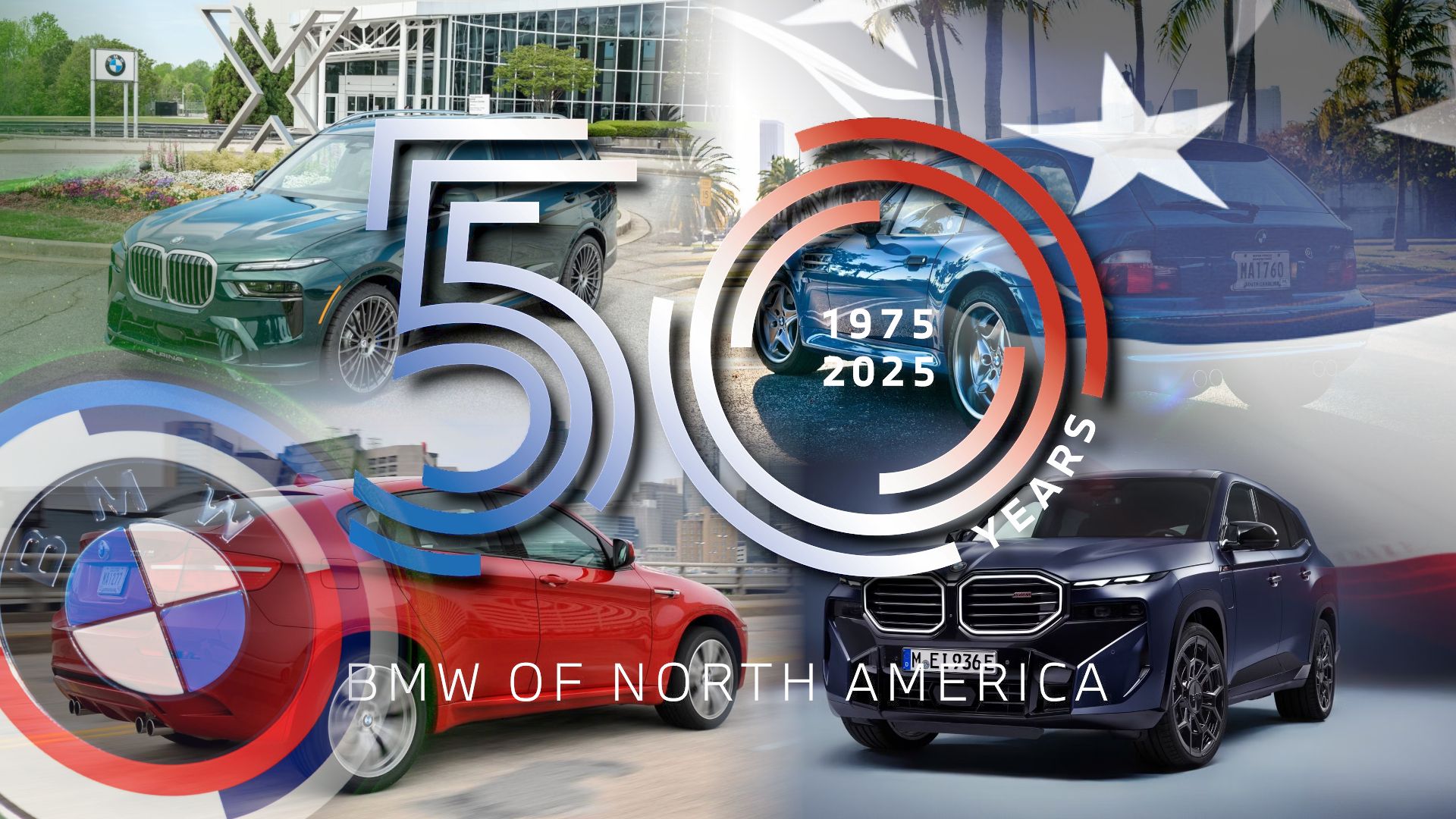
In 2025, BMW North America celebrates its 50th anniversary. In honor of that, this week is BMW Week here at CarBuzz, where we’ll be looking at BMW North America’s greatest achievements, interesting stories, and some broader looks at the BMW brand, its history, and some of our most and least favorite models.
10
1994 BMW 318i Sedan
0-60 MPH: 10.5 seconds

|
Engine |
1.8-liter inline-four |
|---|---|
|
Horsepower |
138 hp |
|
Torque |
129 lb-ft |
The first BMW ever assembled in the United States was a 3 Series sedan, something that took this author by surprise. The E36 in question was a 318i sedan model, and although its spec was rather sedate – white over black with humble bottlecap wheels – it became a very important footnote in 3 Series history, establishing Plant Spartanburg as a facility that could build BMWs with the same quality and precision as the plant in Munich. Production of the entry-level Bimmer only lasted through 1994 and 1995, when it was replaced with something else entirely, and to this day, those two years of the E36-generation 3 Series are the only to have ever been built in the U.S.

Related
The Story Of The Iconic BMW M3 Built Just For America
Sometimes, less is more.
9
1996 BMW Z3 007 Limited Edition
0-60: 9.7 seconds

|
Engine |
1.9-liter Inline-4 |
|---|---|
|
Horsepower |
138 hp |
|
Torque |
133 lb-ft |
Although the 3 Series units built in Spartanburg were primarily intended for the North American market, the facility’s real test came with the advent of the 1996 BMW Z3, which entered production in early 1995. The entire world would look to South Carolina for its supply of the two-seat roadster, so quality and craftsmanship would have to be up to snuff. Some critics initially scoffed, but almost overnight, the Z3 became a big seller for the brand, thanks in part to its association with 007. James Bond himself drove an Atlanta Blue Metallic Zed roadster in the 1995 film GoldenEye, and BMW released a limited edition through Neiman Marcus in that year’s Christmas catalog. Suddenly, the relatively inexpensive, four-cylinder roadster became a worldwide status symbol, and it all started in the South.

Related
This Iconic BMW Wouldn’t Exist If It Weren’t For The Mazda Miata
The story behind the BMW Z3, and the car that inspired it.
8
1999-2002 BMW M Coupe
0-60: 5.1 seconds (2001 S54)
|
Engine |
3.2-liter inline-six |
|---|---|
|
Horsepower |
240-315 hp |
|
Torque |
240-252 lb-ft |
Every single Z3 variant produced over its 1996–2002 production schedule was built in Spartanburg, and that includes the now-legendary M Coupe and Roadster. BMW’s first M-badged two-seater since the M1 supercar followed the classic hot rod formula – stuff a big engine in a little car and see what happens. In this case, it was the 3.2-liter inline-six from the contemporary M3. The M Coupe, which arrived for the 1999 model year after letting 1998 be a drop-top-only affair, was even more raucous than its open-air sibling thanks to newfound structural rigidity and a decidedly unusual Touring-style body. Still, the wagon-like M Coupe has a huge following today – especially the 2001 and 2002 models, which got the E46 M3’s S54 inline-six and kicked out a healthy 315 horsepower, more than double that of the humble 1.9.

Related
The 15 Best BMWs Of The Last 50 Years, According To CarBuzz
BMW has produced many Ultimate Driving Machines over the last half-century, and these are our favorites.
7
2000-2006 BMW X5
0-60: 5.9 seconds (2004-2006 X5 4.8is)
|
Engine |
3.0-liter Inline-6, 4.4- or 4.8-liter V8 |
|---|---|
|
Horsepower |
225–355 hp |
|
Torque |
221–360 lb-ft |
From 1994 to 1999, the Spartanburg factory only produced one vehicle lineup at a time – first the aforementioned 3 Series, then the Z3. However, the facility added another nameplate to its output when it began production of the 2000 BMW X5, the automaker’s first “Sports Activity Vehicle.” Similar to the Z3, most global-market X5s were built at Plant Spartanburg, and the growing worldwide popularity of SUVs has turned South Carolina into one of the biggest exporters of vehicles from the U.S. to other regions.

Related
The Go-Faster BMW X5s That Never Got The M Badges They Deserved
These BMW SUVs packed plenty of power and provided more than enough pace, but yet they missed out on becoming fully-fledged M models.
6
2003-2008 BMW Z4
0-60: 7.1 seconds (2003 2.5i), 4.5 seconds (2008 Z4 M)
|
Engine |
2.5–3.2-liter inline-six |
|---|---|
|
Horsepower |
184–330 hp |
|
Torque |
175–262 lb-ft |
Even as BMW’s two-seat roadster grew in popularity, BMW continued to manufacture it in Spartanburg County and Spartanburg County alone. The Z3’s successor, renamed Z4, stayed in its ancestral home, and every variant was assembled by South Carolinians. The Z4 was a broad departure from its predecessor, retaining the long-hood proportions of a two-seat roadster but rendering everything in “flame-surfaced” sheet metal, to use a term from BMW’s then-design chief Chris Bangle. But underneath the ultra-modern, geometrical skin, the Z4 is a great contemporary roadster, with aluminum-intensive construction that provided great handling and better fit and finish than the somewhat dated Z3. And as with its predecessor, there was an M variant, offered both as a coupe and roadster. Both are popular second-hand sports cars today.

Related
Driven: 2025 BMW Z4 Is A Love Letter To The Manual Transmission
The Handschalter Package is more than an extra pedal; it transforms the Z4 Roadster entirely.
5
2010–2013 BMW X6 M
0-60: 4.7 seconds
|
Engine |
Twin-turbocharged 4.4-liter V8 |
|---|---|
|
Horsepower |
555 hp |
|
Torque |
501 lb-ft |
Alongside its more conventional X5 sibling, the 2010 X6 M “Sports Activity Coupe” was the first SUV ever to carry the vaunted BMW Motorsport badge on its rump. Both the X5 and X6 M were also the first all-wheel-drive vehicles produced by the performance brand, which had its way with the twin-turbocharged 4.4-liter V8 under the hood, boosting it to a nice, consistent 555 hp and 501 lb-ft of torque. The fastback X6 was heavier than most “coupes” though, weighing more than 5,300 pounds. Still, active dampers and torque vectoring gave it pretty good reflexes, and despite logic telling us that heavy, powerful, practicality-limited SUVs are a silly proposition, the X6 M remains a member of BMW’s lineup to this day.

Related
Driven: 2025 BMW X6 Is A Weird But Excellent SUV
We’d get the X5, but the X6 makes a strong case for itself.
4
2011–2017 BMW X3
0-60: 5.5 seconds (2011 X3 xDrive35i)
|
Engine |
2.0-liter Inline-4, 3.0-liter inline-6 |
|---|---|
|
Horsepower |
240–300 hp |
|
Torque |
220–300 lb-ft |
Some people erroneously assume that all BMW SUVs are built in Spartanburg, but in reality, some of them have roots elsewhere. The first-generation X3, for example, wasn’t manufactured in the U.S., with even American-market cars coming from Europe. The second-generation model changed tack, however, with most of the world’s supply coming from South Carolina. The move underscored BMW’s commitment to its U.S. workforce, especially as the compact luxury SUV segment quickly began to overtake its midsize counterpart all over the planet.

Related
Best BMW X3 Model Years For Reliability
Focus on these BMW X3 years to increase chances of scoring a trouble-free SUV.
3
2020–2024 BMW X3 M / X4 M
0-60: 3.9 seconds (2024 X4 M Competition)
|
Engine |
Twin-turbocharged 3.0-liter Inline-6 |
|---|---|
|
Horsepower |
473–503 hp |
|
Torque |
443 lb-ft |
For its third generation, BMW gave the X3 and its X4 “coupe” variant a crack at the full M treatment, bestowing them with the twin-turbocharged 3.0-liter inline-six that would eventually make its way into the controversial G8x-generation M3 and M4. Making 473 hp in base form and 503 hp with the Competition package, the X3 M and X4 M are nearly as quick as the far more powerful BMW X5 M. The success of the Motorsport-branded SUVs is one reason why the BMW Performance Center East, located across the street from Plant Spartanburg, is as popular as it is, giving M customers a chance to learn how to drive their vehicles with even more confidence.

Related
Why America Got The Manual M5 The Rest Of The World Missed Out On
We got two versions of the BMW M5 with a manual that the rest of the world missed out on. Why did this happen, and did the rest of the world miss out?
2
2020– BMW Alpina XB7
0-60: 3.9 seconds
|
Engine |
Twin-turbocharged 4.4-liter V8 |
|---|---|
|
Horsepower |
631 hp |
|
Torque |
590 lb-ft |
BMW’s plant in South Carolina has been producing M-branded products for nearly 30 years now, but it might surprise you that the company’s luxury-and-design Alpina division also builds its flagship SUV in Spartanburg County. Manufactured alongside the regular X7 three-row crossover is the Alpina XB7, which features exclusive leather and interior finishes, bold exterior styling details, and signature multi-spoke wheels to set it apart from lesser luxury SUVs. BMW chose the Alpina XB7 to be its 7 millionth vehicle produced at Plant Spartanburg, the latest entry in a family tree that dates all the way back to that humble, base-spec 318i from 1994.
18:25

Related
2023 BMW XM: The First Standalone M Model
The 2023 BMW XM is a controversial vehicle, and not because it’s the first hybrid M model.
1
2023–present BMW XM
0-60: 3.6 seconds (XM Label)
|
Engine |
Plug-in hybrid, twin-turbocharged 4.4-liter V8 |
|---|---|
|
Horsepower |
644–738 hp |
|
Torque |
590–738 lb-ft |
These days, most vehicles assembled by BMW Group Plant Spartanburg have local production in other parts of the world. Not so for the controversial, U.S.-assembled XM, which is only the second standalone M product in the company’s history after the M1 supercar. The plug-in hybrid BMW XM makes up to 738 hp and 738 lb-ft in the simply named “Label” trim, allowing it to hit 60 mph in well under 4 seconds. What’s more, the hybrid battery gives it an EPA-rated 31 miles of silent, all-electric range, good for the times when you desire some subtlety – at least as much as the brashly-styled XM can muster.
Source: BMW