
The Honda CR-V has been in production since the mid 1990s. Spanning six generations, this Honda compact SUV has not only been a product that has won over families as their ideal vehicle throughout the years, but it has presented itself as a significant milestone for the brand. It was Honda’s first ever SUV designed from scratch, and as of 2020, is the brand’s best-selling vehicle in the world, in addition to being consistently ranked as the second most popular SUV in the world. Moving towards the current year, the CR-V remains as popular as ever as a practical crossover SUV that combines Japanese reliability with various selling points people want from a family car.
As the latest iteration of Honda’s best-selling compact SUV enters another model year, we decided to go through the model’s history and highlight some of the most interesting facts you might not know about this small Honda SUV.
2024 Honda CR-V
- Base MSRP
- $29,500
- Engine
- 1.5L Turbo Inline-4 Gas
- Horsepower
- 190 hp
- Fuel Economy
- 28/34 MPG
All information has been sourced from the manufacturer. Authoritative sources are listed at the end of the article. In cases where the MSRPs are quoted, note these prices exclude additional fees such as the destination fee, applicable taxes, title, and dealer charges. The facts listed cover all six generations of the CR-V.
1 The CR-V Was Honda’s First Built-In-House SUV

The first Honda-badged SUVs were not built by the company from start to finish. Models like the first and second-generation Honda Passport or the Japan-only Honda Horizon (1994-1999) were not original Honda products, but namely SUVs produced by other car brands whose association with Honda was limited to cosmetic changes. The first years of the Honda Passport, for example, started out as a rebadged version of the Isuzu Rodeo – distinguishing itself as a Honda with different grille designs, and Honda badges on the exterior and interior.
Honda did not have the budget until the 1990s to invest in creating its own, fully independently made and engineered compact SUV model. Hence, it relied upon rebadging SUV models via alliances with other car manufacturers to ensure they could still cover this popular segment among American buyers at a minimal cost. This reliance on badge engineering (rebadging) ended once funding was secured for R&D to make the first Honda small SUV that became the CR-V.

Related
Best Honda CR-V Model Years For Reliability
Honda lives and breathes reliability, and the CR-V is no exception.
2 Second-Generation CR-Vs Used Honda K Series Engines

North American-spec second-generation CR-Vs, made for the 2002 to 2006 model years, were equipped with a 2.4L naturally-aspirated four-cylinder engine – specifically, the K24A1 from Honda’s K Series engine family. The K-Series engines are widely praised by various Honda communities, offering the perfect balance of reliability and horsepower in a compact engine that is easy to upgrade and can be utilized in various platforms. These engines (in their most potent form) carry further prestige as being the powertrains of high-performance Honda models – such as the Civic and Integra Type R, along with the North American-exclusive Civic Si hatchback, coupe, and sedans.
Notable Honda models that have used K-Series engines
- Accord/Accord Euro R (Japan Market, 2002-2008)
- CR-V (US market, 2002-2006)
- Civic Type R EP3 (Japan Market, 2001-2006)
- Integra Type R (Japan Market, 2001-2006)
- Civic Si Hatchback (US Market, 2002-2006)
- Civic Si Coupe/Sedan (US Market, 2006–2011)

Add CarBuzz to your Google News feed.
3 The Current CR-V Has A Hydrogen-Powered, Fuel Cell Model
Hydrogen as an energy source for vehicles has yet to popularize beyond the West Coast, but Honda’s compact SUV is still aiming to spread awareness for its adoption, with the Honda CR-V e:FCEV.
This is the first-ever plug-in hydrogen fuel cell vehicle to be sold in the United States, making history for both Honda and hydrogen vehicles in the country. The CR-V e:FCEV can run on either compressed hydrogen or recharg via its plug outlet like any other electric vehicle to provide electricity to charge up its electric motor. Currently, the e:FCEV is only available to lease in the state of California, the only US state that offers some degree of a hydrogen refuelling network via dedicated pumps and stations.
|
2025 Honda CR-V e:FCEV Specs |
|
|---|---|
|
Powertrain |
Electric Motor with Hydrogen Fuel Cell |
|
Horsepower | Torque |
174 hp | 229 lb-ft |
|
0-60 MPH |
~ 8.0 seconds |
|
Transmission |
Fixed, Single-Speed Direct Transmission |
|
MPGe (City/Highway/Combined) |
94 / 79 / 87 |

Related
6 Ways The Honda CR-V e:FCEV Is A Game-Changer For Hydrogen Vehicles
It could be a smash hit, but some changes need to be made on a large scale.
4 The Name ‘CR-V’ Has More Than One Meaning

Depending on which market and part of the world you are in, two definitions are accepted as the official, word-by-word explanation for the CR-V’s acronym. From Honda Japan’s official press information, CR-V in full means ‘Comfortable Runabout Vehicle’ – summarizing its purpose as a safe and practical car to move people, cargo, or anything in between.
But in the United Kingdom, CR-V is believed to be an abbreviation for ‘Compact Recreational Vehicle’. Honda reportedly accepted this interpretation of the CR-V model name following a review by a British publication that attributed the model name to be a spin on the abbreviation for SUV – aka ‘Sports Utility Vehicle’. Given the CR-V is marketed as a crossover that has some SUV traits like elevated ride height and aesthetic traits like protruding bumpers, it is understandable to see the argument for the British interpretation of the CR-V. Both explanations nonetheless are recognized by Honda.
Along with these two definitions, some unofficially claim CR-V can also stand for ‘Civic Recreational Vehicle’, which alludes to the first-generation’s Honda Civic roots.

Related
Honda Stepwgn: Getting To Know The Odyssey’s Boxier, Oddly-Named Cousin
Spelled Stepwgn, pronounced Step Wagon, this JDM Honda relative to the American Odyssey is one fascinating little minivan.
5 The CR-V Is Sold Under A Different Name In China

The CR-V model name applies to the majority of markets where this Honda SUV is sold, from the North Americas to Japan and Europe. But the CR-V is also sold under a different name exclusive to the Chinese market – the Honda Breeze.
Name aside, the Breeze is still the same crossover SUV model inside and mechanically but features a different front fascia and rear taillight design, along with unique front/rear bumpers that add a slightly more premium appearance. The Breeze also carries the unique selling point of being available as a seven-seater, combined with slightly more legroom to make it attractive to Chinese customers. The Breeze has existed as a spin-off variant of the CR-V since the fifth generation, allowing buyers in China some diversity in their choice of compact Honda SUVs.

Related
5 Differences Between China’s Car Culture And The West
The Chinese motor industry is exploding, and venturing into new markets. But their car culture do differ on key aspects with that of the West.
6 Actor Matthew Broderick Helped Sell The CR-V For A Super Bowl TV Commercial

Known for his famous role as the rebellious teenager Ferris Bueller in the teen comedy film, Ferris Bueller’s Day Off, actor Matthew Broderick starred in a Super Bowl commercial for the 2012 Honda CR-V. The commercial, titled Matthew’s Day Off, was prominently broadcast during Super Bowl XLVI. The spot itself was a homage to the film, with references to several iconic scenes throughout the advertisement, including the ‘joyriding valet’ scene (with the third-generation Honda CR-V standing in for the Ferrari 250 GT California originally used in the film).
This was not the first time Honda utilized the prolific Super Bowl commercial block to advertise its SUV. The launch of the first-generation CR-V was featured as one of many advertisements broadcast during Super Bowl XXXI in 1997. Another Super Bowl advert in 2017 focused on the CR-V, titled Yearbooks, also made its way to audiences during Super Bowl LI.
7 The First Two Honda CR-V Generations Were Equipped With A Picnic Table

This is a rather obscure fact about this compact Honda SUV that continues to surprise owners, Honda enthusiasts, and fans of quirky automotive features.
CR-Vs made from 1997 to 2006 came with a built-in picnic table as standard. The rear cargo floor that covered the spare tire compartment, when not serving as a surface for the rear cargo area, could also be removed entirely to serve as a portable table. This whole section also came with foldable legs to stand on its own. This clever CR-V feature made it perfect for outdoor activities – from tailgate parties to beach picnics, campsite cooking, or any other task that called for its use. Sadly, from the third-generation model onwards, the dual-purpose cargo cover/picnic table was dropped.
Before the Chinese car industry established its own brand identity and distinguishable models in the highly competitive EV market, a recurring theme among domestic Chinese car brands was to copy the designs of cars they thought would be desirable in China (but not able to be sold locally), leading to some rather interesting knock-offs sold to local buyers, and some markets abroad.
One example came from Shuanghuan, a domestic SUV/truck brand, that decided to copy the body and design of the second-generation Honda CR-V to create its Laibao midsize SUV model. With design traits clearly copied from the CR-V, from its front grille design to side window profile and signature vertical rear tailight shape, the Shuanghuan Laibao paired this Honda facsimile with the chassis of a fifth-generation Toyota Hilux.
Honda filed a lawsuit against the Chinese manufacturer for copyright infringement in 2003, accusing them of blatantly copying the CR-V’s patented design, but the Chinese State Intellectual Property Office rejected their claim – stating Honda’s patent for the CR-V’s design was not recognized under China’s intellectual property laws. In a twist of events, the Beijing High Court reversed this decision in 2016 – confirming Shuanghuan had copied Honda’s design without permission and ordered them to pay a fine of 2.4 million US dollars.
This Chinese SUV was produced from 2003 to 2010, with Shuanghuan retiring from business in 2016.

Related
China’s Worst Copycat Car Designs
Good artists copy, great artists steal. That’s what these Chinese car companies tell themselves, anyway.
9 First-Gen CR-V Was The First SUV With Four-Wheel Double Wishbone Suspension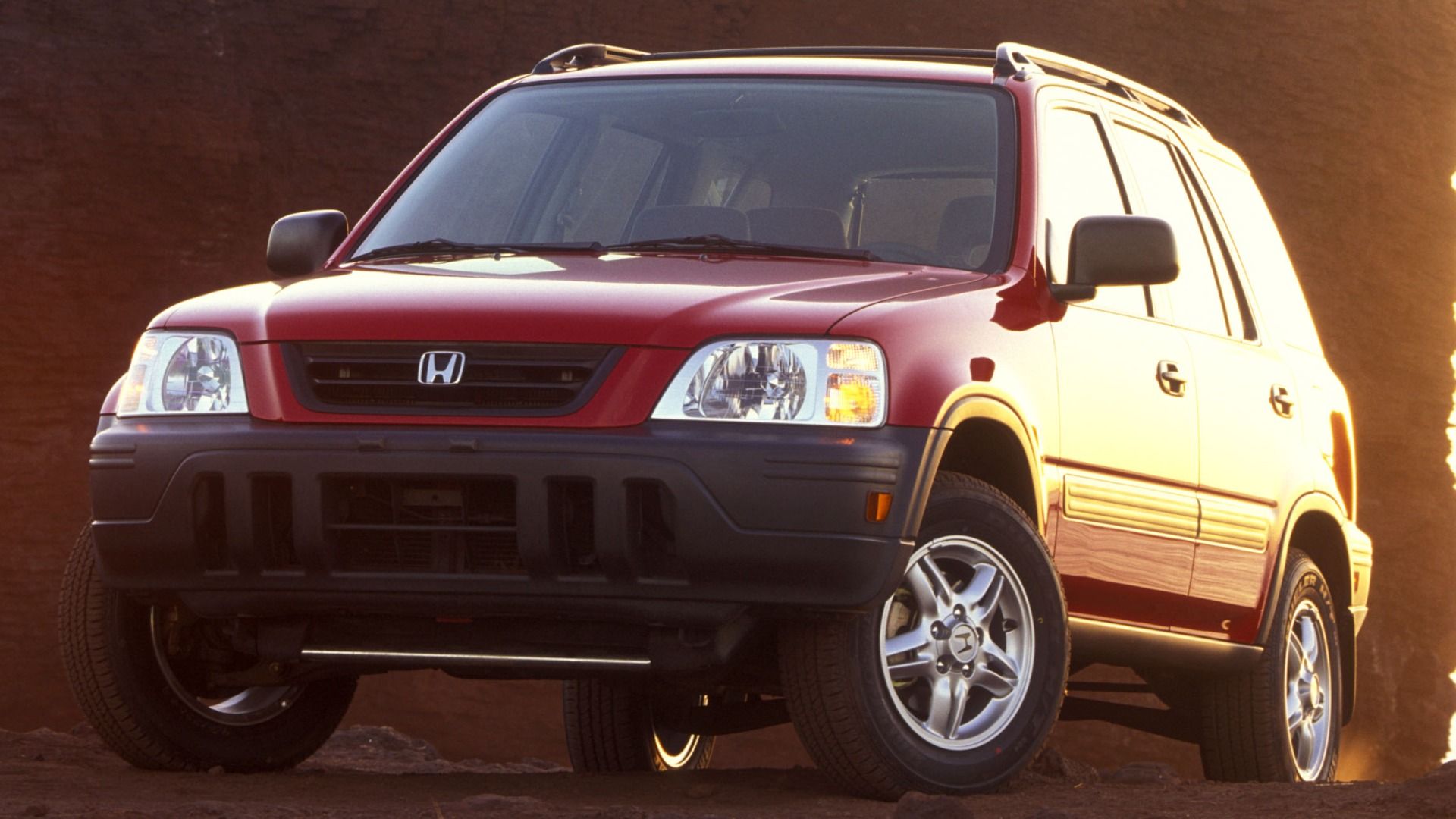
This small Honda SUV also represented a milestone for both the brand and SUVs/4x4s in general – specifically, it was the first one to use four-wheel double-wishbone suspension.
Traditional SUVs at the time utilized a less complex, more utilitarian suspension setup. Honda wanted its first in-house-designed SUV to be somewhat capable off-road but retain a standard car-like driving experience and keep the occupants comfortable. Achieving this balance was the incorporation of a four-wheel double wishbone suspension setup. This allowed the CR-V to retain normal handling characteristics despite an elevated ride height and ground clearance of 8.1 inches. It also allowed a stable, smooth ride whilst keeping the passenger cabin well-insulated from outside vibrations and road noise.

Related
What Is Double-Wishbone Suspension?
Considered a gold standard for sports cars, what is double-wishbone suspension, and how does it work?
10 All Honda CR-Vs Feature Vertical Rear Taillight Designs
Like other off-road models, the Honda has a unique design trait that has always remained an integral part of its appearance since the very first generation. Land Rovers identify themselves with their prominent brand lettering across their front hoods and Jeep Wrangler models of the past and present carry the same square-shaped grille design. All years of the CR-V, from the first to the current version, have always possessed vertical rear taillights, which span from the roof and down the rear window. In more recent years, these extended taillight designs have been slightly updated to reflect a sportier character as part of Honda’s current design language, with the incorporation of LEDs and aggressive lines.

Related
10 Attractive SUVs That Started A Design Trend
They started out as rugged, off-roading vehicles. Today they’re stylish modes of transport. But some were created with more flair than others.
Does Honda have a compact SUV?
In the USA, the only Honda compact SUV on sale is the CR-V, positioned above the subcompact HR-V.
What is the cheapest Honda compact SUV?
For the 2025 model year, the cheapest Honda compact SUV on sale is the base CR-V LX that starts at $30,100.
Is there a Honda SUV smaller than the CR-V?
Within the current Honda lineup, only one Honda SUV is smaller in overall size than the CR-V. This slot is occupied by the current iteration of the Honda HR-V. While the CR-V is marketed as a compact crossover SUV, the HR-V is sold as a subcompact crossover.
Is a Honda HR-V a small SUV?
The HR-V is intended to compete against other small SUVs in the subcompact crossover segment, such as the Toyota Corolla Cross, Nissan Kicks, and Mazda CX-30.
Sources:
Honda,
FuelEconomy.Gov
,
China Motor Vehicle Documentation Centre