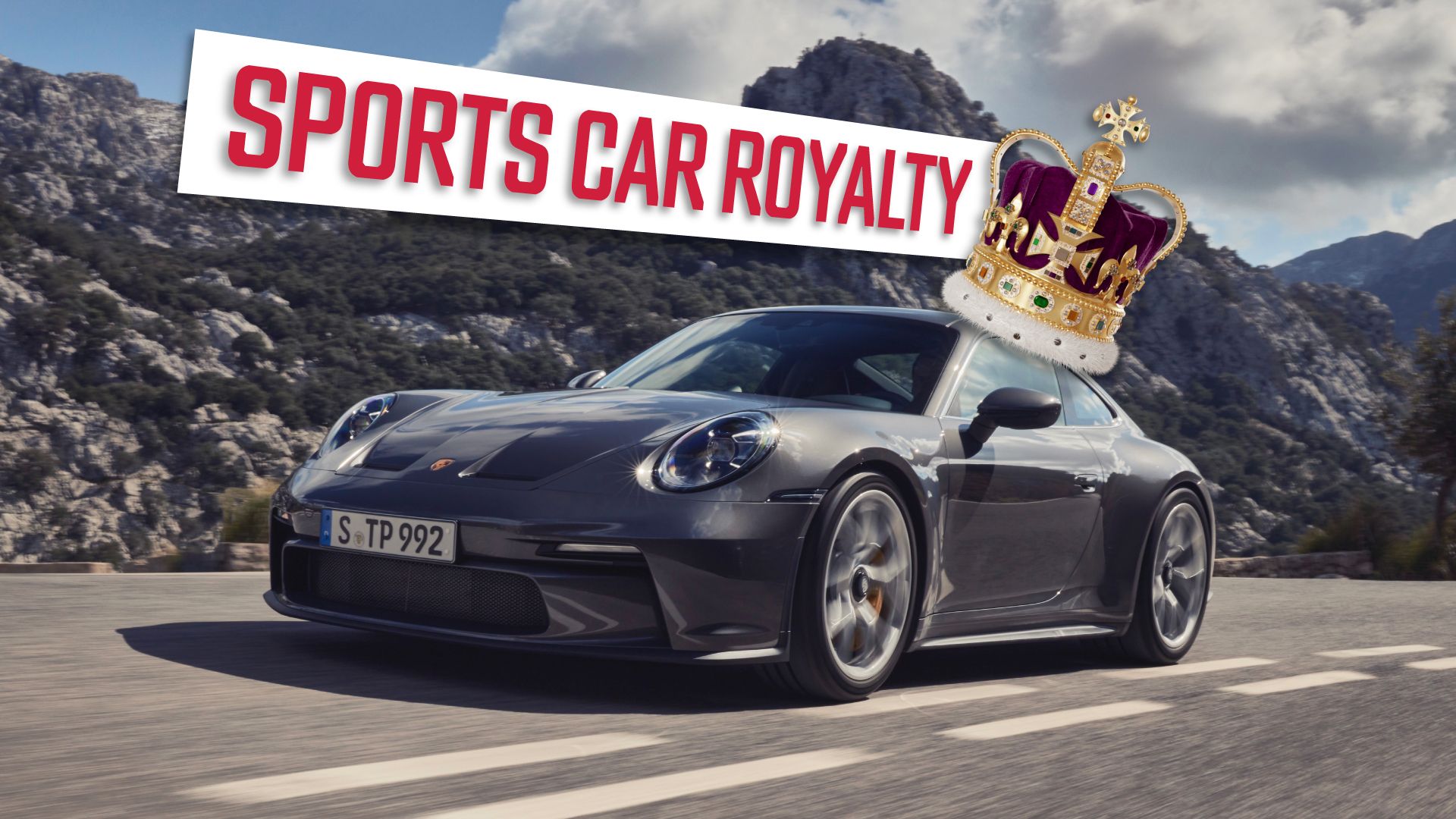
Driving a Porsche 911 is a life-affirming experience that every person on the planet should experience at least once. You’ll notice that I included everyone on Earth and not just the gearheads. Why? Because the 911 is one of those cars that gaps the boundary between car lovers and those who simply see them as appliances. If you put a non-gearhead into one and tell them to drive a lap of any circuit, they won’t necessarily return reformed, but they’ll certainly have a better understanding of the bond between man and machine.
As an automotive writer, I often get flack for the praise we heap on Porsche, but the German giant almost never gets it wrong, especially regarding its bona fide sports cars. I have two main criticisms, one subjective and one objective.
Related
The Porsche 911 GT3 Is Dead For 2025
Good luck getting a brand new 992 GT3 any time soon.
On the subjective side, I dislike the turbocharged flat-four sound of the entry-level 718 models. It’s a brilliant engine and a magnificent car, but a 718 shouldn’t sound like a Subaru WRX STI. On the objective side, it’s disheartening to see how expensive the 911 has become and how much Porsche charges for options. For a base 911, you’re looking at $120,000. While that’s still out of reach for most, it’s far from costing so much that you have to dismiss even the dream of ever owning one.
The GT models are at the top of the 911 range. Only one GT product is currently available (GT3 RS) because the GT3 has gone out of production, and we’re still waiting for the furious GT2 RS to arrive. As an homage to the GT3, I shall now give 5 reasons why it’s the king of sports cars, starting with how Porsche nailed both definitions of that term beautifully.

2024 Porsche 911 GT3
- Base MSRP
- $182,900
- Engine
- 4.0L Flat 6 Gas
- Horsepower
- 502 hp
- Torque
- 346 lb-ft
- Transmission
- 6-speed manual, 7-speed automatic
- 0-60 MPH
- 3.2 seconds
- Top Speed
- 199 mph
1 It Fits The Classic And Modern Definition Of A Sports Car
Even in this office, we don’t always agree on the difference between a sports car and a supercar. Heck, I don’t even always agree with my own assessments. I think of the C8 Corvette as a supercar because of its mid-engine layout, yet the Lotus Emira I drove recently didn’t feel special enough to deserve the moniker. A while ago, our managing editor attempted to explain the differences between the various classes of go-faster cars and nailed the two definitions of a sports car. The traditional definition is any road car built to go racing. Classic examples include the Jaguar XK, the Ferrari 250 GTO, and even the original Mercedes Gullwing.
The GT3 also fits this bill because the first generation was built as a homologation special, so Porsche could compete in the FIA’s GT3 Cup. Porsche removed all the luxuries to make the car as light as possible. The beancounters didn’t think the car would sell particularly well, as it lacked any sort of refinement, and because the (much) faster 911 Turbo existed. As it turns out, there was a rather large market for an unfiltered driving experience, which is why the 996 received a facelift to make it more user-friendly on track. The GT3 has been part of the 911 range ever since and is one of the most sought-after models. That’s the first definition covered. The GT3 was built to go racing, and it still is.

Related
What’s The Difference Between A Sports Car, A Supercar, And A Hypercar?
Is it even possible to define these concepts?
The second definition is more of a statement. Sports cars prioritize the driving experience above all else and are, therefore, compromised. Power isn’t a factor, as proven by the Mazda Miata and Toyota GR86. These cars have less than half the power of the Mercedes-AMG C63 S E Performance, but the latter is a luxury car with a sporty edge, while the Miata and GR86 are purebred sports cars.
Even if Porsche wasn’t as involved with racing, the GT3 would still qualify as a sports car. Over the years, the GT3 has become more comfortable. With the first-gen model, Porsche even removed the radio and air conditioning to save weight, but the systems in the latest 911 are so integrated that they can no longer be removed. It doesn’t matter, however. The GT3 thrills more than 90% of the supercars and hypercars out there, even though it’s “underpowered.”
2 The GT3 Proves That 500 Horses Is All You Need

|
Engine |
4.0-liter naturally aspirated flat-six |
|---|---|
|
Power |
502 hp @ 9,100 rpm |
|
Torque |
346 lb-ft @6,100 rpm |
|
0-60 mph |
3.2 seconds (3.7 seconds with manual gearbox) |
|
Top Speed |
197 mph (199 mph with manual gearbox) |
In 2020, the 911 GT3 went around the Nürburgring in 6:59.927, but Porsche timed the car around the older, shorter loop. It’s widely accepted that you can add roughly four seconds to this time for a car to align with the longer 12.85-mile loop, which places the GT3 in the same company as the Mercedes-AMG GT R Pro, Lamborghini Huracán Performante, McLaren 720S, the iconic Porsche 918 Spyder, and even the Rimac Nevera. What do all of these cars have in common? They have at least 100 horsepower more than the GT3. In the case of the 720S, it has 200 additional horses, while the 918 has an additional 380 hp. The all-electric Nevera has roughly 1,300 hp more…
Porsche has repeatedly proved that power isn’t everything. What you need is the perfect balance between power, weight, and grip.
You’d expect the GT3 to be a bit of an animal to achieve such an impressive time, but if you look at the onboard footage of the lap, it doesn’t look like it wants to kill Lars Kern at all. That being said, we mere mortals will never be able to get as much out of a GT3, but that’s perfectly fine.
3 The 911 GT3 Wants To Be Your Friend
My first experience with the current GT3 was at a 1.2-mile nine-turn track housed within the Las Vegas Motor Speedway. The Infield Road Course is the perfect circuit to get to know this car because it has a long straight that you enter with a decent amount of entry speed, allowing you to hit 9,000 rpm in third gear. At 9,000 rpm, the GT3 produces one of the most enchanting exhaust notes this side of a naturally aspirated Ferrari V12, accompanied by some serious induction noise over your shoulder. I like EVs, but at that moment, I knew that I’d never be able to give up internal combustion forever. I also want Porsche to go on a tour to every car-building nation on the planet to give PowerPoint presentations on how to tune an EPAS system to work properly.

Related
Driven: 2023 Porsche 911 GT3 Is Sports Car Nirvana On Track
It doesn’t get better than this.
Because the GT3 has such a broad rev range, you really can have more fun with the various corners at your disposal. As with any new car, you approach it cautiously, finding a safe pace. From there, you start building speed and reducing those lap times. There are so many ways you can play around with the GT3 to get the best time. The first thing you need to be aware of is the grip. There’s a lot of it, and it takes time to find the limit. On several occasions, I thought I’d found the limit between turns two and three, only to be surprised that the GT3 simply hunkers down, grips even harder, and turns in even more eagerly, thanks to the double-wishbone setup at the front. And then there are the brakes. Their ability to scrub speed is immense and, once again, something you have to learn to trust.
Basically, the GT3 is not a singular experience. It’s a car you can live with for years, and it will continue to surprise you as you learn the intricacies of driving it fast. On the 1.2-mile Infield Road Course, I managed to reduce my initial lap time by 20 seconds simply by playing around with everything the car had to offer.
4 You Can Still Have It With A Manual
Porsche shocked the world in 2013 when it announced that the 991 GT3 would not be available with a manual gearbox. Porsche developed a seven-speed PDK (dual-clutch) transmission specifically for the updated 3.8-liter flat-six, and it was good. Still, it robbed keen drivers of a valuable form of self-expression. The fanboys were so despondent about this commission that they complained constantly and loudly. When Porsche facelifted the car a few years later, the six-speed manual returned as an option. It was also the first time Porsche introduced the Touring Package, which effectively removes the massive rear wing and makes the GT3 less conspicuous.

Related
Porsche 911 GT3 Generations: Everything You Need To Know In One Place
Through eight generations, the 911 GT3 has only become more and more thrilling, taking up a space in the dream car garage of true enthusiasts.
Naturally, as a gearhead, I’m always advocating for the manual transmission to stay around, but I’d have a GT3 with a PDK without thinking twice. There are two reasons for this. While the GT3 is sort of singular in its focus, you can live with it daily. The infotainment system is good, the climate control does a decent job, and the visibility is better than in most crossovers with annoyingly large C-pillars. You simply slap it into D, and it behaves like a normal 911 Carrera S with a firmer – yet still compliant – ride. Why would I want to row gears when 90% of my daily driving is commuting?

Related
10 Manual Transmission Cars That Prove Stick Shift Cars Ain’t Dead Yet
It turns out there are still automakers committed to manual transmissions.
“But what about the track?” I hear you ask. Well, PDK is also better on the track. Fill the comments section with hate if you must, but using the paddles behind the steering wheel allowed me to focus more on other (more entertaining) elements of the driving experience. I hit the braking zones and apexes perfectly without having to worry about heel-and-toe shifting. A GT3 with a PDK transmission is also an extremely forgiving car. If you’re halfway through a corner and realize that you’re in a higher gear than you should be, you can shift down. The shifts are so quick that they don’t upset the balance of the car even a tiny bit. Try doing that with a manual and getting away with it.

Add CarBuzz to your Google News feed.
5 It Will Always Be Valuable
Rather annoyingly, Porsche has a bad habit of limiting GT3 production, and you can only get your hands on one from the dealer if you have an established relationship. In other words, you’re only invited to buy a GT3 if you’ve already purchased a Cayenne, Taycan, 911 GTS (now available as a hybrid), and a ride-on Macan for your kids. Even then, that invitation is not a guarantee. The advertised MSRP was roughly $180,000 before it was recently discontinued, but you can forget about that. Realistically, you’re looking at $260,000 to $300,000 for a certified pre-owned model with less than 5,000 miles. Not even previous generation models are selling for less than the claimed MSRP.

Related
Study Finds Porsche 911 And Jeep Wrangler Are Practically Depreciation Proof
Both the 911 and the Wrangler have proven to be good buys, even with nasty markups.
Few things annoy automotive enthusiasts as much as a ridiculous markup, but in this case, it’s the lesser of two evils. If you had to buy all the Porsches your local dealer required to get on the list, the cost would be roughly $500,000. Or you could simply just go out and buy the car you wanted in the first place for cheaper. It likely won’t be the color you want, but that’s what vinyl wrapping is for. You can also take some comfort in the fact that it won’t lose value. In fact, you’ll likely make a solid profit after a few years. For proof, we looked at some used examples on AutoTempest. A mint 2007 GT3 with 14,000 miles on the clock is currently selling for $315,000. Vehicles with multiple owners are selling for roughly $200,000. In 2007, the GT3 cost $107,500. So the lucky owner of the mint car owned it for 16 years, put some miles on the clock, and will make more than $200,000 in profit. That’s a sweet investment return.
6 Bonus: It Has No Equal
Porsche wasn’t the only automaker to notice how well the GT3 did during its first generation. Lamborghini tried with the Gallardo Superleggera, Mercedes-AMG had a go with track-ready versions of the SLS and GT, BMW built the M4 CSL, and Jaguar got in on the lightweight game with the Project 7. Even America had a go with the recent Corvette Z06. The GT3 beat all of these cars before they even got a chance to go head-to-head with its bigger brother, the GT3 RS. So why is the RS not the greatest sports car ever made? Well, its focus is perhaps a bit too singular, and it requires an expert driver to get the most out of it. Simply put, you need to be a career racing driver to get the most out of the trick aerodynamics. For 99.9% of the population, the GT3 is enough.

Related
5 Coolest Features Of The 2023 Porsche 911 GT3 RS
We’re madly in love and infuriatingly poor.
Of course, the beauty of this opinion is that you don’t necessarily have to agree with it. I’m 14.5 years into this job, and there have been many cars that I’d add to my collection if my numbers came up in the lottery. Examples include the Ferrari 458, Alfa Romeo Giulia Quadrifoglio, Bentley Flying Spur V8, a Jaguar F-Type with a supercharged V6, Mini John Cooper Works GP (first-gen), a Kia Stinger, a Hyundai Ioniq 5, and the new Toyota Camry. But at the top of the pile of over 600 cars driven so far is the GT3. It’s the closest I’ve ever come to an automotive transcendental experience.