How high can a car go? Just over 22,000 feet, actually. That’s the benchmark that Porsche set in 2023, with a highly modified Porsche 911 Carrera 4S. The Porsche 911 smashed the 2019 record set by a modified Mercedes-Benz Unimog U 5023, which in turn snatched the world altitude record away from a well-used Suzuki Samurai SJ413, driven by two 4WD enthusiasts – a record that stood for 12 years.
But why is it such a challenge to drive up a large mountain? What modifications are required to make a vehicle reach an altitude of more than 20,000 feet?
This is the story of the three vehicles that went higher than any others, and set new high-altitude driving records. It’s a story of trial and tribulation, of David versus Goliath.
There have been many attempts at setting high-altitude driving records. Notably, the big-budget Jeep Wrangler record in 2007 – which was broken two months later by two amateur 4WD enthusiasts in a 20-year-old Suzuki Samurai, rendering Jeep’s subsequent marketing efforts inconsequential. For this feature, we focus on that Suzuki, the Unimog that broke the Suzuki record, and the Porsche that smashed the Unimog record.
Porsche Aims For The Stars
|
Porsche 911 Carrera 4S |
|
|
Engine |
3.0-liter twin-turbocharged flat-six |
|
Power |
443 hp |
|
Torque |
390 lb-ft |
|
Top speed |
50 mph (estimated) |
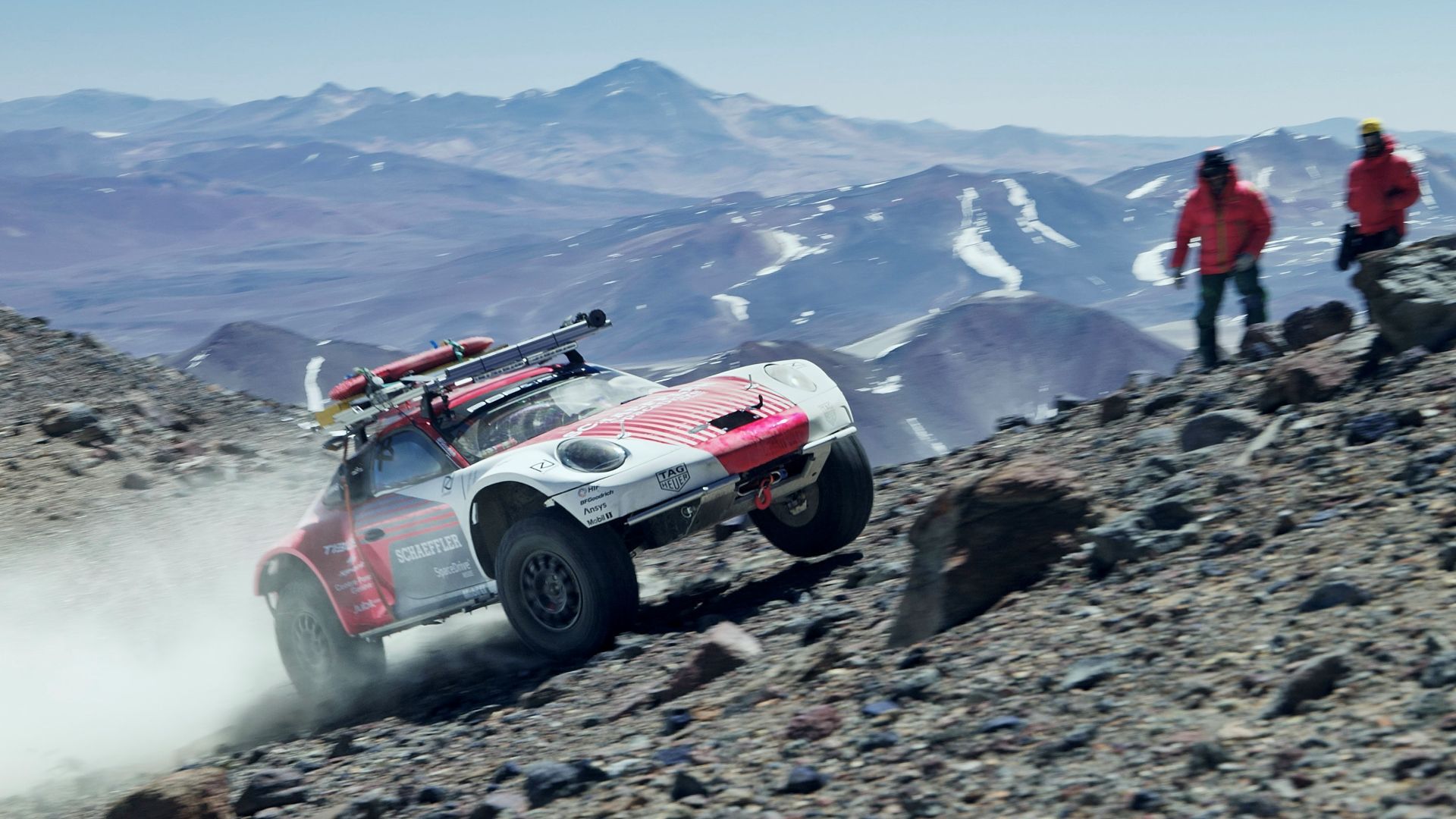
Edith. That’s how Porsche christened the modified Porsche 911 Carrera 4S that broke the high-altitude driving record in 2023. And it was far from a regular Porsche 911. In fact, the most regular aspects of it were the 3.0-liter, twin-turbocharged flat-six, the seven-speed manual gearbox and the all-wheel-drive system.
For the rest, Edith was a purpose-built machine with only one task at hand: to go higher than any other vehicle ever had. To achieve the feat, Porsche engineers gave the 911 a comprehensive makeover.
Most significantly, Edith was fitted with portal axles, which increased ground clearance to 13.7 inches. With no two-speed transfer case in the game, the stock seven-speed manual gearbox fed the engine’s 443 hp to all four wheels via a much lower portal axle ratio. This resulted in much lower ratios than a stock 911. This car was, after all, designed to drive up a steep, rocky and inhospitable volcano. This 911 runs out of engine revs in top gear at around 50 mph.
Porsche created two 911s for the record attempt. ‘Doris’ featured a customized steel body, doors, and roof. Edith, the record car, had bespoke carbon fiber body panels, roof and doors, and every bit of extra weight was stripped from it.
But even more cool was the suspension that did service in both cars. Featuring technology first developed for the magnificent Porsche 918, the system was called Warp Connector in these 911s. The Warp Connector is essentially an inboard racing car-like rear suspension, with bespoke aluminum parts, consisting of a heave spring, Watts linkage, Warp Connector rear bell crank, and the Warp Connector. The system features much improved rear wheel travel, ensuring the 35-inch mud terrain tires remain in contact with the volcano’s surface, thus maintaining forward momentum.
The same suspension system – with some specific design elements – did service at the front. This ensured the front wheels also had excellent articulation, maintaining contact with the volcano’s surface, and improving traction.
Other cool bits included carbon fiber seats with five-point harnesses, and lightweight but extremely tough Aramid fiber underbody protection to allow celebrated driver Romain Domais to slide the 911 over rocks. Another trick was Space Drive. This steer-by-wire system was developed by the Schaeffer Group, and provided precision feedback to the driver.
The Porsche lived on a diet of Mobil 1’s finest lubricants that enabled the car to operate without issues at minus-a-lot temperatures. The 911s used HIF eFuels, hailing from Chile. The fuel’s production centers around the extraction of hydrogen, where an electrolysis process breaks down water into components of hydrogen and oxygen. In the next chemical process, where electricity is used in the conversion process, hydrogen is combined with CO2 and converted into a so-called energy carrier, otherwise known as eFuel.
Porsche is investing in eFuel technology, and the company believes it will play a pivotal role in securing the internal combustion engine’s future.
How To Conquer A Volcano
The Porsche team first tackled the Ojos del Salado volcano, located on the Argentina-Chile border, in 2022. On this exploratory run, the team made it to 19,500 feet, but then encountered insurmountable snow, and were forced to retreat. The team returned in 2023, armed with knowledge and experience. With some lessons learned, the crew took two weeks to acclimatize to the high altitudes, where less oxygen can have a marked effect on man and machine.
The team slowly gained in altitude, with short daily pushes up the volcano. This was where the Porsche 911’s standard electronic control unit (ECU) came to the party, adjusting the car’s fueling requirements to compensate for the lack of oxygen and higher altitudes. The team members were also closely monitored, with two doctors keeping an eye on heart rates and oxygen levels in the minus-a-heck-of-a-lot temperatures.
Then, two weeks after embarking on the expedition, at 3:30am on a Saturday morning, Edith and driver Dumas departed base camp – about 3,000 feet below the summit – and headed up the volcano. Instead of having to deal with snow, Edith had to pick her way through rocks and boulders, all the time climbing higher. The 911’s rear differential locker saw plenty of action on this stretch.
By late that afternoon, sporting a few battle scars, Edith and Dumas reached the summit and set a new high altitude record of 22,050 feet.
What came before: The ‘Mog’ Record
|
Mercedes-Benz Unimog U 5023 |
|
|
Engine |
5.1-liter turbocharged Inline-4 diesel |
|
Power |
231 hp |
|
Torque |
664 lb-ft |
|
Top speed |
56 mph |
4WDs don’t get much more iconic than the Mercedes-Benz Unimog. The Unimog has been around since 1948, when Mercedes created an extremely capable 4WD truck that served in armies around the globe, on farms, was turned into firefighting machines, and served as all-terrain working trucks for utility companies.
Where the Porsche 911 had to be modified with portal axles, the Unimog gets them as standard. It also has a turbodiesel engine with enough torque to move a small town, and enough differential lockers to make any 4WD enthusiast go “yeeehaaah!” In short, it is an unstoppable 4WD tour de force.
In 2019, German adventurer Matthias Jeschke from Extreme Events, tackled the Ojos del Salado volcano with two modified Unimogs. Jeschke had organized the Jeep record-breaking climb up the volcano in 2007 – a record that was smashed just two months later by a pair of local 4WD enthusiasts in a supercharged Suzuki Samurai. Returning to the volcano with ‘The Mother Of All 4WDs’ – with backing from Mercedes-Benz and other sponsors – Jeschke was out for some redemption.
The Unimogs and back-up vehicles carried provisions and supplies for the large crew, 475 gallons of fresh water, and 554 gallons of fuel. The Unimogs were fitted with massive off-road mud terrain tires with bead-lock rims. This ensured that the tires could be deflated to super-low pressures, providing a floating effect on snow. The trucks were also fitted with adjustable booms on the front, which could be fitted with a heavy spare wheel… this was to prevent the top-heavy truck from tipping backwards on extremely steep sections. Yep, it gets that steep.
One Unimog ultimately reached a height of 21,961 feet, setting a new world record for the highest altitude achieved by a vehicle. This record stood for four years before a Porsche 911 called Edith came along.
What started the battle: The Insufferable Enthusiasts Who Ruined The Jeep Party
In 2007, two months after Matthias Jeschke had set a new record with two Jeep Wranglers on the Ojos del Salado volcano, two Chilean 4WD enthusiasts in a modified 1986 Suzuki Samurai surpassed Jeschke’s record, reaching 21,942 feet.
The Jeep team had famously planted a special sign that read “Jeep Parking Only” at the altitude the Wrangler reached. Gonzalo Bravo and Eduardo Canales famously removed said sign, brought it back down the volcano, and sent it back to Jeschke.
How did they do it? Firstly, they completed this feat without mega budgets and a fleet of back-up vehicles, filled with doctors and cooks. The Suzuki Samurai featured a host of upgrades, including a modified suspension, differential lockers for both axles, an upgraded transfer gearbox, 35-inch mud terrain tires on bead lock rims and winch.
Most importantly, the Suzuki Samurai was apparently powered by a non-stock, supercharged 1.6-liter four-cylinder engine. The actual record climb was said to have been the Chilean duo’s third attempt up the volcano, so they certainly did not just arrive at the base of the volcano, and decided to “have a go”. The volcano is the team’s backyard, too, which also helped.
It nevertheless remains an amazing feat, accomplished by two 4WD enthusiasts in a 20-year-old vehicle, up against the might of Jeep, Mercedes-Benz and Porsche.
Source: Porsche, Mercedes-Benz, Stellantis, Gonzalo Bravo, Motortrend.