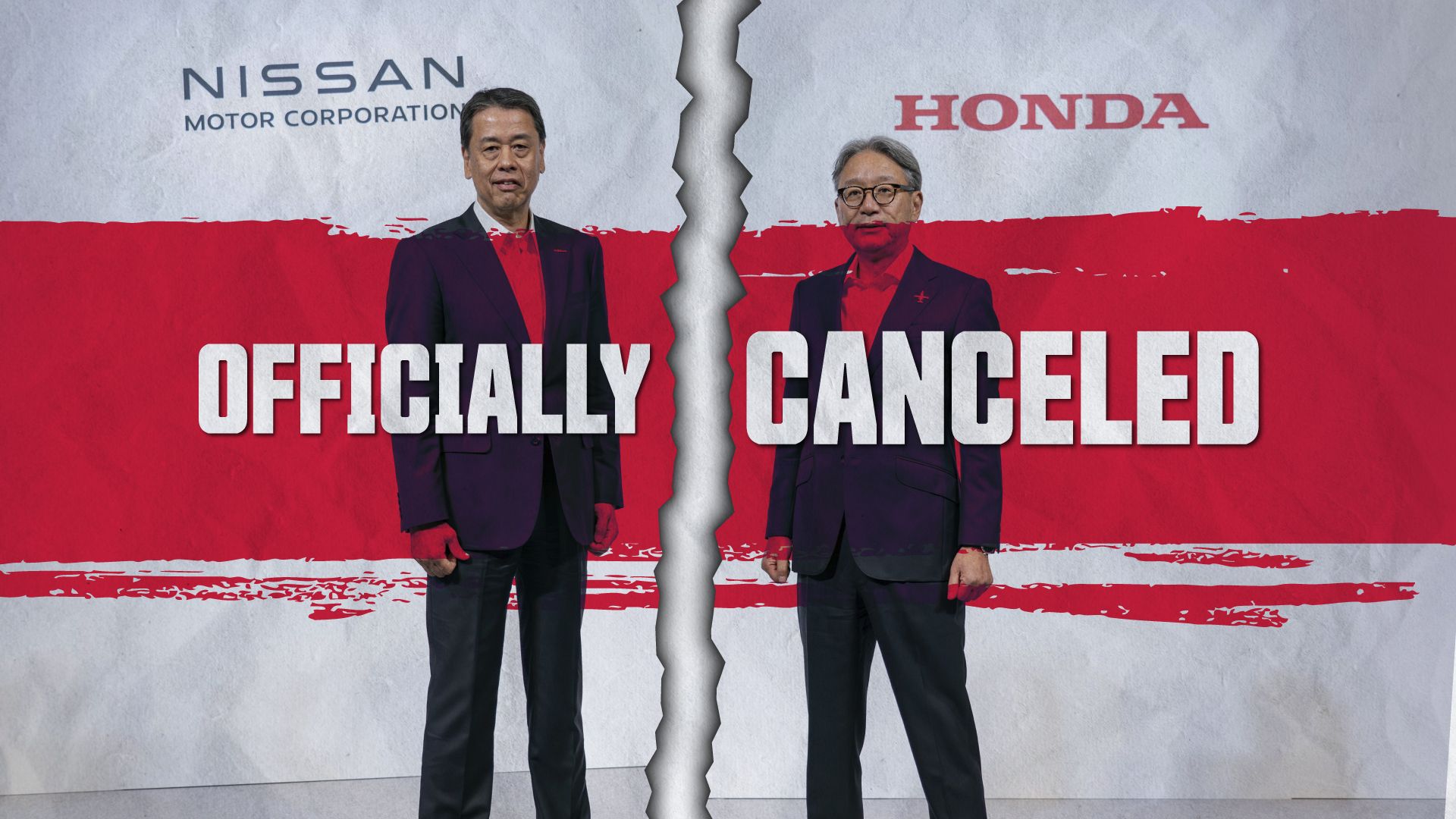
At the end of last year, Honda and Nissan finally confirmed what the rumor mill had been claiming: that the two were discussing an expansion of their existing agreements, with the end goal being for the two automakers to merge in some way. A Civic with a Nissan badge was never on the cards, but Nissan may have benefited in other ways, even if only years from now. At the time, some publications suggested that the proposed merger might be skewed in Honda’s favor, and more rumors began to form. We theorized that it might be a bad business move for Honda, and now it seems that we were right, as were several Japanese outlets that indicated the merger was on rocky ground; the proposed merger has officially been terminated. So why did things break down so quickly?
-
Nissan
Nissan Motor Corporation is a Japanese automaker founded in 1933 and the parent automaker of Infiniti and formerly Datsun. Nissan produces a wide variety of mass-market vehicles, including popular SUVs like the Rogue, sedans like the Sentra, and trucks like the Nissan Frontier, but is also responsible for iconic sports cars like the Nissan Z and GT-R. Since 1999, Nissan has been part of the Renault-Nissan-Mitsubishi alliance (the name changed when Mitsubishi joined in 2016).
- Founded
-
26 December 1933
- Founder
-
Yoshisuke Aikawa
- Headquarters
-
Nishi-ku, Yokohama
- Owned By
-
Publicly Traded
- Current CEO
-
Makoto Uchida
-
Honda
Japanese automaker Honda rose from the ashes of WWII and set about its business as a manufacturer of motorcycles initially, only launching its first car, the T360 kei truck, in 1963. Founder Soichiro Honda targeted the American market as the most important nut to crack, leading to generations of iconic nameplates like the Civic and Accord being among America’s best-selling passenger cars. Today, Hondas are renowned for their safety, practicality, and reliability, with a sprinkling of performance from models like the Civic Type R.
- Founded
-
24 September 1948
- Founder
-
Soichiro Honda
- Headquarters
-
Hamamatsu, Japan
- Owned By
-
Publicly Traded
- Current CEO
-
Toshihiro Mibe

The Official Explanation Is, As Usual, Vague – But There Are Curiosities Therein
The joint press release from the two automakers spoke in general about how the pair had discussed the market environment, what the merger might have hoped to achieve, and the management strategies and structures once the integration of the two companies was complete. Various stakeholders were also consulted, likely including parts suppliers, investors, and Renault. But here’s where things appear to have gone wrong:
“Honda proposed changing the structure from establishing a joint holding company, where Honda would appoint the majority of directors and the chief executive officer based on a joint share transfer as initially outlined in the MOU [Memorandum of Understanding], to a structure where Honda would be the parent company and Nissan the subsidiary through a share exchange. As a result of these discussions, both companies concluded that, to prioritize speed of decision-making and execution of management measures in an increasingly volatile market environment heading into the era of electrification, it would be most appropriate to cease discussions and terminate the MOU.”
Rumors from Japan indicated that the merger might not be equal (how could it be when Nissan is flailing and Honda is in a position of strength?), and other reports suggested that Honda wanted to buy out the Renault stake in Nissan. This official explanation seems to confirm that Nissan would have had little to no say in its future.

Related
Mitsubishi Thinks It Can Survive Without Honda’s Help
Mitsubishi reportedly wants to see if it can survive the coming years on its own steam, rejecting potential collaborations with Honda & Nissan.
Honda And Nissan Won’t Be Married, But They Will Continue Dating
The final paragraph in the joint statement says “Nissan and Honda will collaborate within the framework of a strategic partnership aimed at the era of intelligence and electrified vehicles.” How this will unfold remains to be seen, but we suspect Nissan may license certain technologies or powertrains from Nissan. Before Honda and Nissan signed their MOU, there were reports of Taiwanese iPhone maker Foxconn seeking to work with Nissan, and since then, those rumors have not abated. Less than a week ago, we reported that Foxconn was still interested, and it appears that the tech company wants to collaborate with Nissan rather than take it over, which would be preferable for the Japanese automaker.
Foxconn previously collaborated with Lordstown, and that didn’t go too well, but the former is still in a position where it can explore other partnerships, such as that with Pininfarina. In a nutshell, Honda and Nissan will continue to enjoy an amicable relationship, but they won’t share the same house. Foxconn has been developing its own EVs, something Nissan has been slow to do, but it doesn’t have the brand cache of the Japanese automaker. If it goes ahead, this may be the ideal relationship for both.