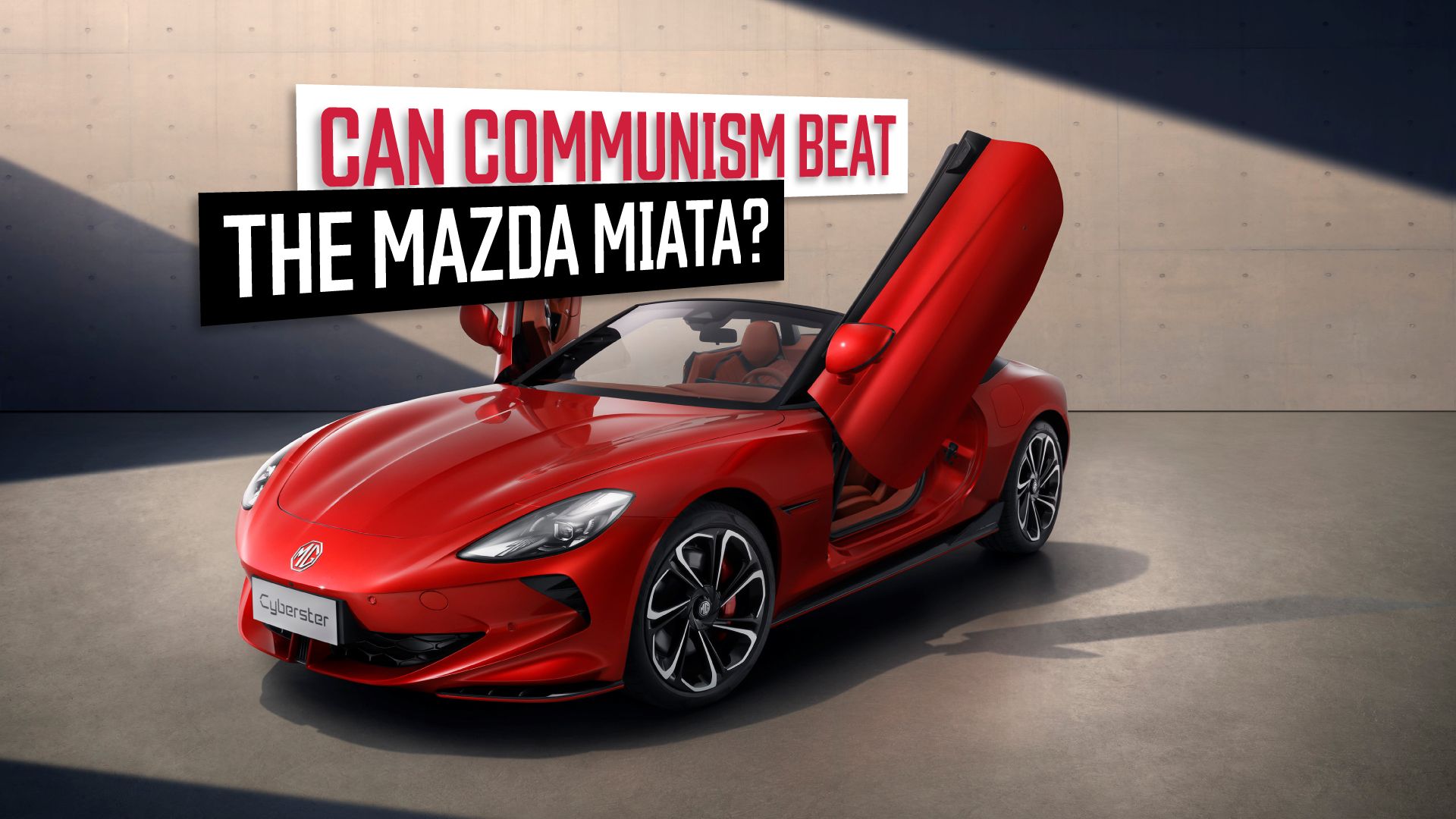
With a hip name that has all the feels of a modern Star Wars remake, MG’s new Cyberster conjures images of open-top driving on British rural roads, he with leather driving mitts and she with a headscarf and Jackie O glasses. MG is all 1960s, innit?
But here’s the funny thing. After spending a week with the Chinese company which today owns the once proud British brand since 2007, SAIC, the references – any, at all – to MG’s storied past as fun driving machines were rather underwhelming. Modern China is still pretty much a utilitarian, communist workers’ haven. Fun and driving don’t really mix. It’s get to work, and then get back home. Meaning the modern Chinese car is a way of getting efficiently from A to B. With not that much laughing and joyriding in between.
What Makes The Cyberster Different?
To take up the baton of your heritage and run with it in a modern way, takes some guts. Especially if the rest of the world actually uses cars only half the time to commute. The other times we use it as an instrument of fun in itself. Of enjoyment. It becomes part of us, and our personalities. You hop into your Mazda Miata, and you drive not because you want to get in the straightest possible way to your destination. But because you want it to be one hell of a drive.
Speaking of the Miata. Across the Yellow Sea from Shanghai, the Japanese most possibly invented the litmus test for fun to be had on four wheels, roof down.
Related
How A Plucky British Brand Beat The Mighty Tesla Roadster
The very cool, very forward-thinking MG Cyberster is worth making a note of. Here’s how they beat Tesla to market.
The philosophy has always been to combine a small engine with modest power figures, with a body the size of a bathtub and a price tag which young people could afford. Fun in the first three gears, was most probably the sticky note on the project leader’s mood board.
Over the next three decades, since the Miata came into being in 1989, the market has grasped this. And applauded it. The Miata has sold more models than any other sports car ever. Is it fair to compare the Miata with the modern, battery-driven Cyberster? Of course, yes, as both teams had the same vision when starting out. But there’s really only one clear winner. And that’s a tap on the back of old school motoring values.
It’s also fair because the Miata was created as a result of British roadsters, like those made by MG. But the Mazda proved that roadsters can be both fun and reliable.
We spent a week in Shanghai as guests of MG, to visit their new factory and production line, as well as their R&D center. All new models were driven on their extensive proving grounds.
The Cyberster – Fun, The Politburo Way
Up to now, MG has focused on hatchbacks and SUVs. Even a couple of EVs have joined the fray. For their big push into overseas markets, they needed a halo car, and for this a modern interpretation of the classic British roadster was developed. Even the name was picked with the PlayStation generation in mind. Indeed, the battery-driven, scissor-doored Cyberster is more with it than a K-Pop boy band.
Which says a lot about the team behind the funky Cyberster. As mentioned earlier, the Chinese car culture is still very young, and in essence, a provider of mobility. But the Cyberster is all about to change that. At least in its home market.
The styling gets the thumbs up emoji. No design-by-committee to be seen here. Just look at that flat, low-slung body. The broad stance. The soft hood that can fold away in the rear, and sleek LEDs to pierce the night sky. The party trick is, of course, those doors. A bit clunky to operate, what with its slow release to open up fully. But it looks (social media) reel-worthy and gives the sports car that bit of wowziness when you arrive fashionably late.

Related
MG Is One Step Closer To Returning To America
The MG Cyberster would be interesting to see on local roads.
Brief history of MG
Cecil Kimber started the MG Car Company in 1924. Using the MG (Morris Garages) moniker, he modified standard production Morris Oxfords and branded his modified cars as MG Super Sports. During the next decades, the company underwent several changes in ownership, with British Leyland the biggest of them. In 2007 the company was sold to the Chinese giant SAIC (Shanghai Automotive Industry Corporation), from where sedans and hatchbacks were produced for the Chinese market.
Screaming At Screens
Hop into the new Cyberster and a movie-like array of screens greets you right behind the steering wheel. The whole panel consists of three screens connected to be one broad unit. And a fourth screen sits vertically in the center of the dashboard.
While the center screen is logical in information (speed), the ones to the left and right (reserved for things like your satnav and energy flow) are right behind your hands, and thus most of the time out of your line of sight. To see when your turn-off is coming up, you have to lean over and peer around your hands. This ergonomical oversight is followed up by the vertical screen (reserved for your aircon switches) being clunky to use whilst driving on a bumpy road. It takes some real concentration to hover the fingertip on the exact spot where you want it to be, and not touch anything else.
Storage space
That said, the Cyberster’s interior is in general a very nice place to be. Leather-clad sports seats with fluffy Alcántara touches here and there make the interior cozy, sporty and premium. There is a lack of storage space, though: small door pockets, a tiny shelf behind the seats covered by a net, and a trunk smaller than that of a BMW Z4. But no second trunk in the nose. Strange.

Add CarBuzz to your Google News feed.
The range
Two models are on offer, both using the same 77 kWh battery pack. But whereas the Trophy has only a single motor powering the rear wheels (340 hp), the GT unleashes its inner caged panda with a combination of front and rear motors to provide 510 hp to all four paws. That’s good enough for a 3.2 sec. sprint – super car territory in any language or alphabet. Even the Trophy’s 5.0 sec. sprint isn’t slouch like.
The Cyberster – A Modern Miata?

The Mazda Miata started off with a petite 1.6 liter engine, but soon progressed to a more powerful 2.0 liter. But all the while keeping the original ethos of a cheap and cheerful, fun-to-drive runabout. Its weight of just over a ton was the key element. That, and its diminutive size, which you could cover under a kimono. Who needs turbos when you could play around in second and third gear all day long?
Warp speed Cyberster
Punching the accelerator of the GT, there’s a hit in the back followed by a swoosh of wind and tire noise as the Cyberster accelerates in the blink of an eye to magical speeds. Then the first corner arrives, and you throw it into a left-right combination of twisties which could catch out any rear-wheel drive sportster with traction control off.
Maybe it’s the weight of the half-a-ton battery in the floor, or maybe it’s due to the front axle also helping with the traction, but the Cyberster just keeps on gripping onto the tarmac as you wield it left and right. It’s impressive.
Over a bumpy section, things get interesting, though. That massive extra weight in its belly has now started becoming a factor. As one 20-inch wheel crashes into a dip and then rebounds, the weight amplifies the chassis’ up and down movement. The car gets unsettled, and doesn’t recover quite as swiftly as a lightweight sports car would. Like a Miata.
Momentum shift
There’s this thing called momentum, and it works horizontally as well as vertically. Meaning that that big battery in the floor wants your Cyberster to trudge on to the roads’ outer edge, and even more so when you’re bouncing over an uneven surface.
Once you’re back onto even tarmac, the Cyberster turns into that panda who chows bamboo leaves in front of the cameras all day long. It’s predictable and stable. In the straight lines, you can confidently step onto the accelerator, and engage the racing line in the corners. Waiting for the front axle to pull you straight when a rear wheel drive’s rear end would’ve tried to catch up with you.
Enter The (Miata) Dragon
Not to be too nostalgic, but there is something to be said for an engineering philosophy that prioritizes nimbleness over sheer power. If the Cyberster is the modern Euro Typhoon version of the Spitfire, the Miata is Crouching Tiger, Hidden Dragon. All light footed and deft as it zips from rooftop to vertical wall and back.
With the Miata, you can play on country roads. It’s agile and fun, even if you have to stay in the first couple of gears to get some performance going. And because batteries, electric motors, touchscreens, and scissor doors are expensive, the base Cyberster costs twice as much as the Miata Club, which comes standard with all the track day goodies.

Related
11 Reasons The 4th-Gen Mazda MX-5 Miata Is More Important Than Ever, Even At 10 Years Old
Despite the Miata going through a bit of a slump, we thought we’d list 11 reasons why it still matters.
Conclusion
The modern MG has to be applauded for its brave take on the modern MG roadster. It’s tailored to the young, new PlayStation and TikTok audience. From its name right through to its EV powertrain and wall of screens.
Heritage – that knowledge of building cars for decades on end – does come into play, though. The Cyberster is more of a straight line brute force than the joyful toy the Japanese created some thirty years ago in Hiroshima. Each impressive, but one is the example of a long, rich motoring history. And the other maybe the example of a culture that wants to join the party, but still plays by numbers.
Sources:
MG Cyberster
,
MG Motor Europe
,
MG Motor UK