Our collective obsession with Mazda’s rotary engine finally came to fruition when the automaker officially reincarnated a section of its R&D department dedicated to rotary engines. We saw the engine earlier this year and now, the Japanese marque has claimed its plan to bring the rotary-equipped sports car to the US, confirmed by none other than Mazda CEO Masahiro Moro.
Mazda
Mazda is a Japanese automaker founded in 1920 as the Toyo Cork Kogyo Co and only started producing vehicles in 1931 when it made the Mazda-Go auto rickshaw. The Japanese automaker’s first official car arrived in May 1960 when the Mazda R360 launched, starting Mazda as we know it today, although the Mazda name was only adopted in 1984. Mazda has a rich history in motorsport, including the honor of being the only manufacturer to win the 24 Hours of Le Mans with a car not powered by a reciprocating engine.
- Founded
- January 30, 1920 (as Toyo Cork Kogyo Co)
- Founder
- Jujiro Matsuda
- Headquarters
- Hiroshima, Japan
- Owned By
- Publicly Traded
- Current CEO
- Masahiro Moro
In an interview with Automotive News, Moro bared the latest update on its rotary engine development, claiming that they are close to completing the challenge of complying with stringent emission regulations. However, in relation to the US market, Mazda’s head honcho noted that a single-rotor power plant wouldn’t be capable enough, so a twin-rotor is in the pipeline.
“I want a rotary engine that complies with very stringent emission regulations. That is going to be a significant challenge. We are very close. If we are thinking about the US market, one rotor is not enough. Two rotors are needed to generate more power.”
– Masahiro Moro, CEO, Mazda
But It Won’t Be Like The Twin-Rotor Renesis
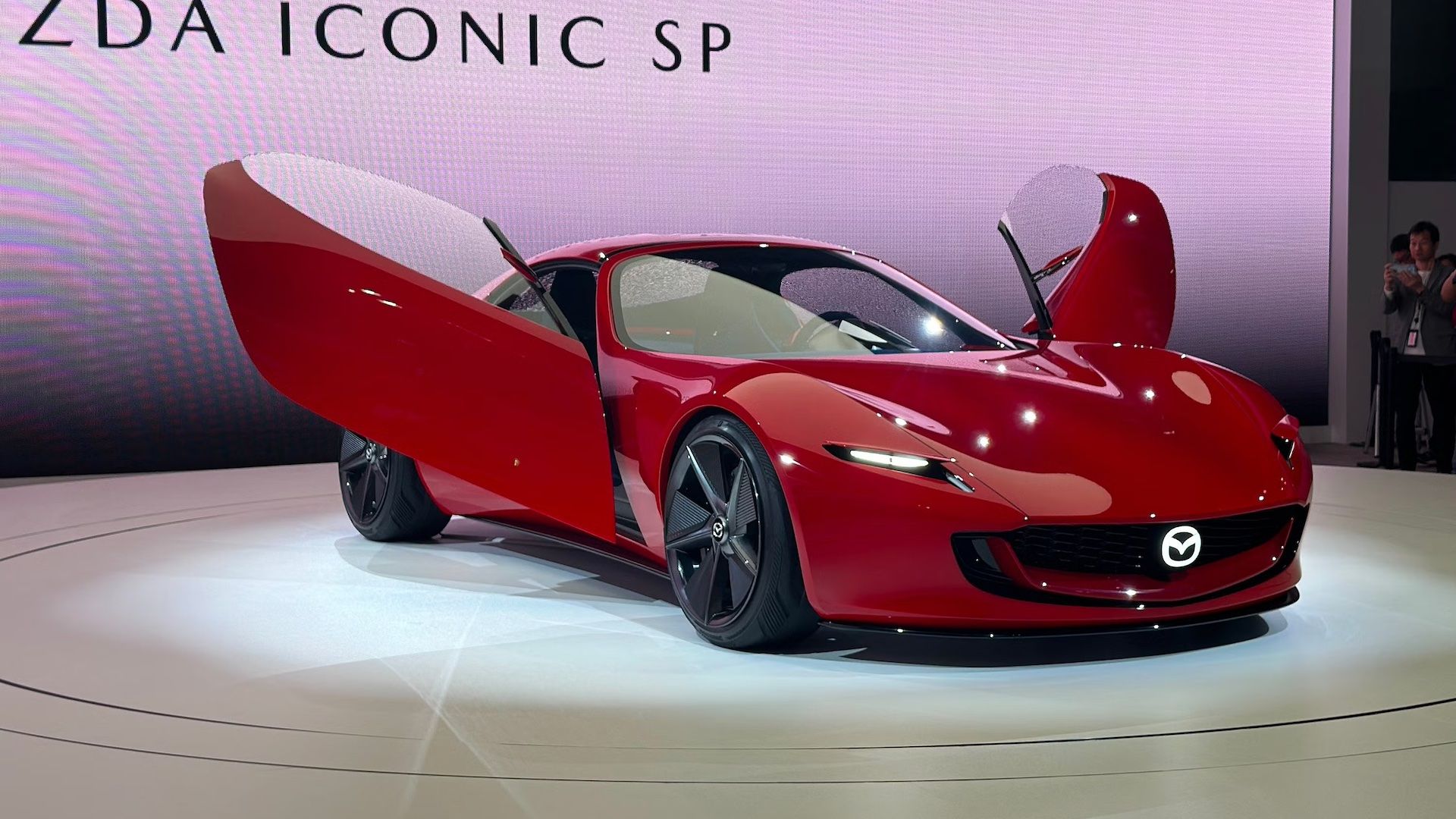
Sounds like a dream for rotary fans, but we’d be remiss not to remind you that the two-rotor engine that Mazda’s developing is unlike the twin-rotor Renesis engine of the RX-8, the last rotary-powered sports car. Just like in the Iconic SP Concept revealed last year (depicted here), Mazda will be using the two-rotor mill to generate electricity to charge the battery, which will in turn power the electric motors. Yes, it will be a range extender, just like in the MX-30 e-SkyActiv R-EV, but better (and hopefully cooler).

Add CarBuzz to your Google News feed.

Related
The Only Pistonless Engine To Ever Win Engine Of The Year
It left an indelible mark on automotive history that transcends decades.
Moro added that Mazda has already tested a single-rotor engine and is now moving on to the next phase that will involve two, which will be spinning in separate chambers with one shaft. He then reinforced the plug-in hybrid range extender setup by saying that the rotary engine being developed needs to generate more electricity (not power) to suit the needs of American buyers. Essentially, if a driver wants more power from the electric motors, the rotary engine needs to produce more electricity to provide more juice to the battery.
Not Exactly What We’re Hoping For, But It’s A Start
While this might not sound like the rotary sports car we’ve been waiting for, it’s confirmation that substantial efforts are being made to keep the rotary engine alive. There are many reasons to support our hope for a rotary comeback and if a range-extended EV that drives great (and hopefully sounds nice) will pave the way for that, then so be it.

Related
Mazda EZ-6 Is A $20k EV Range Extender With 800 Miles Of Range
Available as a hybrid or an EV, this sedan has morphed to become a more practical liftback, and it looks fantastic.
Moro also revealed in the Automotive News interview that Mazda is in the advanced research stage for solid-state batteries for EVs, though the priority right now is a purely in-house developed next-generation lithium battery. The target release for this battery tech is 2030. Meanwhile, Moro also boasted that the recently announced Skyctiv-Z engine would be the ultimate Mazda engine that will carry the brand beyond 2030.
Source:
Automotive News