Not every timing belt failure results in catastrophic engine damage, but it will bring your trip to a sudden halt and cause a major hassle you’d probably rather avoid – as well as the expense of a tow-truck ride to the nearest repair shop. Below, we’ll look at what a timing belt is, how to care for yours, what happens if you don’t, and why you may not even need to worry about timing belts at all if you drive a modern Honda, Volkswagen or Kia.
Honda
- Founded
-
24 September 1948
- Founder
-
Soichiro Honda
- Headquarters
-
Hamamatsu, Japan
- Owned By
-
Publicly Traded
- Current CEO
-
Toshihiro Mibe
Timing belts are funny because maintaining them works a little differently than maintaining just about anything else on your car. You change a timing belt on a set interval, while it’s still in healthy, working condition. Timing belt maintenance works this way because when a timing belt fails, your car’s engine stops working instantly, and extensive engine damage is possible or even likely, depending on what you drive. The point is, you change a timing belt before it fails, because changing a good timing belt is a fraction of the cost of repairing the damage a failed one could cause.
Timing belt replacement intervals can differ by model, so make sure you consult your user manual to determine the specific replacement interval relevant to your car. Both interference and non-interference engines can use a timing belt.
A Brief History of The Timing Belt
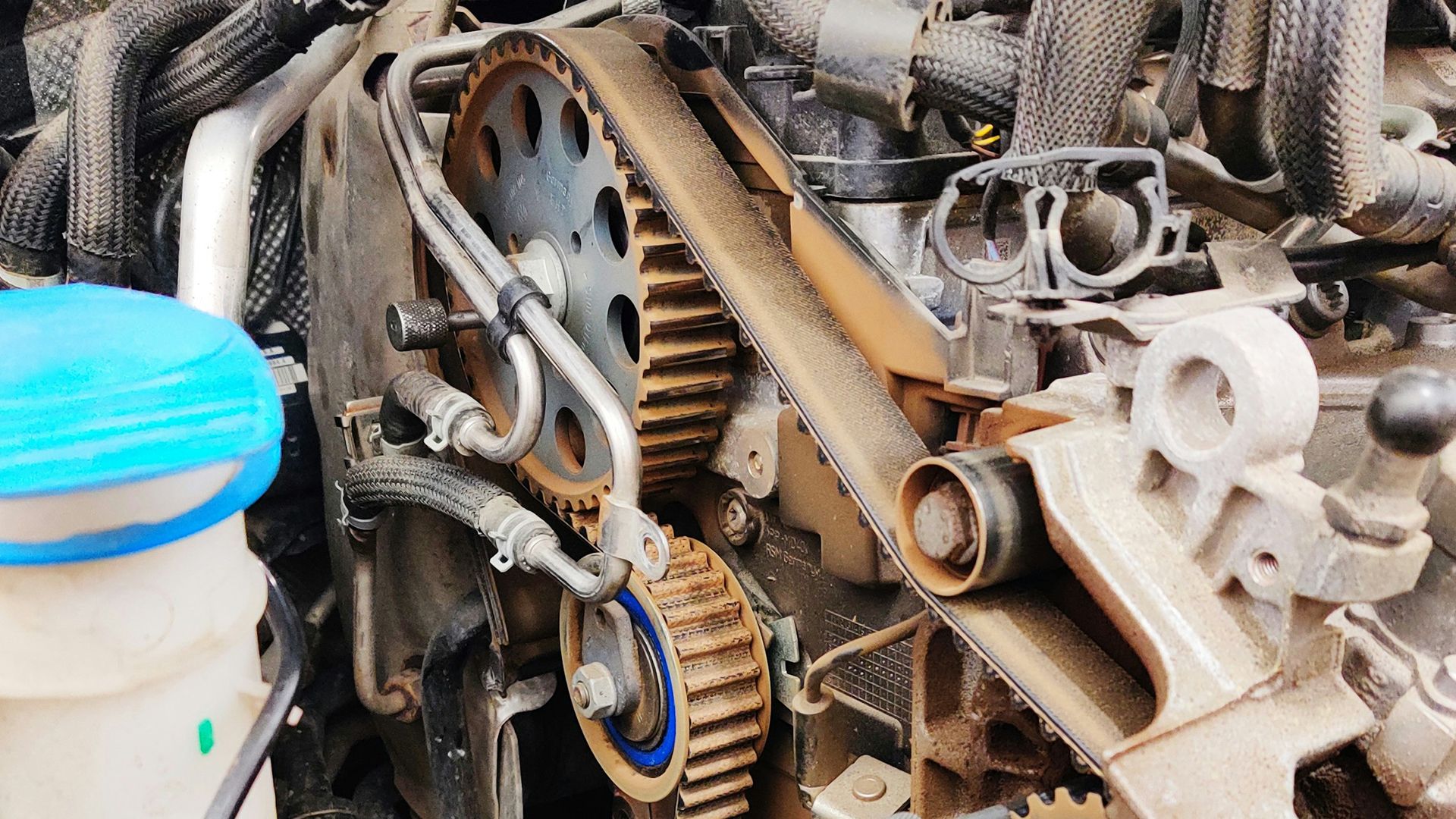
Deep inside your engine, a minimum of two rotating shafts need to be precisely synchronized at extremely high speeds. One of these is the engine’s crankshaft, and the other is the camshaft(s), which controls the rhythm of your engine. This precise synchronization of two or more rotating shafts sets the literal heartbeat of your car’s engine.
There are various ways to synchronize the timing between a crankshaft and camshaft, including chains, gear drive mechanisms, and the topic of our story today, the timing belt. This style of notched belt has been around since at least the ’70s when automakers started using them to replace heavier, noisier and more expensive timing chains. At the time, and well into the decades that followed, the adoption of timing belts allowed automakers to sell cars that were cheaper, lighter, quieter, smoother, and more fuel efficient.
|
Manufacturer |
Regular Interval Mileages |
|
Acura / Honda |
60,000-100,000 |
|
VW / Audi / Porsche |
70,000-100,000 |
|
GM / Chevrolet |
60,000 |
|
Chrysler / Dodge |
60,000-110,000 |
|
Hyundai / Kia |
60,000 |
|
Ford / Lincoln / Mercury |
60,000-120,000 |
|
Toyota / Lexus |
60,000-90,000 |
|
Nissan / Infiniti |
50,000-100,000 |
|
Mitsubishi |
60,000 |
|
Subaru |
105,000 |
|
Suzuki |
60,000-100,000 |

Related
Busting Myths About Timing Belts And Chains
The answer may not be as simple as you had hoped for.
Drivers Caught On To The Costs
Sounds great, but timing belts had their disadvantages too – and at some point in the early-to-mid 2000s, shoppers had started to catch on. In that era, many four- and six-cylinder engines from automakers including Honda, Volkswagen, and many others, used engines synchronized by timing belts. For most shoppers in that era, driving an affordable sedan or crossover meant a pricey timing belt replacement every 60,000 miles or so, with the threat of potential engine failure if not.
In some engines, a failed timing belt just causes your engine to stop running with no further damage. You’ll need a tow to the nearest repair shop, and about $500-$1,500 for the replacement, depending on what you drive. Add a few hundred bucks more if your car has a water pump driven by its timing belt, since you might as well skip redundant labor and change that nearby part while you’re already inside the engine.

Related
How Much Does A Timing Belt Replacement Cost?
If your engine’s timing belt breaks, severe damage can occur.
In other engines, a failed timing belt could allow contact between the rapidly reciprocating pistons and valves, causing instant and catastrophic damage that turns your engine’s insides into shrapnel. Having a timing belt fail on an ‘interference’ engine like this can cost you an engine. Most modern engines are interference-style engines, meaning a failed timing belt will likely result in an unfortunate (and very expensive) marriage between the pistons and the valves.
In this same era of timing belts and interference engines, advances in computer controls, fuel injection systems, hybrid engines, and engine oil technology allowed engineers to stretch the maintenance intervals of engines further and further to the benefit of customer convenience. By this point, some shoppers were starting to take note of popular timing-belt-related headaches experienced by some of the day’s common engines, as well as the ongoing costs of timing-belt maintenance.
The Switch Back to Timing Chains
As time went on, more and more shoppers started to avoid timing belt-equipped engines to save on maintenance costs in the long term. In some cases, automakers, including Chevrolet and Volkswagen, began using revised timing belts with longer service intervals on some models, but the strong customer perception around the costly maintenance of timing-belt engines remained a challenge.
By the second half of the 2000s, there was a shift back to the timing chains once popular decades earlier. Modern timing chain engines have no replacement interval and shouldn’t require any care or attention to the timing chain system in the context of a healthy and regularly-maintained engine. Of course, that didn’t stop some engines from having well-publicized timing chain problems, including early versions of GM’s 3.6-liter V6, the 4.2-liter V8 found in some Audi models of the day, and famously, early copies of BMW’s N20 four-cylinder turbo engine.
Some modern engines still use a timing belt, though today’s tend to be more durable and long-lasting than their predecessors, and can go 100,000 miles or more without a replacement.
Does Your Engine Have A Timing Belt or Timing Chain?
The V6 engine in the Honda Odyssey, Honda Passport, and other models, uses a timing belt, with service intervals of 100,000 miles in normal use and 60,000 miles in severe use as defined by extreme heat, extreme cold, or regular towing. The EA888 four-cylinder turbo engine used in the Volkswagen Golf R uses a timing chain, which has no regular service interval – though you’ll want to stay well on top of oil changes to keep things healthy for the long haul.
These are just two examples of popular engines on the market today. To quickly find out whether a car or truck has a timing belt or timing chain, you’ll need a web browser and about 30 seconds. First, search for the year, make, and model of the vehicle you’re after, and add the words ‘maintenance schedule’ or ‘service schedule’ to your search. With a moment’s browsing, you’ll have a PDF or website version of the vehicle’s maintenance schedule on screen, provided by its manufacturer. Once that’s open, browse to the regular maintenance section, or simply do a text search for the words ‘timing belt’ within the document.
If the engine has a timing belt, you’ll see it here – alongside its service interval. If it has a timing chain, nothing will show up. If in doubt, contact your favorite technician or dealer service advisor for more information.
Sources: Honda, Volkswagen