
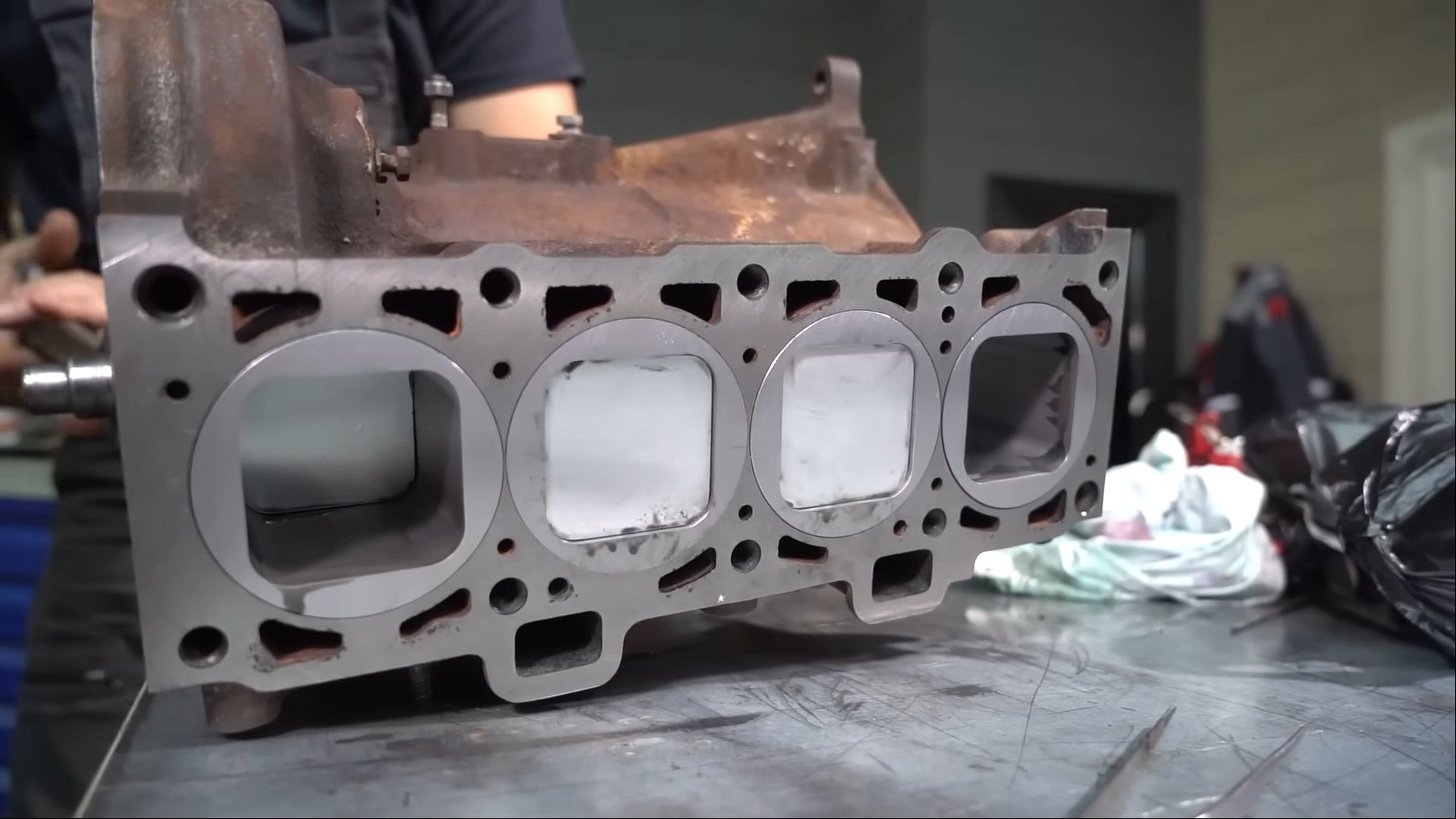
We’ve highlighted the guys at Garage 54 a few times for some of their craziest builds and bizarre engineering experiments. With all due respect to the American tuners and hot-rodders squeezing extra horsepower out of crate engines and used Ford Mustangs, these Russian maniacs building whole engines out of chainsaws and screwdrivers, or swapping their tires out with springs, satisfy those “what would happen if…” intrusive thoughts that run through your head now and then.
One of the weirdest experiments these guys have conducted lately has to be swapping the round pistons out of a four-pot Lada (the signature car for utterly ridiculous Russian science experiments) for custom-built squared-off pistons. Garage 54 posted a video going over every step of the process, from the initial casting and build to the pile of oily parts they were left with at the end of the project. The video description says it about as well as anyone could, “What will happen?” Let’s find out…
How To Build A Square-Piston Car
Going about the craziest experiment in the smartest and most efficient possible way, Garage 54 uses an EDM, or Electrical Discharge Machine, which uses a wire to cut metal blanks into your desired shape. As they say in the video “the way the machine works is simple. The wire moves around, you have electricity going through it, the whole thing is liquid cooled, and cutting occurs, somehow.” Well alright then, that explains it.
The EDM machine is used to cut square-shaped cylinder sleeves to be pressed into the cylinder block, machined for a perfect fit, and then it’s on to endless measuring, drilling, cutting, test-fitting, and assembling. Even with the help of automated machining tools, the project winds up taking weeks because of all the testing and fine-tuning required along the way, and the time-consuming machining process itself.
Plugging A Square Peg Into A Round Hole
The team runs into countless issues that wouldn’t come up when building a more conventional engine, mostly having to do with parts coming into contact with parts that they shouldn’t be touching. For instance, during an initial attempt at assembly, they discover that the odd shape has the valves clanking up against the cylinder sleeves and digging into the metal, forcing them to dig little grooves into the sleeves to correct the issue.
An initial attempt to start the car sees the engine failing to produce adequate compression to get anything moving, so the team adds a second set of piston rings, reassembles the engine, and the car finally sputters and whines to life, with plenty of knocking and wobbling as if it’s begging to be put out of its misery.
Taking The Square-Piston Lada On Its Maiden Voyage

It’s a testament to the Garage 54 gang’s experience under the hood that they’re able to get the square-pistoned Lada moving at all, and not only that, but “moving along confidently,” according to our brave test-driver. They find that the car drives well enough in first gear, cruises along nicely in second, and technically completes a short burn-out, or at least kicks a handful of gravel away as it gets into motion.

Taking this Frankenstein monster back into the garage to assess the damage after a short test-drive, they find the engine spattered in oil and smoky residue, as they were never quite able to create a perfect seal with those rubber piston rings. The cylinder sleeves are scorched in soot and grime from escaped gases, and at least one piston ring is “burned to a crisp”.
The Piston Rings Crapped Out, But That Might Not Be Their Fault

In his assessment of the damage, the lead engineer notes that the rings they bought were apparently “not of very high quality,” but the cylinders come out in decent shape, and the cylinder walls have a nice mirror finish.
It’s unclear if a higher-quality piston ring would have solved the engine’s imperfect piston seals, or if this is a problem that you’d run into with even the highest-quality parts when using square pistons. Piston rings are designed for circular pistons, and a square piston will put undue stress on the corners, potentially making a perfect seal impossible if you’re not using parts custom-fitted for the job.
Why Are Pistons Round, Anyway?

Most of the problems the Garage 54 team runs into along the way when building their square-piston engine have to do with the simple fact that nobody out there is building square-piston engines. The parts you can buy for tuning, hot-rodding, and custom engine builds are manufactured on the assumption that you’re using round pistons and cylinders. So one of the main reasons why automakers use round pistons is simply because that’s the way it’s done, and you’re going to run into countless compatibility issues if you try to reinvent the wheel.
Round Pistons Make More Sense From An Engineering Perspective

As to why we settled on round (or oval, in some cases) pistons in the first place, there are a few basic engineering principles that naturally lead us to that shape…
- Manufacturing is easier with a round hole. Imagine if you were asked to drill a round hole with tools you have in your garage. You’d probably get the job done in minutes. If we asked you to drill a square hole, that might not even be possible with what you have available to you.
- Force is distributed more evenly with a round cylinder. Next time you watch an action movie, note that those slow-motion explosions always expand in a more-or-less spherical shape. It makes sense for a combustion chamber to match that shape.
- As demonstrated by Garage 54, piston rings struggle to provide a tight seal around a square. Piston rings would need to be manufactured specifically for a square piston, and they still would not provide as tight a seal as you would get with a round piston.
- A circular shape means less surface area, which means less friction inside the cylinder, which means more efficient performance.
- Round pistons are easier to balance. Watch that square-pistoned engine bouncing around inside Garage 54’s Lada to see what we mean.
- Square parts are just one more thing that can break, with the corners of the pistons and cylinders being easier to damage.
- Finally, there simply aren’t enough advantages to using a square piston to justify all of the disadvantages. Theoretically, an engine block built around square pistons could provide the same displacement in a smaller package as a conventional powerplant, but it wouldn’t be a worthwhile tradeoff when you consider the decreased durability, the lower power output, the compatibility issues, and the difficulty in attaining a perfect seal. The list of pros is simply shorter than the list of cons.
There are physics professors out there who can explain it better than us, but when we’re talking about expanding force, objects moving through a physical space, the bottom line is that circular and spherical designs are simply the most efficient, practical shape. Basically, pistons are round for the same reason sports cars have that sleek, aerodynamic shape. There’s a reason the moon isn’t shaped like a microwave oven, and baseballs don’t look like Rubik’s cubes, after all.
With all of that being said, we have to admit that square-shaped cylinders look really cool, but they just don’t make sense as an engineering solution.
Sources: Garage54.