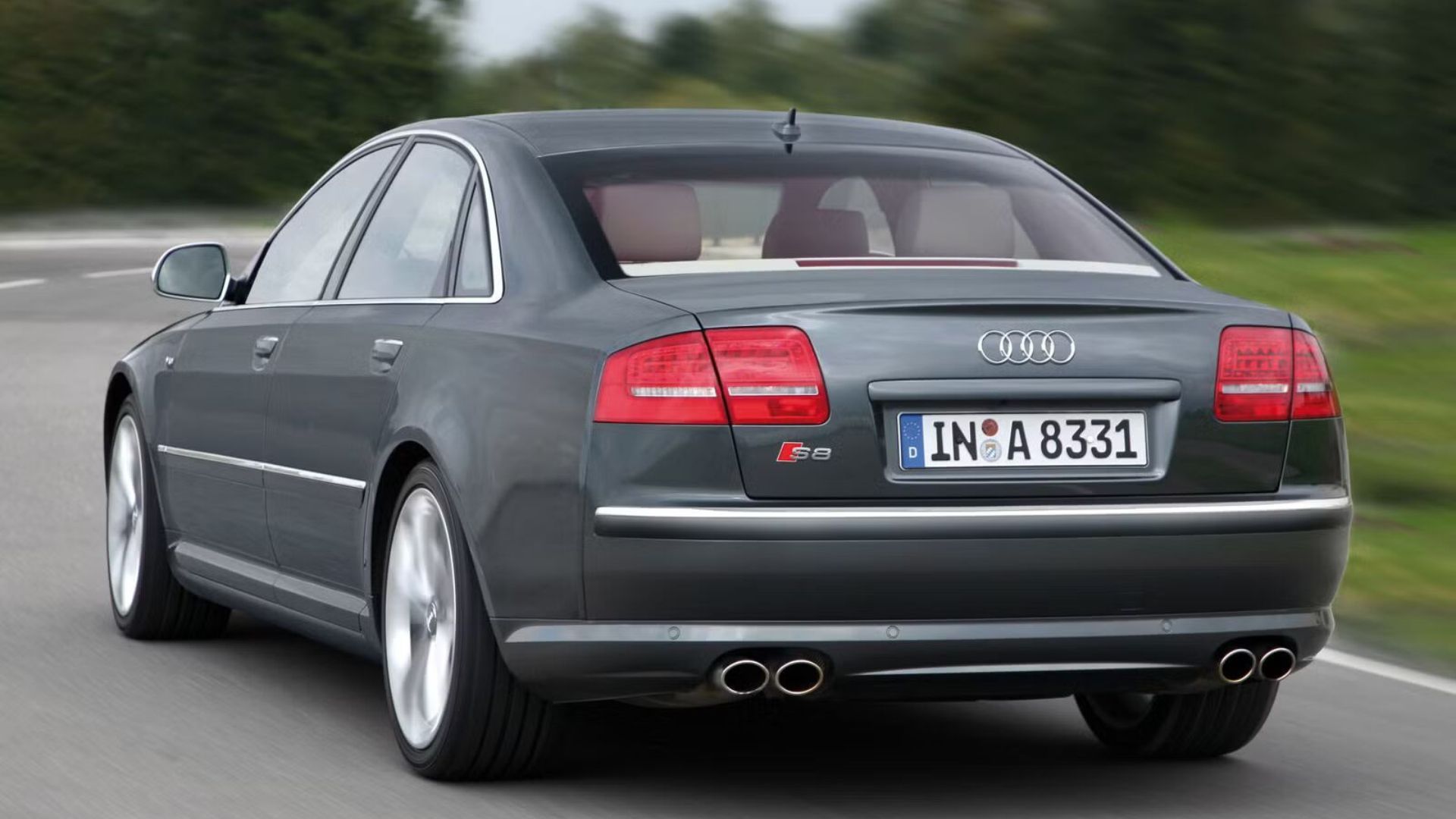
What better way to create the ultimate sleeper car than combining German automotive nous with Italian high-revving flair? That’s exactly what Audi did, nearly two decades ago, when it brought us the Lamborghini-powered luxo-barge, the S8. Complete with a storming 5.2-liter V10 in the nose, very similar to what you could find at the time in a flashy Gallardo.
The used car market hasn’t been kind to the Lambo-powered S8, though. You can pick up an early model for dirt cheap, and prices rarely exceed $20,000. That’s a big drop since 2007’s (when it appeared on the market) asking price of $94,420. What happened? Well, a couple of things. Let’s have a look.
The Audi S8 has dropped nearly 80 percent of its value since it came onto the market in 2006. We speculate on what the reasons for this could be.
Audi’s Sleeper-Sedan With Lambo Power
It was a good day in the automotive world when Audi’s brass at HQ in Ingolstadt, Germany, decided its new, second-generation luxury flagship, the A8, should be powered by a Lamborghini V10. Up to that point, the S8 in its first iteration (D2, Typ 4D) had to be content with a 4.2-liter V8. The big story around the A8 has always been the body structure made of lightweight aluminum. Now, there was something different to talk about. And way more interesting. The luxo-barge now spoke Italian.
Short History Of The Audi A8
- Spanning four generations, production started in 1994
- The body is aluminum
- Conceived as a competitor to the Mercedes S-Class, BMW 7-Series, and Lexus LS
- Second-generation S8 used a Lamborghini-derived V10
- The long wheel-base A8 L used a 6.0-liter W12
It’s a bit fuzzy regarding whether the V10 was really derived from the Lamborghini Gallardo’s 5.0-liter V10. Audi’s engineering team tried to play this down by saying the engine was an evolution of the old 4.2-liter V8. However, it is fair to say it is a reworked version of the Gallardo’s V10. The S8’s version uses a less robust crankshaft with a split pin design, cast aluminum pistons, and a traditional wet-sump oiling system (versus the Gallardo’s dry sump), as well as differences in the valvetrain – all of which, combined, result in the much higher RPM red line and specific power output for the Gallardo.

Related
The Original Baby Lambo, The Gallardo, Just Turned 20
Sant’Agata looks back on two decades of its first V10-powered supercar.
All this means that the flagship sedan used a big V10 which was very similar to what was found in a Lamborghini supercar. The large, yet sporty S8 was the result.
|
Specifications of the 2007 Audi S8 V10 |
|
|
Engine |
5.2-liter naturally aspirated V10 |
|
Power |
444 hp |
|
Torque |
398 lb-ft |
|
Transmission |
Six-speed automatic |
|
Top-speed |
155 mph |
The S8 debuted in 2006 and went on sale in the United States for the 2007 model year. The V10 produced 444 hp and 398 lb-ft of torque, sent to all four wheels using a six-speed automatic gearbox. The all-wheel-drive system used a Torsen center differential, usually sending power in a 40/60 split between the front and rear axles. However, if needed, the differential could channel up to 85 percent of the power to the rear wheels or 65 percent to the front.

Related
European Luxury Sedans: Audi A8
A relative newcomer which nonetheless has managed to set a new standard for luxury.
Light On Visual Touches, But Plenty Of Changes Underneath The Skin
Adaptive air suspension was standard, and drivers could select three drive modes (Comfort, Automatic, and Dynamic) on the fly. Bigger, 20-inch rims were standard, as were the uprated brakes and firmer suspension setup. Visually, you can distinguish the S8 from lesser models by the V10 badges on the wings, the S8 moniker on the grille, and the little lip spoiler on the trunk’s edge.

Expectations were high for the V10-powered sedan, but the performance disappointed some drivers. Audi wanted to keep its sedan as a luxurious vehicle rather than solely focus on speed. At 4,609 pounds, the S8 was heavy, even with its aluminum body. Journalists at the time commented on how the big Audi would understeer in fast corners, feeling all the weight of the big V10 ahead of the front axle. There was also a lack of occasion as you pulled off – no punch in the back or aggressive sound. The engine’s tuning provided a flat torque curve instead of high-rpm power.

Related
Kim Jong Un Should Buy The Audi A8 L Security
Dictators love this stuff.
Audi may have disappointed the petrol-heads in the motoring fraternity by taming its V10 for use in its elegant A8 family. But it got one thing right because the S8 jumped ahead of rivals from BMW and Mercedes-Benz, which didn’t have direct competitors available then. Mercedes was working on a new S63 AMG to augment the S550. BMW had the 750i but no M7. The S8, for a while, had the segment all to itself.
It’s Cheap, But Why?
Here is one of the saddest truths of the car world: big, luxury sedans from foreign automakers typically don’t hold their value very well. The beautiful, technically advanced second-gen Audi S8 is a case in point. We couldn’t find one above $20,000. High-mileage models typically go for as cheap as $8,000. Pristine examples are available for about $19,800, which is still 78 percent less than the $94,420 a buyer would’ve paid in 2007.
The Curse Of The Less-Desired Luxo-Barge
How did the S8 end up here? First, considerable depreciation is a common curse among luxury sedans. Only a select few retain their value, and the rest plummet like a spent rocket re-entering the atmosphere. By limiting numbers and offering the models with a lot of new technology, automakers can ask for a premium price for these vehicles when they’re new. Twenty years later, the features are no longer cutting edge, and the styling might be out of fashion.

Related
Audi A8 Owner has Anger Issues
Instead of waiting for a tow truck, this driver opts to smash the hell out of his car – a clear sign of a seriously bad temper.
The second reason is brand cachet. Some brands’ luxury cars hold their values better than others. It has nothing to do with the inherent build quality or technological wizardry contained in the car, but all to do with the market’s perception of it. The market puts more value on an old Mercedes and BMW than an old Audi.


- Base Trim Engine
-
5.0L V10 Gas
- Base Trim Transmission
-
6-Speed Manual
- Base Trim Drivetrain
-
Four-Wheel Drive
Finally, there is the fact that the V10 is a bit of a downer in the much-talked-about S8. Audi did its best to downplay the Lambo V10. But the market made the connection, which stayed at the top of people’s minds. When the first reports came out, the feedback was that the big, Gallardo-powered S8 wasn’t as much of a raging bull as expected. Audi tried to control the message, but the market had decided.
Other Luxury Sleeper Sedans To Consider
After introducing its new XJ in 1997, Jaguar introduced the XJR with a supercharged 4.0-liter V8, making 370 hp and 387 lb-ft of torque, and rear-wheel drive. The brutish Brit could jump from standstill to 60 mph in 5.3 seconds, and was considered one of the fastest four-doors in the world at the time. The top speed was electronically limited to 155 mph. The car exuded all the elements of Jaguar co-founder Sir William Lyons’ mantra of “grace, space, and pace.”

Related
This Jaguar XJ Is Not What It Seems
It’s one of the last Daimlers that Jaguar ever made, and it’s coming up for auction.
Somewhat more familiar is BMW’s 540i from around the same late-1990s era. The Bimmer used a 4.4-liter V8, producing a handy 281 hp and 325 lb-ft of torque. Today, this might sound a tad light, but it was real performance car numbers at the time. The superbly built and luxurious interior had all the typical BMW touches, such as the driver-facing dashboard and uncluttered dials.

Related
The G8 Proved That Pontiac Deserved Saving
One of the best sports sedans the brand ever made deserved better.
And For Some Local Flavor
The Pontiac G8 GT sports a modest four-door sedan body, and due to its reserved styling, it easily flies under the radar. At a glance, there’s nothing about this full-size sedan that screams sports car, and that’s a big part of what makes it so special. It is a tire-shredding muscle car dressed up like a carpool commuter. The GT uses a 6.0-liter V8 packing 355 hp and 385 lb-ft of torque.
In addition, the 2011-2014 Hyundai Genesis 5.0 R Spec not only performs on the road when you need it to, but also boasts Hyundai’s reliability record, a luxurious interior, lots of cargo space, and an understated exterior appearance. It uses a naturally aspirated 5.0-liter V8 to send 429 hp and 383 lb-ft of torque to the rear wheels, and can accelerate from 0 to 60 mph in just 5.3 seconds. The powerplant kicks out more horsepower than a 2011 Ford Mustang and a 2014 Porsche Boxster,
Conclusion
Audi has produced a classic sleeper car with its V10-powered S8. It looks understated but boasts a mighty Lamborghini V10 under the hood. It started as a luxury sedan at nearly $100,000, but today, thanks to brand cachet and less desirability than its competitors, you can pick one up for close to an 80 percent price drop to below $20,000. It must be one of the biggest bargains in the segment.
Sources: Audi, Lamborghini, BMW