Often to come up with something truly special, you need to think outside the box, and BMW has been incredible at this over the last 30 years. Part of this is because the company isn’t afraid of going with bold, divisive designs to make a splash. The current 7 Series is a great example, but the XM is less so. Another part of it is because it understands when to let its designers and engineers off the leash. This all started in 1985 when the brand founded a subsidiary called BMW Technik which was created outside the usual BMW system to explore designs and technologies without the usual red tape.
BMW
BMW is a German luxury car and motorbike manufacturer and current owner of Mini, Rolls-Royce, and Alpina. With roots dating back to 1913 as Rapp Motorenwerke, it officially became Bayerische Motoren Werke in 1922 as a manufacturer of aircraft engines. BMW’s first car was built in 1928 when it built the Austin 7 under license from Dixi, which was called the BMW 3/15. BMW grew into a manufacturer of premium and luxury automobiles, launching iconic nameplates like the 3 Series, 5 Series, and 7 Series, and is today known as one of the leading luxury automakers in the world, while the BMW M division is hailed as a leading manufacturer of performance cars.
- Founded
- 1916
- Founder
- Karl Rapp
- Headquarters
- Munich, Germany
- Owned By
- Publicly Traded
- Current CEO
- Oliver Zipse
An executive board meeting from 1985 clearly outlined its purpose. “The recently founded company BMW Technik GmbH has the mission to develop innovative, future-oriented, and original overall vehicle concepts and sub-concepts away from the constraints of a specific series workflow schedule,” they said. “However, the objective should always be to develop solutions that have the potential for series development.” Over the next decade and a half, the subsidiary explored cutting-edge designs and alternative powertrains, creating several fascinating concept cars that perfectly encapsulate the division’s exciting approach.
The Technik concepts on this list are some of the wildest ever created. They are listed from the oldest to the latest. BMW Technik GmbH no longer exists, and all design work was moved in-house, and is currently under the leadership of
Adrian van Hooydonk
.
1 Z1 Coupe Concept (1991)
The BMW Z1 Roadster is well-known for its quirky looks and retractable doors that slide vertically into the body, but you may be unaware that BMW almost took the design a step forward. When it decided to put the Z1 concept into production, it made sure the chassis could not only accommodate AWD, but also a Coupe version, which the company expanded on in concept form as you can see above. It never made it past the concept phase, unfortunately, but it’s easy to see how the vehicle is inspired by the Z1, particularly thanks to its doors that open and close vertically.

Add CarBuzz to your Google News feed.
The front end is much sharper than on the Z1 too, less cutesy and more focused as a sports car probably should be, but the most interesting part has to be the greenhouse, which almost feels out of place on the car, yet it somehow works. While we never saw this design make it to production, seeing this concept now explains where BMW received inspiration for its bold Z3 Coupe, a vehicle we hope in vain will receive a successor at some point.
2 E1 (1991)
The E1 concept marked BMW’s first real foray into electric mobility, thanks in part to the 1990 California Air Resources Board law that required a small percentage of zero emissions sales in the state for major automakers to do business there. Debuting at the 1991 International Motor Show Germany in Frankfurt, Germany, the Z11 E1 was the company’s take on an electric city car, with three doors and a tiny footprint. It was powered by a 19-kWh sodium sulfate battery pack paired with a 32-kilowatt electric motor producing 45 horsepower and 111 lb-ft of torque at the rear wheels. This setup delivered a range of approximately 124 miles, which was impressive despite the model only achieving a top speed of 75 mph.
Nothing came from it, however, and two years later BMW unveiled the second generation (Z15) of the concept, this time featuring a 19.2 kWh sodium nickel chloride battery, and even creating a hybrid version that utilized a four-cylinder motorcycle engine. Still, BMW never pursued the concept, and its first mass-produced EV ended up being the i3.
3 Z13 (1993)
While the E1 was meant to explore an economical city car, the Z13 had a much more fun objective of being small, innovative, and particularly fun to drive. Without any limitations, the engineers went to work and came up with an unconventional three-seat layout to make it extra compact that appeared to take inspiration from the McLaren F1. This allowed the driver to have a much better seating position in the car, allowing maximum visibility and control over the vehicle.
Under the hood, the Z13 was powered by a modest 1.1-liter four-cylinder engine borrowed from a BMW motorcycle, producing around 50 horsepower. This isn’t much, but power wasn’t the focus here, efficiency and a great chassis were, and thanks to its lightweight aluminum construction, it came in under 2,000 lbs. Besides looking unlike anything else in the BMW lineup, it also introduced GPS into a BMW for the first time, showing that sometimes the smallest innovations are the ones that make it to production.
4 Z18 (1995)
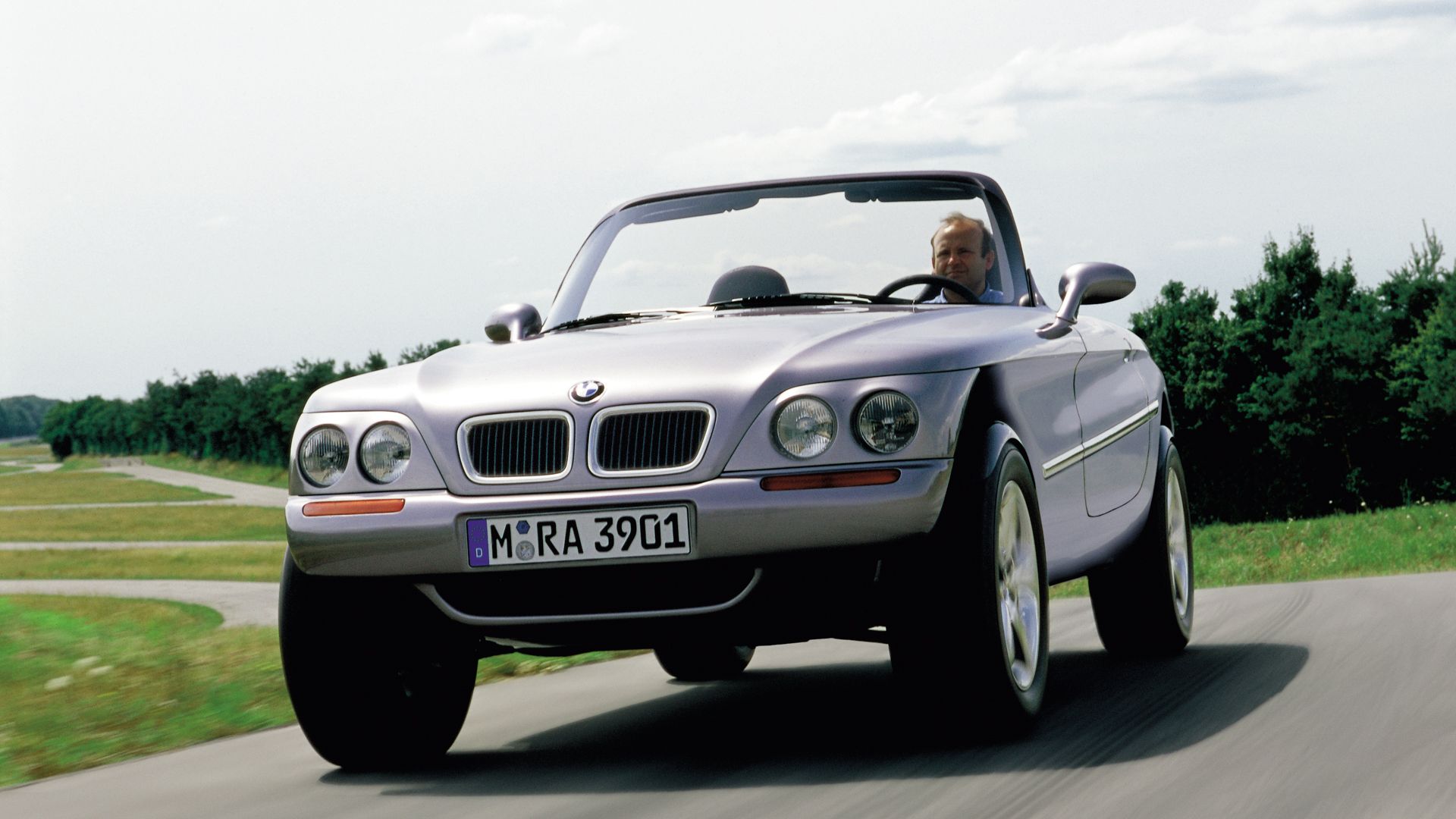
The Z18 is the perfect example of how concepts can be so awesome. Just look at it. In what other scenario would BMW ever create a lifted, off-road roadster with a V8 under the hood? Yes, there is a 350 horsepower, 4.4-liter V8 under the hood that would eventually find its way under the hood of the X5 SUV, and it was mated to a 5-speed manual transmission for a little extra fun.
Styling was obviously inspired by the Z3 at the time, although it was exaggerated more with longer front and rear fascias and side skirts, that, from the windshield down, very obviously influenced the brand’s SUVs to follow. Unfortunately, the concept utilized a plastic body over a steel frame, making it particularly heavy, but the good news was that the interior was waterproof since it was built without any sort of roof, making even the most adventurous excursions a breeze. BWM should be glad this never went into production, because SUV convertibles just don’t work.
5 BMW Just 4/2 Z21 (1997)
Did you know BMW created the Ariel Atom years before the sports car came out? Back in 1995, BMW unveiled the Z21 concept, or the Just 4/2, as they called it, at the Tokyo Auto Show. Whereas the previous concept was focused on off-road performance, this back-to-basics roadster embodied BMW’s focus on sheer driving pleasure. This minimalist two-seater stripped away everything unnecessary – the doors, roof, and even windshield to create as honest a driving experience as possible, and we’re massive fans.
This meant drivers and passengers needed to wear goggles and helmets while in the vehicle, a throwback to the early days of the automobile. This time, the motorcycle engine being used was tuned to produce about 100 horsepower, a healthy amount given the vehicle weighed around 1,200 lbs. The concept seems very well-thought-out and surprisingly close to production-ready, which is why it’s such a shame it was never produced, because we feel the company could have captured a part of the market no other major automaker dabbled in at the time.
These days, track day specials like the Atom are big business, and if we were BMW, we’d give it the greenlight immediately.

Related
How A Tiny Automaker Built A Bonkers V8 Using Two Motorcycle Engines
V8 power packed into a bare bones, driver-focused rocket ship is every bit as fun as it sounds.
6 BMW Z22 Concept (1999)
The Z22 wasn’t BMW Technik’s most attractive model, but what it lacked in looks it made up for in innovation, with BMW saying the model was packed with dozens of technical innovations. It was created for the 15th anniversary of Technik, and thus the company wanted to see how much it could throw at one concept without it becoming overwhelming. Little did they know that many of these futuristic innovations would be found in vehicles of all kinds by 2024.

Related
BMW’s Prettiest Concept Is Heading To Production, But At What Cost?
A very small production run of just 50 examples is planned.
The exterior was made from carbon-fiber-reinforced plastic to increase rigidity while keeping the weight down, and this was important thanks to all the electronics. It featured advancements like steer-by-wire, brake-by-wire, head-up-display, and rearview mirror cameras that sent their feeds to a centrally mounted display, a digital dashboard, and so much more. Even the minimalism used can easily be seen in many of the EVs on sale today.
7 BMW Z29 Concept (2001)
The last model is the most conventional sports car BMW Technik ever made, but it only debuted a few years after the division changed focus. The car debuted in 2006, and it brought with it unconventional styling that doesn’t match any BMW we know of. The doors are semi-similar to those found on the i8. The long hood and flat rear end do have a lot in common with the first-gen Z4, but the rest of its minimalism and scissor doors are uniquely its own. While it wasn’t exactly a looker, it did perform like one, thanks to its lightweight carbon-fiber-reinforced plastic body and aluminum suspension and drivetrain components.

Related
We Drove Every Generation Of M-Badged BMW Z Car To Find Out Which Is Best
Our favorite BMW Z might not be the one you’d expect.
It only weighed about 2,500 lbs, and under the hood was the 3.2-liter inline six out of the E46 M3, sending 338 horsepower through a six-speed sequential transmission to the rear wheel. Power and weight like this meant the vehicle weighed less than the legendary BMW M3 CSL and allowed it to hit 60 mph in less than 4.5 seconds from a standstill. Was it better than the Z4 M Coupe that followed? Probably not, but it’s interesting to see how things could have been different.
Sources:
BMW