
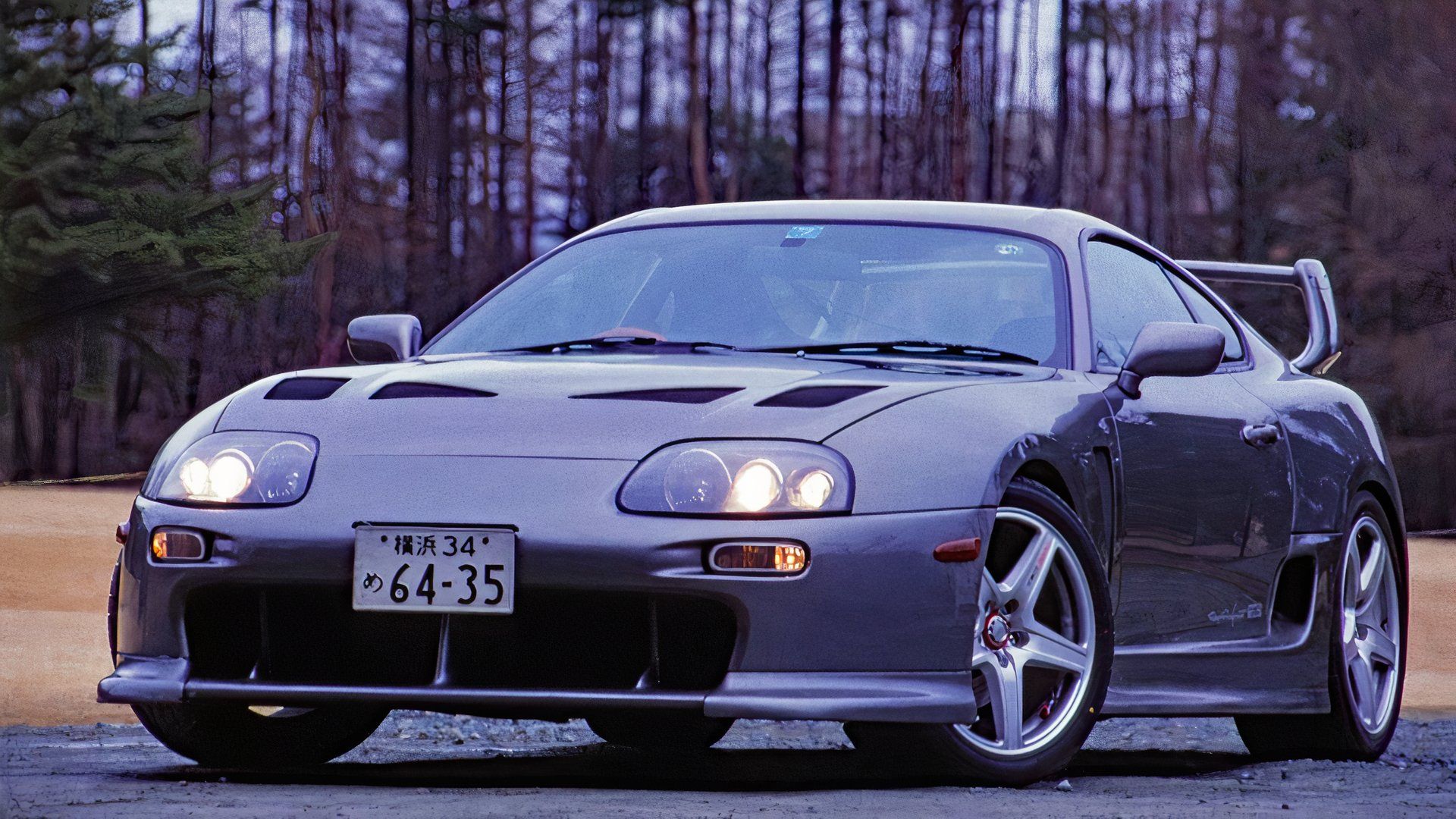
Toyota’s Supra is synonymous with performance in the automaker’s ranks. Of the five generations spawned since the nameplate’s debut in 1978, one generation stands out from the rest as the most iconic. That is the fourth generation, also called the Mk4 Supra, unveiled to the world at the 1993 Chicago Motor Show. A long, low hood and high-rise rear spoiler characterized the Mk4 Supra’s silhouette, but arguably the most notable aspect of the fourth generation Supra was its engine.
Related
Toyota GR86 Finally Gets Turbo Power From The GR Corolla
Toyota has fitted the GR Corolla’s AWD turbo-three into a GR86. It’s what we’ve all been asking for.
The iconic and venerated 2JZ-GTE inline-six engine was praised for its flexibility, tuning potential, and performance capability, cementing the Mk4 Supra as an automotive icon. However, even though the vanilla Mk4 Supra was a more than commendable performer, a derivative of it stood head and shoulders above anything that came from this generation. That model was the TRD 3000GT.
The information and figures presented in this article have been sourced from the manufacturer and other reputable third-party sources.
Road-Legal GT500 Super GT Lookalike
The arrival of the TRD 3000GT, a hardcore race-car-inspired derivative of the standard Supra, came 18 years after the founding of the iconic Toyota Racing Development division. Not only was it the most capable derivative of the Mk4 Supra, but it was also a model that bucked TRD’s modus operandi of taking standard passenger cars and imbuing them with some race-car flair; instead, in the TRD 3000GT, all of TRD’s motorsport athleticism was imposed onto the standard Supra.
Before the Toyota 1994 GT500 race car debut, the Japanese firm unveiled the striking TRD 3000GT at the Tokyo Auto Salon tuning show. The most notable change was that it featured the same wide and shapely body honed and chiseled in countless hours in a wind tunnel used for the GT500 race car. The many components exclusive to the TRD 3000GT were offered to order as dealer-fit accessories. However, the exclusivity of the TRD conversion parts was not comparable to that of the full factory-built models. Only 35 examples of the ultimate Mk4 Supra were created, each featuring a new VIN plate that changed its classification from “Toyota Supra” to “TRD 3000GT”.
So, what did TRD add to the 3000GT?
It’s important to note that TRD’s focus with the TRD 3000GT wasn’t to extract the most power from the 2JZ engine but rather to improve the Supra’s performance by improving its dynamic ability through mostly swapping out comparatively heavy body components for much lighter and aerodynamically superior ones. TRD offered various performance packages that would coax its output to as high as 600 hp. While chasing high power outputs wasn’t the crux of TRD’s efforts, the TRD 3000GT’s engine was improved by adding an improved induction system.

The wide-body 3000GT featured a distinct front bumper that included a larger, sharper front splitter, large bumper intakes (that force-fed twice the amount of air to the engine), and three new air ducts that channeled air to the radiator and the turbo intercooler. One of the most characteristic TRD 3000GT elements was the hood, which featured four geometric vents intended to relieve air pressure and improve cooling in the engine bay. An interesting fact about this hood is that special panels covered the vents to prevent the engine components from suffering water damage, but they could be removed for track days.

Related
Toyota Hints At Possible Celica And MR2 Revival In A Weird Way
Do you like Toyota sports cars and anime? This is for you.
By implementing wider wing panels, that striking body kit increased the Supra’s width by 60 mm at the front and 50 mm at the rear. The widened stance accommodated wider tires, which improved the 3000GT’s lateral grip compared to the standard Mk4 Supra. The wider wing panels were connected by squared-off side skirts that not only added to the 3000GT’s visual appeal but were functional, too, preventing airflow from the upper portion of the body from interfering with the ground-level airflow.

Related
10 Of The Greatest Toyota TRD Cars
It’s hard to believe that these cars come from the same company that makes the humble Corolla.
The supped-up Supra’s rear terminated in a high-rise wing offered in Type-S and Type-R configurations. These wings improved downforce compared to the standard Supra. The Type-R featured a triple-leg design, while the Type-S was similar to the wing of the standard Supra model but could be set to six different angles. Capping off the TRD 3000GT was the diffuser integrated into the rear bumper, which aided the other aero add-ons in producing downforce.
The TRD 3000GT’s Racing Counterpart
The TRD 3000GT was the street-legal equivalent to Toyota’s race car employed in the All Japan Grand Touring Car Championship, a championship contested by upper GT-class race cars. Toyota debuted the iconic JGTC race car in 1995, known as the Castrol TOM’S Supra, because of its now easily recognizable livery, marking the first entry into the racing series. For the uninitiated, the TOM’S moniker was an abbreviation for Tachi Oiwa Motor Sports, an automotive aftermarket parts manufacturer and tuner. TOM’S was a factory-backed racing team responsible for tuning the race car.
|
Engine |
2.0L turbo I4 |
|---|---|
|
Horsepower |
493 hp |
|
Torque |
443 lb-ft |
|
Transmission |
6-speed manual |
|
Drivetrain |
Rear-wheel drive |
|
Racing Series |
Super GT |
The 1995 season was the second full season of the new JGTC series, with Nissan and its Skyline GT-R Super GT race cars dominating the first season. Aside from the iconic livery, the Castrol TOM’S Supra’s engine was another important characteristic of the early ’90s race car. Early JGTC regulations allowed manufacturers to utilize any existing engine in their fleet. While the 2JZ-GTE was a good engine to squeeze power from, Toyota instead employed the 3S-GTE four-cylinder engine that had been used in its rally car lineup.

Related
How Toyota Can Save The Supra If The BMW Z4 Is Killed Off
The BMW Z4 is being laid to rest. While it might not affect the Toyota GR Supra, if it does, this is what Toyota could do to save the GR Supra.
Although smaller and featuring fewer cylinders, the 3S-GTE engine produced significantly more power and torque, enough to put the Supra GT500 race car on a level playing field with the dominant Nissan Skyline GT-R race cars. Ultimately, the Castrol TOM’S Supra would be one of the most celebrated and beloved models in the firm’s entire history and would garner some success in the top-class racing series throughout the years, with later versions forgoing the four-cylinder engine in favor of the 4.3L 3UZ-FE V8 engine.

Add CarBuzz to your Google News feed.
The Modern Descendant
In 2019, at the SEMA Show, Toyota unveiled a concept lauded as the modern-day revival of the TRD 3000GT, based on the new (at the time) GR Supra. The GR Supra 3000GT was heavily inspired by the model that came before in the early 90s. While the original 3000GT variant of the Supra nameplate saw 35 examples produced, only ten units would be built for the newer rendition.
The GR Supra 3000GT featured many design elements that nodded to the early model, like the hood with geometric vents and the high-rise rear wing. While it didn’t borrow the body from the GT500 Supra, the GR Supra 3000GT is much wider than the vanilla GR Supra, thanks to specially crafted over-fenders. Like its predecessor, the new 3000GT has been subjected to a weight-loss regime, losing its rear seats and gaining lightweight bucket front seats. It also has a rear-body brace bar. Other additions to the new 3000GT model include 19-inch aluminum alloy wheels, Tein coilover suspension, and a custom HKS exhaust system. A final nod to the original is the brushed silver vinyl that adorns the GR Supra 3000GT, which is similar to the original color of the TRD 3000GT.
Sources:
Toyota
,
Toyota UK Magazine
,
TopSpeed
,
Supercars.net
.