These days, nearly every automaker is trying to offer a performance SUV. This niche segment started with luxury vehicles like the BMW X5 and Mercedes-Benz ML, and ever since, it’s spread like wildfire, moving down market and spreading across American and European brands alike. However, Japanese automakers have been mysteriously absent, much more interested in pursuing performance sedans and coupes over fire-breathing family haulers.
- Base Trim Engine
-
3.5L V6
- Base Trim Transmission
-
CVT
- Base Trim Drivetrain
-
Front-Wheel Drive
- Base Trim Horsepower
-
245 HP @5800 RPM
- Base Trim Torque
-
246 lb.-ft. @ 4400 RPM
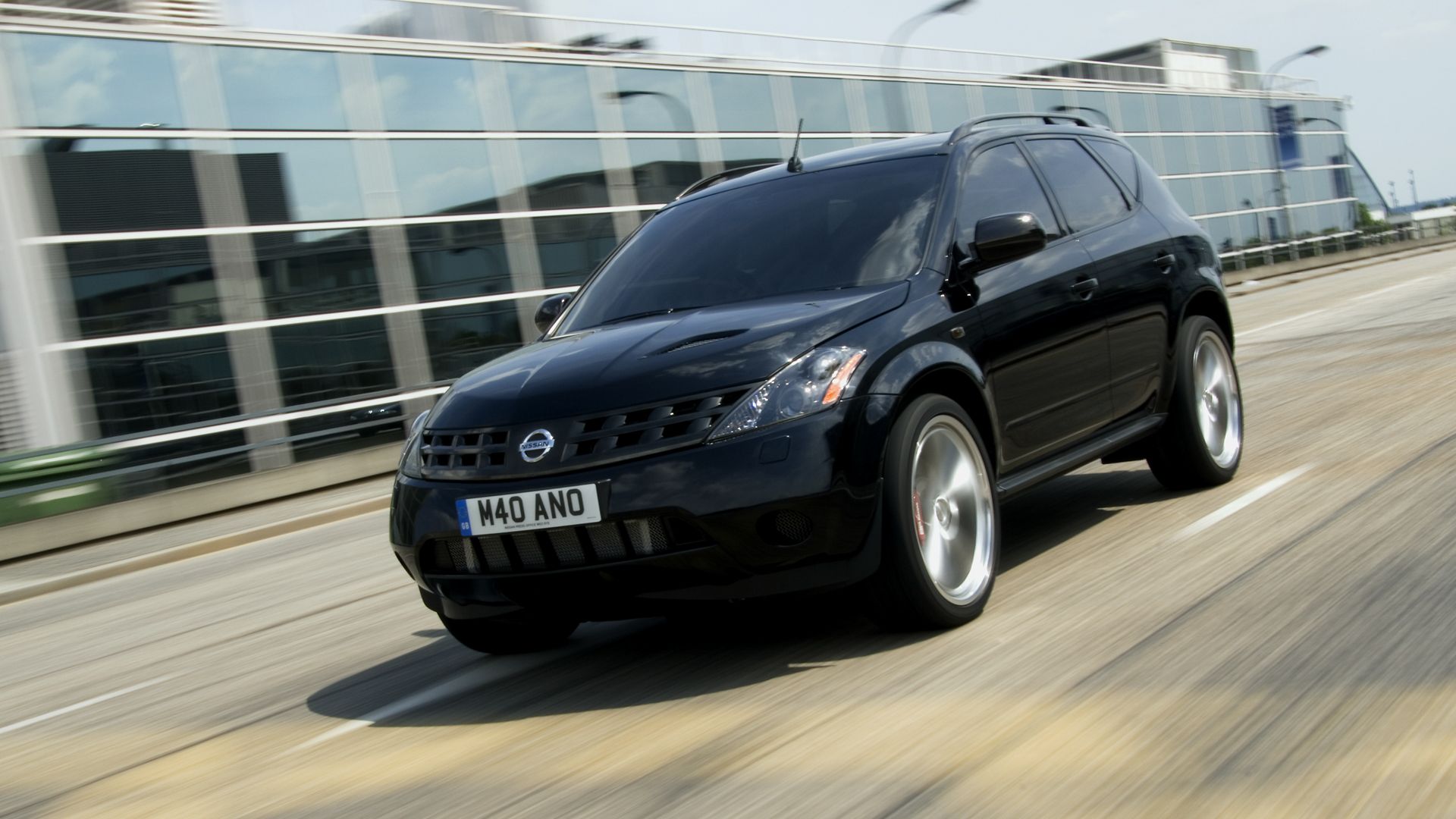
There have been a few notable exceptions, and one you may not have heard of was the hopped-up Nissan Murano with a twin-turbo V6 under the hood. In the early days of the crossover, Nissan was flush with cash, and it was ready to experiment. The idea of a high-performance Nissan Murano was floated, and a single model was created. However, despite showing much promise and receiving positive reviews, it never made it to production. This is the story of the Murano GT-C Concept.
We look at the Nissan Murano and why the company decided to make a high-performance version, how the company elevated the Murano’s potential, and how it influenced future projects.
The Murano Was A Decent Crossover, But Nissan Wanted More
When Nissan released the Murano for the 2003 model year, it wasn’t just another new crossover ready to congest roadways, but a statement in a radical package. Yes, it still looks like a big blob, as many crossovers do, but there was something new to this design, thanks in part to wheels pushed to all four corners, short overhangs at both ends, and an origami-like shape with some pretty cool-looking lights. Today, it doesn’t turn heads, but when it was new, there wasn’t another crossover like it on the road (other than its corporate cousin).
Related
Everyone Forgot About The Coolest SUV Infiniti Ever Made
A V8 Luxury SUV with timeless looks? Sign us up.
One of the biggest focuses of the crossover was its handling, agility, and power. It sat on the FF-L platform, along with vehicles like the Altima, which gave it great balance, a long wheelbase, and the aforementioned wheels in the corners. Power came from the soon-to-be-ubiquitous VQ V6, to the tune of 245 horsepower, and that power could be sent to either the front wheels or all four. Thanks to a multi-link rear suspension and great balance, it drove well, and it was able to put the power down with ease, thanks to the inclusion of a CVT transmission on a US SUV for the first time.
Look, we know “CVT” and “Nissan” don’t stir up fond feelings at this point, but, at the time, the technology showed a lot of promise. The transmission aided acceleration and fuel economy, with the company claiming it was better than comparable four- and five-speed autos of the time, and contemporary tests showed it could put down acceleration numbers in line with contemporary V8s. Along with a simple, but roomy interior with seating for five, it was shaping up to be a formidable competitor, one that would go on to steal some sales away from others.

Related
Best Nissan Murano Model Years For Reliability
These are the most and least reliable Murano model years.
It was a great offering, an extension of a company that was finding its footing after almost losing it a few years prior, and now that the money was coming in, Nissan was finally in a place to explore pet projects again. One of those projects came from the mind of Nissan UK, which wanted to explore what a true performance Murano would look like. The division believed the market was there, and as Jerry Hardcastle, then director of Customer Oriented Engineering at Nissan Europe, put it, “There’s no longer a need to compromise when you want both a sports car and a 4×4.”
Twin Turbos And A Custom AWD Drivetrain
The company dubbed the project the Murano GT-C, or Grand Tourer-Concept, for long. It was created under the supervision of Nissan’s European Technical Center, and everything about the crossover was updated and improved to deliver the best parts of performance and luxury into a single Nissan crossover package.

Related
The V6 That Won Engine Of The Year More Times Than Any Other
Nissan’s V6 engine is reliable, powerful, and durable enough to feature in a wide array of different vehicles from trucks to sports cars.
At the heart of the model lay the same 3.5-liter V6 we’re familiar with, but it was tuned to the gills thanks to the addition of a single Garrett T3 turbocharger and T4 compressor. With the addition of air-to-water charge cooling and Darchem heat shielding, among some other minor changes, the engine now produced 335 horsepower and 365 lb-ft of torque, which the company said would drop the 0-60 mph time to 7.0 seconds and increase the top speed to 140 mph.
|
Specification |
Murano GT-C (Concept) |
Murano SE (Production) |
|---|---|---|
|
Engine |
3.5L V6 Turbocharged |
3.5L V6 Naturally Aspirated |
|
Horsepower |
335 hp @ 6000 rpm |
245 hp |
|
Torque |
265 lb-ft @ 3600 rpm |
246 lb-ft |
|
0-60 mph |
7.0 seconds |
~8.0 seconds |
|
Top Speed |
140 mph |
112 mph |
|
Suspension |
Lowered, Bilstein dampers |
Standard tuning |
|
Brakes |
AP Racing (6/4 piston) |
Factory discs |
|
Transmission |
Xtronic CVT |
Xtronic CVT |
|
Drive Layout |
AWD (ALL-MODE) |
AWD (optional) |
The company didn’t just stop there. Bilstein mono-tube dampers, 35% stiffer springs, and an all-over revised suspension improved handling and dropped the car by about an inch, helping the vehicle stay flatter in the curves. Six-piston AP Racing calipers clamped against massive 14-inch rotors in the front, while four-piston calipers clamped to 13-inch rotors in the rear.
An ALL-MODE AWD system was fitted, and the large 22-inch wheels now wore sticky Dunlop SP Sport Maxx ZR 265/35 tires. If the company could have stopped here, it would have been a practically perfect super Murano, but the inclusion of the same Xtronic CVT found in the lower trims let the rest of the package down. This was the absolute limit of what that transmission would handle, and it showed, with reviewers noting the transmission struggled to keep up with the increased power of the new engine.
It Looked The Part, Too
This was much more than just a performance exercise, however, as the vehicle sported a massive number of aesthetic and luxury upgrades, which underscored Nissan’s goal of determining its real-world viability.
First, the car features revised front and rear fascias, with the addition of black/bronze Dupont lacquer accents and blacked-out trim. It was painted in Kuro Black and sat on some tasteful five-spoke alloy wheels. Of course, the quad-chamfered tailpipes and rear spoiler were the cherries on top, though they probably led one to believe the vehicle had a little more power than it really did. The inside was much more luxurious than your average Nissan. The electrically-adjustable and well-bolstered seats were draped in hand-stitched Strathspey leather, with the headliner and pillars sporting a tan Glove material. The black/bronze lacquer accents continued on places like the door sills and center console.

Related
Why The 2025 Nissan Murano Is The Most Important Model In Nissan’s Lineup
Facing a wave of challenges, the giant automaker needs the Murano to once again bail it out of trouble.
Despite being a concept, the group even put together a matching leather laptop bag in the same Strathspey leather as the seats, and the gear lever was now made out of hand-blown blue and clear glass. A rear view camera, automatic climate control, seven-speaker Bose sound system, and bi-xenon headlights rounded out the details.
Everywhere you looked, the interior felt more Infiniti than Nissan, and this concept even put some of those models to shame. Debuting at the 2006 Goodwood Festival of Speed, Nissan received enough interest to warrant a full-blown feasibility study. According to Car Magazine, the hope was that the division would sell about 100 a year for £45,000, which equates to approximately $60,000 today. This is a princely sum for something with less than 400 horsepower and a Nissan badge, and that price would ultimately prove to be its downfall.
It Was Never Produced, But Another Nissan Performance Crossover Was
Well, the price was likely only a part of it, as the company also likely realized the CVT wasn’t up to snuff for the task at hand, and grabbing an entirely new transmission would have incurred significant cost. Ultimately, the model simply faded into the background like most concept cars do, leaving the Murano to a life as a family-hauling chariot and not much else. However, the idea of a sporty Nissan crossover didn’t die with it, it was just biding its time, waiting for a vehicle like the more radically-styled Juke to finally rear its head. This new model was more of a lifted hatchback than anything else, but its taut proportions made it the perfect candidate for increased performance.

Related
The Nissan That Was Hated At First, But Is Now Loved For Its Weirdness
Nissan’s original Juke was controversial and even clownish. But it grew on people to such an extent, it’s now a firm favorite. How did that happen?
That much smaller crossover arrived in 2010, and soon after, the Juke Nismo arrived with it. In 2013, this hopped-up crossover arrived with some more aggressive Nismo accents and an improvement to 197 horsepower. It drove well, even though it looked a bit juvenile, but it was fun and accessible, something the Murano GT-C was never going to be. This formula was further improved on the Juke Nismo RS, which boosted power even more to 215 horsepower, and both could be paired with a manual transmission or AWD, but unfortunately, not both.
Even better, Nissan finally realized its dream of putting a twin-turbo V6 into one of its crossovers with the creation of one of the most bonkers vehicles of all time: the Juke R. Another UK dream build, the mad scientists across the pond envisioned a Nissan Juke with the powertrain out of a GT-R, and realized that dream in 2013 after much hard work and fabrication.
The project was done in secret, but when news broke to the higher-ups, it was allowed to continue, and soon the angriest 485-horsepower Nissan bug was drifting around race tracks and garnering praise from around the world. This vehicle was a pipe dream, start to finish, and it was only one-upped by the 600 horsepower Juke R 2.0 that arrived a couple of years later.

Related
Nissan (And Its Employees) Could Be In Serious Trouble
Big losses in 2024 mean the company will lay off 15 percent of its global workforce in the next few years.
However, despite the Juke R’s insanity, this vehicle received a production run when the GT-C didn’t. Except, instead of 100 a year, fewer than 20 were made, and the price had ballooned to $300,000 for the privilege. With this in mind, a $60,000 performance Murano doesn’t seem so bad, and perhaps in another life we’d be seeing 700-horsepower Nissans dominating takeovers instead of Grand Cherokees, but as it stands, the Murano has been fully domesticated, and we don’t think Nissan is planning any pet projects anytime soon.
Sources: Nissan