1983 was, by all accounts, a very good year for pop-culture icons. Eurythmics made it to the top of the charts with Sweet Dreams (Are Made Of This), while on the big screen, Star Wars: Return Of The Jedi broke box-office records. One American icon, however, was conspicuously absent: for the first time since 1953, when the model had gone into production, there was no Chevrolet Corvette.
Chevrolet
Founded in 1903, Chevrolet is one of America’s oldest remaining legacy automakers. Acquired by General Motors in 1918, Chevrolet is the core GM brand responsible for the bulk of GM’s US sales. As a mass-market manufacturer, Chevrolet competes in multiple key segments, primarily the SUV and truck segments, but also sports cars and mainstream sedans and hatchbacks (until recently). Core models for the brand include the Silverado, Colorado, Suburban, Camaro, and Corvette.
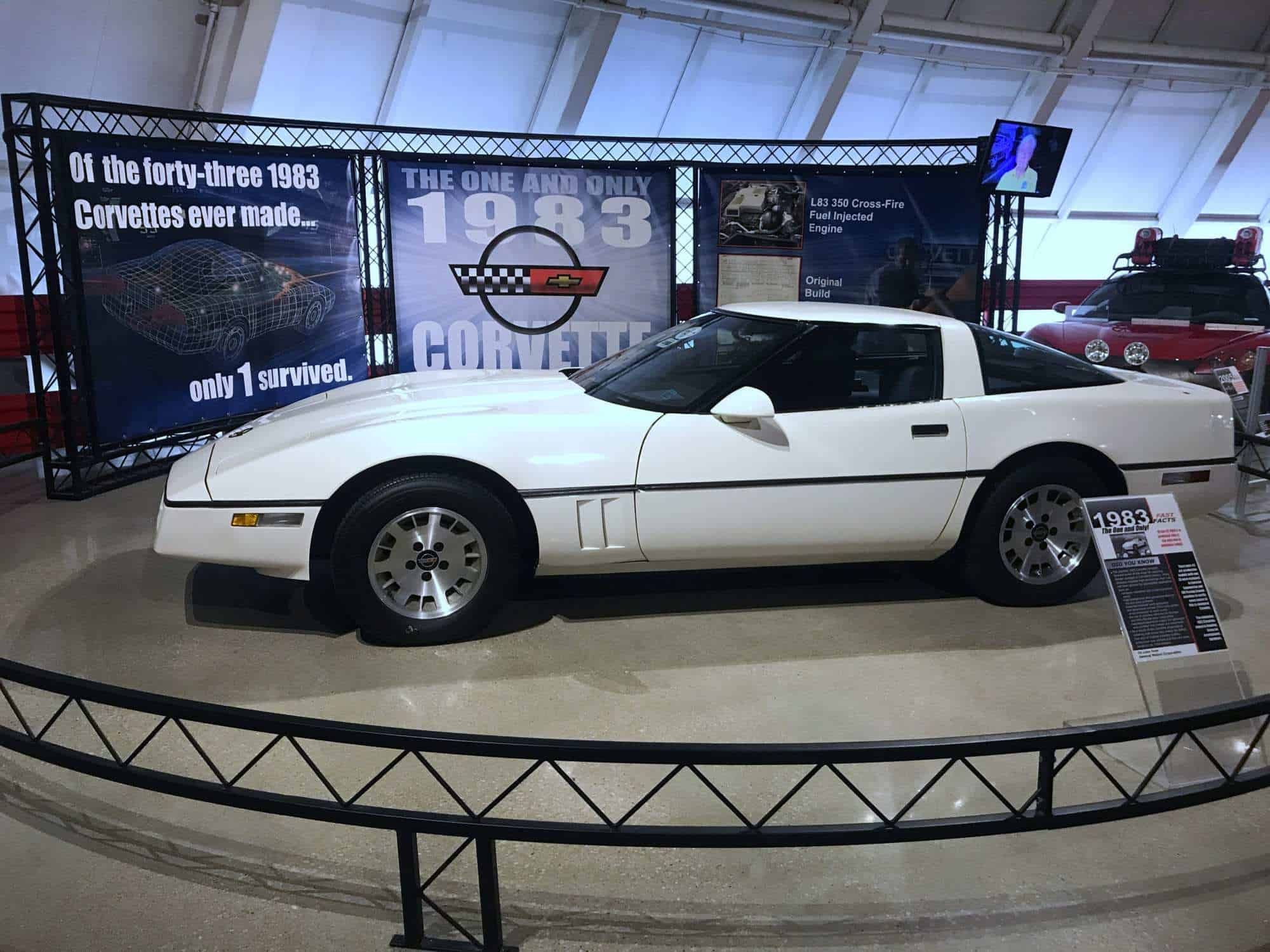
Well, technically, there was one – a single car of the handful produced for the 1983 model year survives to this day, and remains a unique oddity in automotive history. So why did Chevrolet decide to take a gap year instead of celebrating the Corvette’s 30th anniversary in style? And what led to a single 1983 car still being in existence? Let’s dive into the history of the ’83 Corvette that never was, and the one car that made it across the decades.
Bumps In The Road: The Development Of The C4 Corvette
The development phase of the Corvette’s fourth generation, the C4, was fraught with struggles. The reasons why are various, depending on whose point of view you listen to. According to Chevrolet, rapidly changing regulations are to blame, but the truth is likely to be a little more complex. There is a kernel of truth to Chevrolet’s claim; the automotive industry was going through a period of fast-paced change that had started in the mid-70s, with a host of new regulations being introduced regarding safety, emissions, and fuel economy. The new Corvette allegedly had to be tweaked repeatedly to keep up with all the new rules, which slowed down the development process – a simple enough explanation.
However, Chevrolet already had a precedent of creating “compliance cars” to stay on the right side of the law: so-called “California Corvettes” with reduced performance existed long before 1983. Regulations are therefore likely to be only one of several factors that contributed to the C4 Corvette not being released on the original schedule. On the design front, the C4 was also radically different from the C3 that preceded it. Dave McLellan had taken over from Zora Arkus-Duntov as chief designer for the Corvette, and the new model represented a clean break from everything that came before it.

Add CarBuzz to your Google News feed.
Late in the car’s development process, Chief Engineer Lloyd Reuss decided to swap the existing roof (a two-piece T-top structure) for a targa roof in the style of Porsche and Ferrari, eliminating the T-bar that joined the rear part of the roof to the windshield. This resulted in reduced chassis rigidity, and a major headache for the engineering team, who had to find a workaround. The resulting mix of factors brought about a delay in the C4’s creation: working on a complex, brand-new design from scratch, and keeping up with new legislation, the Corvette team was taking longer than expected to get the project to the finish line. As the months passed, it became clear that the finished product was not going to be ready in time to be sold as a 1983 model.
The Sixty-One 1983 Corvettes And Their (Near-Total) Demise
During the long development phase for the C4 Corvette, a total of 61 cars were built – the only true 1983 Corvettes ever made. 18 were prototypes, while 43 were “pilot-line” cars to be used for testing. While 33 pilot-line cars were sent off to Chevrolet’s engineering department, the other ten remained at the assembly plant where they were built, in Bowling Green, Kentucky.
Chevrolet chose not to sell the cars, either at auction or to its own workers, after the testing phase had been completed. They were marked for destruction instead. The reason for this is that the small batch of 1983 Corvettes were still riddled with mechanical issues, and GM had a reputation to protect in light of the growing anticipation regarding the upcoming new generation of the Corvette.

Related
Corvette Evolution, Part 10: The C4 Corvette that Wanted to be a Supercar
Since 1990, the ZR-1 was a challenger to the established European supercars.
The man assigned the task of destroying the 61 cars was Ralph Montileone, then working as a quality manager at the Bowling Green plant. The destruction process consisted of removing VIN plates and windshields from the vehicles before using a portable crusher to finish them off. For all cars but one, the process went ahead without a hitch. However, for the last one, things went a little differently, courtesy of the weather and a fortuitous purchase.
Lone Survivor: Number 23’s Stroke Of Luck
While the 1983 Corvettes were being led to their demise and crushed one by one, it began to rain over the Bowling Green plant. The rain eventually turned into a freak rainstorm, which covered the plant in several inches of rainwater. A few days before, Montileone had bought himself a brand-new pair of boots, and reluctant to let the rain destroy his shoes, he left the last Corvette (pilot-line car number 23) on the plant’s parking lot, determined to come back once the storm had subsided.

A fault in communication, however, meant that other employees at the plant were not aware one car was still awaiting destruction: the finance department failed to realize that not all VIN plates had been returned, and the people in charge of the portable crusher took it away by the next morning, so when Montileone returned he was unable to complete the task. He parked the last 1983 Corvette in a quiet corner of the site, eventually getting an earful from higher-ups but managing to hold onto his job. As for 1983 Corvette number 23, it remained in place at the back of the plant for several years.
What Happened Next: Number 23’s Life As A Museum Piece
Long after Montileone had moved to Cadillac, and a new plant manager had started work at Bowling Green, the 1983 Corvette was rediscovered, after several years of being somewhat of an open secret among employees. Having realized its historical importance as the only survivor of the ill-fated 1983 model year, the new manager decided to give it some TLC and restore it to a place of pride. Painted in a new color scheme inspired by the American flag, and given a proper display stand at the Bowling Green plant instead of being left in a parking lot, Number 23 was now an object of importance, and after a few years it earned itself a spot in the National Corvette Museum. Before being shipped to the museum, it was restored to the original white finish.

However, its adventures did not end during its life at the museum. In 2014, a huge sinkhole opened up inside the museum’s Skydome building, consuming eight of the cars housed inside it. Though the 1983 Corvette also lived in the Skydome, it managed to survive the sinkhole, showing its determination to survive, and was promptly retrieved soon afterward. Today, the 1983 Corvette makes occasional appearances at automotive events, including the “70 Years Of Corvette” exhibition in Michigan in 2023: a fitting conclusion for a car with an adventurous history.
Other Rare Corvettes From The C4 Generation
The 1983 car is not the only rarity to be found in the Corvette’s fourth generation. A handful of other cars, not quite as rare but still extremely hard to come by, also belong to the C4 group: here are two of them.
The Copper Metallic Corvette
Many Corvette owners will tell you their particular car is exceptionally rare due to its color scheme, to the point where it has become a running joke in the automotive community. However, if you happen to run into someone who owns a C4 ‘Vette finished in Copper Metallic, they are definitely telling the truth.

This shiny finish was discontinued by GM due to quality-control issues: assembly plant employees reportedly struggled to make this unique paint adhere to the car’s body, resulting in an uneven finish. As a result, Copper Metallic was pulled from the options list after the 1986 model year (during which only four customers chose it), making any car sporting this finish a rare example indeed.
The 35th Anniversary Edition
Another rare C4 is the 35th Anniversary Edition, created exclusively for the 1988 model year. Perhaps to make up for the development fiasco that had marked the Corvette’s 30th anniversary year, Chevrolet decided to go all-out for the 35th, building a dedicated special edition finished in “Anniversary White” paint paired with an all-white leather interior.

Only 2,050 examples were built; while most were fitted with a four-speed automatic transmission, 180 were equipped with a manual transmission instead, making them even rarer.
Sources:
CorvetteBlogger
,
National Corvette Museum
,
Corvette Action Center
,
CorvSport.com
,
HobbyCarCorvettes
.