Most of us are familiar with the sheer amount of rich automotive history that Italy has contributed to throughout the decades. After all, the Mediterranean country effectively invented the supercar with the introduction of the Lamborghini Miura in 1966. Italy was also involved in creating a massive number of bespoke sports cars throughout the 1950s, ’60s, ’70s, and beyond. Many of these sports cars live within the confines of history as legends.
Ford
- Founded
-
June 16, 1903
- Founder
-
Henry Ford
- Headquarters
-
Dearborn, Michigan, USA
- Owned By
-
Publicly Traded
- Current CEO
-
Jim Farley
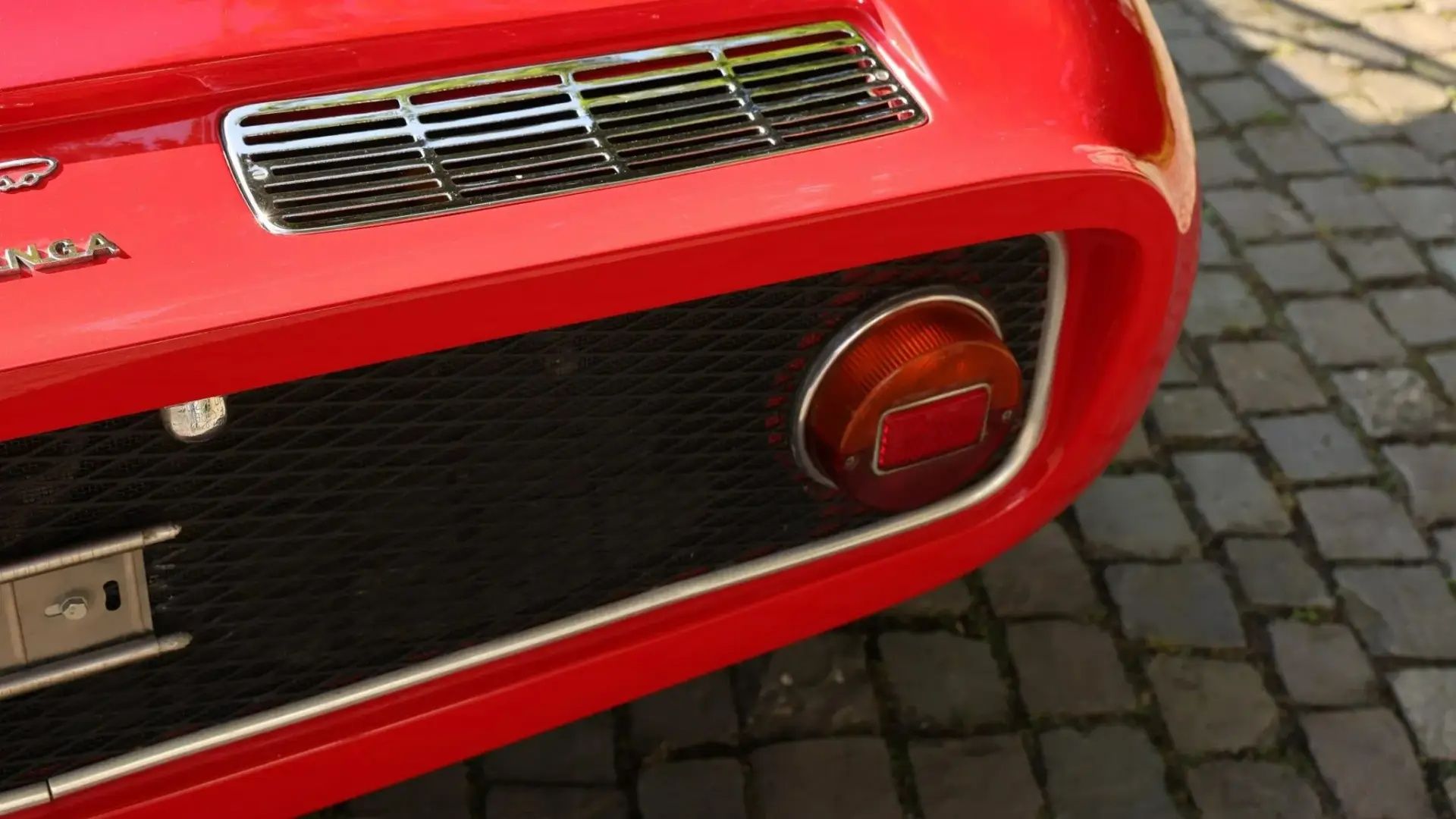
However, some of the sports cars created by the Italians didn’t exactly get the level of fame they deserved. The model we’re focusing on today actually ended up breaking the record for the lightest Italian sports car ever produced, and still holds it today. Yet, nobody remembers it. The model in question is called the De Tomaso Vallelunga, and on top of being the lightest Italian sports car, it even employed the use of a Ford-derived engine.

Related
The Lesser-Known De Tomaso That Was Powered By Ford’s Cleveland V8
The De Tomaso Longchamp was the result of an Italo-American collaboration from the 70s and 80s. Why did Ford’s V8 engine make it so special?
We’ve dedicated this write-up to the De Tomaso Vallelunga due to it being the lightest-ever series-production sports car made in Italy. It also derives its power from a Ford engine.
Light On Its Feet With A Splash Of American Grunt
De Tomaso Vallelunga Key Points
- Introduced in 1964
- Weighs just 700 kilograms, or 1,543 pounds
- Employs the use of a Ford-derived four-pot
- Axed following the 1967 model year
It’s hard to argue with the fact that Italy was responsible for some of the prettiest cars to be built during the 1950s and 1960s. There’s something about their understanding and execution of mid-century automotive design that’s able to captivate both the heart and soul with nothing more than a short glance. Sadly, these days, design such as the sort exemplified by Italy back during the ’50s and ’60s is now nonexistent, and, most likely, will never come back.
Our model in question, the De Tomaso Vallelunga, showcases some of this classic Italian styling in a very small, 700-kilo package. At the time of its debut, De Tomaso as a company had only been around for five years, as it was founded in 1959. The Vallelunga marked De Tomaso’s first production model. Its name was derived from the famous Autodromo di Vallelunga racing circuit, and it boasted an engine borrowed from Ford.
A man called Carrozzeria Fissore headed up the Vallelunga’s exterior design after De Tomaso’s founder, Alejandro de Tomaso, couldn’t find any buyers for the Vallelunga’s original concept design. The De Tomaso Villalunga was only produced for four short years, and only about 60 examples were produced. It was designed to be as light as possible, and take advantage of as much race-ready engineering as was possible at the time.
Current Pricing
Just a forewarning: considering the fact that the De Tomaso Vallelunga was an extremely limited-production model built in Italy during the height of the Italian sports car age, don’t expect you’ll be able to pick one up for the same price as a new Toyota Camry. The fact of the matter is, when an example does come up for sale, it fetches quite a pretty penny. The proverbial penny is so pretty that you could almost buy a modest, Midwestern house for the same money. We’ll take a look at the De Tomaso Vallelunga’s detailed pricing in the table below:
|
1964 |
1965 |
1966 |
1967 |
|
|---|---|---|---|---|
|
Current Average Sale Price |
$342,260 |
$260,000 |
$368,281 |
$192,787 |
*Pricing courtesy of Classic.com
Detailed Specs & Features
Don’t let the handsome “De Tomaso” valve cover fool you, this engine is a Ford mill through-and-through. However, it’s not from Ford of America, rather it’s been taken from a Ford Cortina, courtesy of Ford UK. It’s a small, 1.5-liter unit with just four tiny pistons pumping out just over 100 horsepower. But, because the Vallelunga is so light, its small engine provides plenty of power to rocket the little Italian flea about some twisty B-roads.
As for the rest of the Vallelunga’s mechanical make-up, things are rather simple. Its transmission and drive axle both came courtesy of Volkswagen in a transaxle unit specifically tailored for a mid-engined, rear-wheel-drive application. While the decision to source this VW transaxle was driven mainly by cost-cutting, Alejandro de Tomaso was also interested in ensuring the Vallelunga exhibited a fair amount of reliability, and VW was one of the kings of durability back in the day.
Its hand-rolled aluminum body was mounted on top of a tubular steel chassis featuring a backbone design that incorporates a front crossmember for added rigidity. Its suspension was directly derived from racing, and featured a fully-independent setup with a double wishbone configuration at the front axle, and a multi-link suspension at the rear. Its steering gearbox and associated components were courtesy of Renault, and it also featured disc brakes.
We’ll lay out all the De Tomaso Vallelunga’s engine and performance specs in the table down below:
|
Engine Details |
1.5L NA Ford inline-four |
|---|---|
|
Horsepower |
104 hp |
|
Torque |
129 lb-ft |
|
0-60 MPH Time |
6.5 seconds |
|
Top Speed |
112 mph |
|
Curb Weight |
700 kg (1,543 lbs) |
Features
As you can imagine, the De Tomaso Vallelunga’s options list is rather bare, as not even a radio is included. Instead, the Italian sports car’s center stack contains a few switches that control things like the motor’s cooling fan and ignition. A set of gauges tracking coolant and oil temp are seen as well, along with a volt gauge. A pair of seats, a steering wheel, and a wood-trimmed dashboard are about as fancy as it gets inside the Vallelunga.
De Tomaso’s Relationship With Ford
De Tomaso Mangusta
After De Tomaso’s first model, the Vallelunga, was axed following the 1967 model year, the Italian sports carmaker continued on building. The next model, the Mangusta, was introduced in 1966 and took on a more hardcore, rock-and-roll approach. Building upon De Tomaso’s already-established relationship with Ford UK, the company sourced a Ford 289 CID (4.7L) V8 for use within the Mangusta. Eventually, the Mangusta was then offered with a Ford 302 CID (5.0L) V8.
De Tomaso Pantera
After the limited-production Mangusta came and went, arguably the most popular De Tomaso followed: the Pantera. The Pantera (“panther” in the Italian language) was a sports car that could be mistaken in styling for a supercar, but it packed a trio of all-American V8s under its mid-mounted hood. Ford’s 5.8-liter 351 CID Cleveland V8 was the first American-made mill to see use within the Pantera, with the mill producing 325 horsepower and 344 lb-ft of torque. In time, Ford’s 351 CID Windsor engine was also used, along with the special-edition De Tomaso Pantera SI utilizing Ford’s 302 CID V8. A Pantera in 2025 can cost an awful lot, much like the Vallelunga, but stands out as an interesting alternative to a Lamborghini or Ferrari from the same era.
De Tomaso Deauville
One of the more obscure De Tomaso models was the Deauville; a luxury sedan produced during the 1970s and early 1980s. It was classified as a full-size luxury car, and took advantage of a single Ford engine; the 5.8-liter Cleveland V8. Throughout its 14-year tenure spanning from 1971 to 1985, only a total of 244 were ever produced, with two models being made as station wagons. One of these wagons ended up in the hands of Alejandro de Tomaso’s wife, whom the wagon was specially-designed for. These days, a De Tomaso Deauville is one of the cheapest models from the brand you can find, with an average sale sitting at just $21,000, according to Classic.com
Sources: Classic.com, ZePerfs.com, Bonhams.com, FordAuthority.com