Park-assist doesn’t feel like it should be possible, right? It feels like technology from the future. Sensors and cameras so your car can tell you exactly how far you are from the cars in front of you and behind you, down to a fraction of a centimeter? And that’s not even getting into the automatic parking systems seen in cars like the BMW 7 Series and the Volvo XC90. Full self-driving may be a ways off, but we’ve already got cars that can handle the most boring part of driving for us, and that’s pretty cool.
Toyota
- Founded
-
August 28, 1937
- Founder
-
Kiichiro Toyoda
- Headquarters
-
Aichi, Japan
- Owned By
-
Publicly Traded
- Current CEO
-
Koji Sato
Now, would you believe that the first automatic parking system was actually developed almost a full century ago, and put to use in a 1930s-model Packard? When you see how it works, you’re probably gonna laugh. It looks like something from a cartoon. Here, take a look…
The “Fifth-Wheel” Parking System
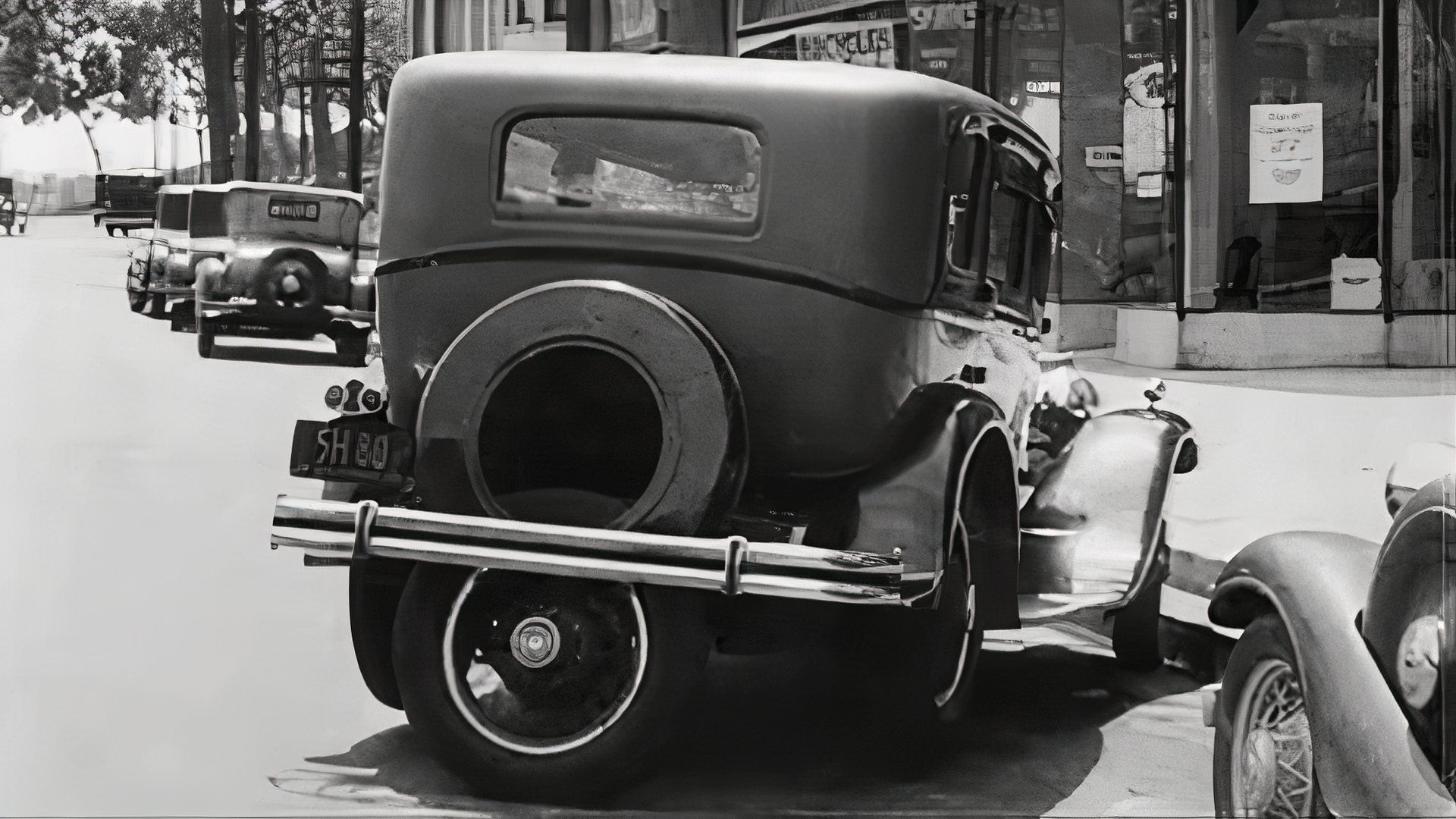
Ever see a car with five wheels? That’s a weird number, right? Well, that’s what you had with Brooks Walker’s patented fifth-wheel parking device. The fifth-wheel was the California inventor’s life’s work. Walker first unveiled the system on a Packard in a newsreel from the 1930s, and he was still trying to get this thing into production well into the 1970s.
The system works by engaging its fifth wheel, located where a spare tire would go, dropping it to the ground and lifting the rear-end, then spinning into motion to slide the car counter-clockwise into a tight parking space, or clockwise to pull out.
There’s an old saying in engineering: if it’s stupid, but it works, then it’s not stupid. You might look kind of silly wheeling in and out of parking spots, but you’d be in and out of the store in the time it took someone else to find a spot big enough to park in without banging someone’s fender.
Here’s Why It Didn’t Catch On…
The newsreel announces that “Somehow it never caught on. Why not? We’ll never know!” Well, we know the reason it never caught on. Actually, we can think of several reasons why it never caught on:
- It was too expensive. Life Magazine ran a feature on Brooks Walker in 1952 and learned that the device would have cost around $175 per unit. Adjusting for inflation, that’s $2,130 in 2025 dollars.
- Even if a consumer was willing to pay $2,130 for the device, Detroit’s automakers didn’t seem interested in pursuing what would have no doubt been a niche product.
- Early versions of the device took up the entire trunk, meaning that you were sacrificing the majority of your storage space for easier parking.
- A later version of the device was mounted on the outside of the car, but, besides road safety concerns that might have rendered such a product illegal on a production level, you have to wonder if you’d have an easier time parking if you didn’t have a giant fifth-wheel parking device mounted to your rear bumper.
- Ultimately, the device’s usefulness would be highly situational, and not worth the extensive modification.
After multiple failed meetings with automakers in Detroit and countless revisions to the device, Walker’s passing in the 1970s would prevent him from ever seeing his invention applied at scale to those big Cadillac land yachts of the malaise era. Worse yet, he never saw the day when the automotive industry would, essentially, take his idea and run with it.
Okay, So Walker Didn’t Invent The Modern Park-Assist System…
Today’s park-assist systems look nothing like Walker’s fifth-wheel device, but the principle is the same. We can pretty much all agree that driving can be fun, but parking usually isn’t. Making the task a little easier may well be the great technological challenge of our day. Alright, maybe Volvo isn’t curing the common cold or colonizing Mars by taking the headache out of parking, but we’d like to nominate them for a Nobel prize all the same.
It Starts With Parking Sensors
If we really want to trace automatic parking systems all the way back, we’ve got to go back to the first onboard computers. And if we’re going that far back, we might as well go back to the first car battery. So let’s start with parking sensors.
The parking sensor is one of those ideas that doesn’t really have a single “inventor.” In some form or other, backyard engineers, automakers, and inventors have been experimenting with parking sensors since our grandparents were buying their first cars. But, the first production car with parking sensors would be the Toyota Corona, which introduced the Back Sonar system in 1982, using ultrasonic “acoustic pulses” to measure the space between cars, and send alerts to the driver to keep them abreast of the situation.
Toyota also holds the honor of having developed the first automatic parking system. IPAS, or the Intelligent Parking Assist System, went into development in 1999 and first made its debut in the Japanese Prius in 2003. The early version of the system used cameras and sensors built into the front and back ends of the car, with the dashboard displaying an image of the parking area. The driver would be prompted to set the location of their vehicle, and IPAS would take over the car’s steering to help maneuver the car into position.
It Was An Industry-Wide Effort To Bring Auto-Parking Up To Speed
IPAS, unfortunately, required a lot of user input. It had trouble detecting obstacles, so you had to be on the lookout for errant shopping carts and the like. It couldn’t even detect parking stripes until 2005, and it was useless in very small spaces, simply flashing an obnoxious warning signal at the user without even trying to scrunch in there.
Toyota would keep working on the IPAS, eventually birthing the more sophisticated Advanced Park used today, which can essentially handle the whole task for you with minimal supervision. Meanwhile, you’ve got Volvo’s Park Assist Pilot, which can handle automatic steering, while leaving the driver to handle the gas and brakes. And then there’s BMW’s Automated Parking, which can steer, accelerate, and even shift gears all on its own.
Toyota gets a lot of credit for innovating modern self-park systems, but the question of who perfected it is a bit more subjective.
Some Ideas Are Just Too Good (Or Ridiculous) To Catch On
The automotive industry is full of ambitious inventors with big ideas, simply wanting for the financial backing or the risk-taking CEO to put the thing into production. Some of these innovators were unfortunate to have come up with the right idea at the wrong time.
Other inventors… well we don’t want to poopoo anyone’s big ideas, but we struggle to see their use. For instance, there was the one-handed driving glove pitched on an episode of Dragon’s Den, which would be worn to remind the driver which side of the road to drive on. Or the “dog sack,” which is exactly what you think it is: a bag that you would hang outside your car so that you didn’t have to let your pet sit on your precious leather upholstery. And then you’ve got the steering wheel food tray that would hold your meal from the drive-thru in place while you drive… As long as you never ever had to turn the steering wheel for any reason whatsoever.
You know what? Come to think of it, that fifth-wheel thing isn’t even in the top fifty silliest car inventions we’ve seen.
Sources: Hagerty, Toyota, BMW, Volvo, Life Magazine.