We’d consider ourselves lucky to simply be in the presence of a priceless race car sitting on the lawn at a luxury event or in the halls of a museum. That’s how most people experienced the 1955 Mercedes-Benz 300 SLR W 196 S, sitting behind a protective perimeter on a stand at Moda Miami.
Our first impression of the car was… a little different. Mercedes-Benz Heritage, a division that maintains and promotes the company’s long back catalog of classic vehicles, invited CarBuzz to the second-annual Moda Miami event with a special treat tossed in: they asked if we wanted to take a ride in one of the most valuable cars in the world. We couldn’t say yes fast enough.
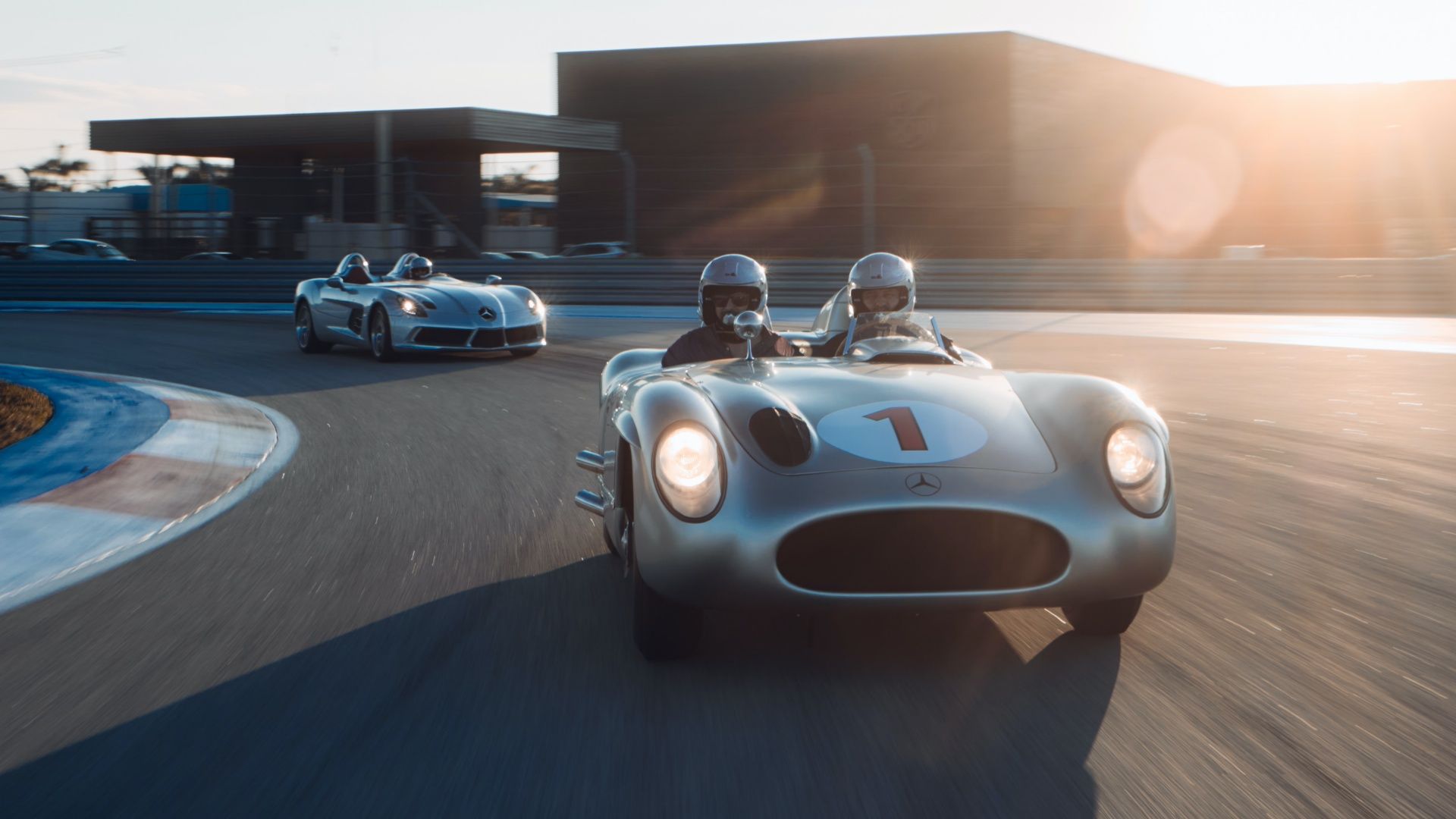
Following a drive down to South Florida in a 2025 Mercedes-AMG GT 63, the team at Mercedes-Benz Heritage ushered us into the Concours Club, a private racetrack country club in Miami, where we received a once-in-a-lifetime ride-along in a straight-eight race car that produced over 300 horsepower. We can only imagine how revolutionary this car felt 70 years ago, but even today, it’s simply awe-inducing.
Mercedes-Benz
While its roots trace back to the creation of the Benz Patent Motorwagen in 1885, Mercedes-Benz was officially founded in June 1926 when Daimler Motoren Gesellschaft and Benz & Cie. (the world’s oldest car company) merged to create Daimler-Benz. This German manufacturer of premium cars is historically known for its motorsport pedigree in early Grand Prix racing, its off-road prowess in the creation of military vehicles like the Genadewagen (now G-Class), and its focus on utmost luxury and technological innovation in models like the S-Class and SL. Today, it is one of the world’s largest automakers.
- Founded
-
June 1926
- Founder
-
Karl Benz, Gottlieb Daimler, Wilhelm Maybach, and Emil Jellinek
- Headquarters
-
Stuttgart, Germany
- Owned By
-
Daimler AG
- Current CEO
-
Ola Källenius
What Makes The 300 SLR So Special?
Most car enthusiasts are familiar with the 300 SL Gullwing, the fastest road-going production car of the 1950s. Despite bearing a similar name, the 300 SLR was based on an entirely different vehicle, the W 196 R Formula One racing car that won two world championships in 1954 and 1955 with Juan Manuel Fangio behind the wheel. Unlike the F1 car, the W 196 S does not feature an open-wheel design, though it does still retain a direct-injected straight-eight engine under the hood, albeit bored out to a 3.0-liter. Other changes were made to the car in order to prepare it for 24-hour racing, including a second seat and headlights.
SLR stands for Sport, Leicht, Rennen (sport, light, racing), and the car was built to race in the 1955 World Sportscar Championship. Sir Stirling Moss drove a 300 SLR to victory at the Mille Miglia, later winning the RAC Tourist Trophy and Targa Florio that same season. This car was absolutely dominant when it raced, and Moss even described the 300 SLR as “the greatest sports racing car ever built” and a “really unbelievable machine.”
Sadly, Mercedes’ success was marred when Pierra Levegh’s 300 SLR was launched into a crowd at La Mans, killing 83 spectators. The German automaker withdrew from the event, then pulled out of motorsport entirely, and did not officially return (it raced through tuning company AMG) until 1997 with the CLK GTR, later rejoining F1 in 2009. The 300 SLR was so controversial, it ended Mercedes-Benz’s direct involvement in racing for decades; no wonder why it commands such a high price today.

Related
Only 3 Rear-Mid-Engine Road-Legal Mercedes-Benz Models Were Ever Made
Mercedes-Benz tends to focus on designing its cars with the engine out front, though a few of its special models broke this traditional rule.
The Most Valuable Car In The World
Mercedes only built nine examples of the 300 SLR, two of which were converted into Gullwing Coupes (referred to as the Uhlenhaut Coupé), making them closely resemble the 300 SL road car. The project was headed by Rudolf Uhlenhaut, the Mercedes chief designer who was responsible for creating the 300 SLR and the 300 SL. One of those cars became his personal vehicle, and was notably able to achieve nearly 180 mph… in 1955. To put that into perspective, the first official production car to surpass a 180 mph top speed was the Lamborghini Countach LP500 S, which didn’t arrive until 1982. It’s rumored that Uhlenhaut drove his car from Munich to Stuttgart on the derestricted autobahn, completing the 137-mile trip in just over an hour.

Related
The Mercedes-Benz Coupe Worth $142 Million
The 300 SLR Uhlenhaut Coupe is one of Mercedes-Benz’s rarest cars, with only two examples in existence. Here’s why it commands such a price tag.
The 300 SLR Uhlenhaut Coupé became the most expensive car ever sold at auction in 2022, when it traded hands to a private collector for $142.7 million, smashing the previous $75 million record set by the Ferrari 250 GTO. Mercedes used the proceeds from this sale to fund a fellowship program called beVisioneers, which provides financial scholarships to underprivileged people to work on projects that support ecological sustainability. It’s unlikely that the car we rode in is worth quite as much, since it’s one of seven, not one of two. With no auction data to look back on, we are left to speculate on how much it could be worth. Let’s just say it’s in the double- or triple-digit millions.
Riding In Royalty
Though Mercedes couldn’t insure us to drive such a valuable piece of history, a passenger ride is still more than most car enthusiasts will ever experience in their lifetime, and the 300 SLR did not disappoint, even from the right seat. From the moment our driver fired up the 3.0-liter straight-eight engine, we could tell that piloting this car is not for the faint of heart. Around 305 horsepower may not seem overwhelming by modern standards, but in a pre-Sputnik world, it must have seemed like science fiction. Remember, not even F1 engines were allowed to produce 300 hp at the time.
It wasn’t just powerful, the M 196 S engine was a technological marvel too. It featured direct fuel injection from Bosch, a dry-sump lubrication system, and dual overhead camshafts. The 300 SLR still relied on drum brakes, rather than the disc brakes used by the Jaguar D-Type, but Mercedes compensated by fitting extra-wide diameter drums mounted inboard.
When it raced at Le Mans, the car even received a “wind brake” that hinged up at the end of the straightaways to slow down without wearing out the drums. Four-wheel independent suspension gave the 300 SLR remarkable handling, further aided by the incredibly light steel tube spaceframe chassis and magnesium-alloy body. This car only weighs 1,986 pounds, a featherweight given its tremendous power.

Related
Before The Mercedes-AMG ONE There Was The SLR McLaren Stirling Moss
This is the last one ever made.
We’ve included a video of our passenger laps around the Concours Club because mere words can not describe the spine-tingling bellow of the straight-eight. These laps weren’t done at race pace, but the 300 SLR easily kept up with our chase car, an 805-hp Mercedes-AMG SL 63 E Performance. Our driver was cued to get closer to the SL for photographs, meaning he could open up that glorious engine with a thumping “dugga-dugga-dugga” note from the side-mounted exhaust.
Even with the wind smashing me through my open-faced helmet, I could still hear the straight-eight at full blast, overpowering even the forces of physics and nature. Later in the day, we had the chance to drive an SLR Stirling Moss, a 641-hp supercharged modern homage to cars like the 300 SLR. This car also lacks a roof or a windshield, but its modern V8 engine was almost completely drowned out by the wind. Never before have we been left speechless by a moderate lap around a racetrack, so just imagine what it would have been like to see Sir Stirling Moss piloting this car at full tilt.