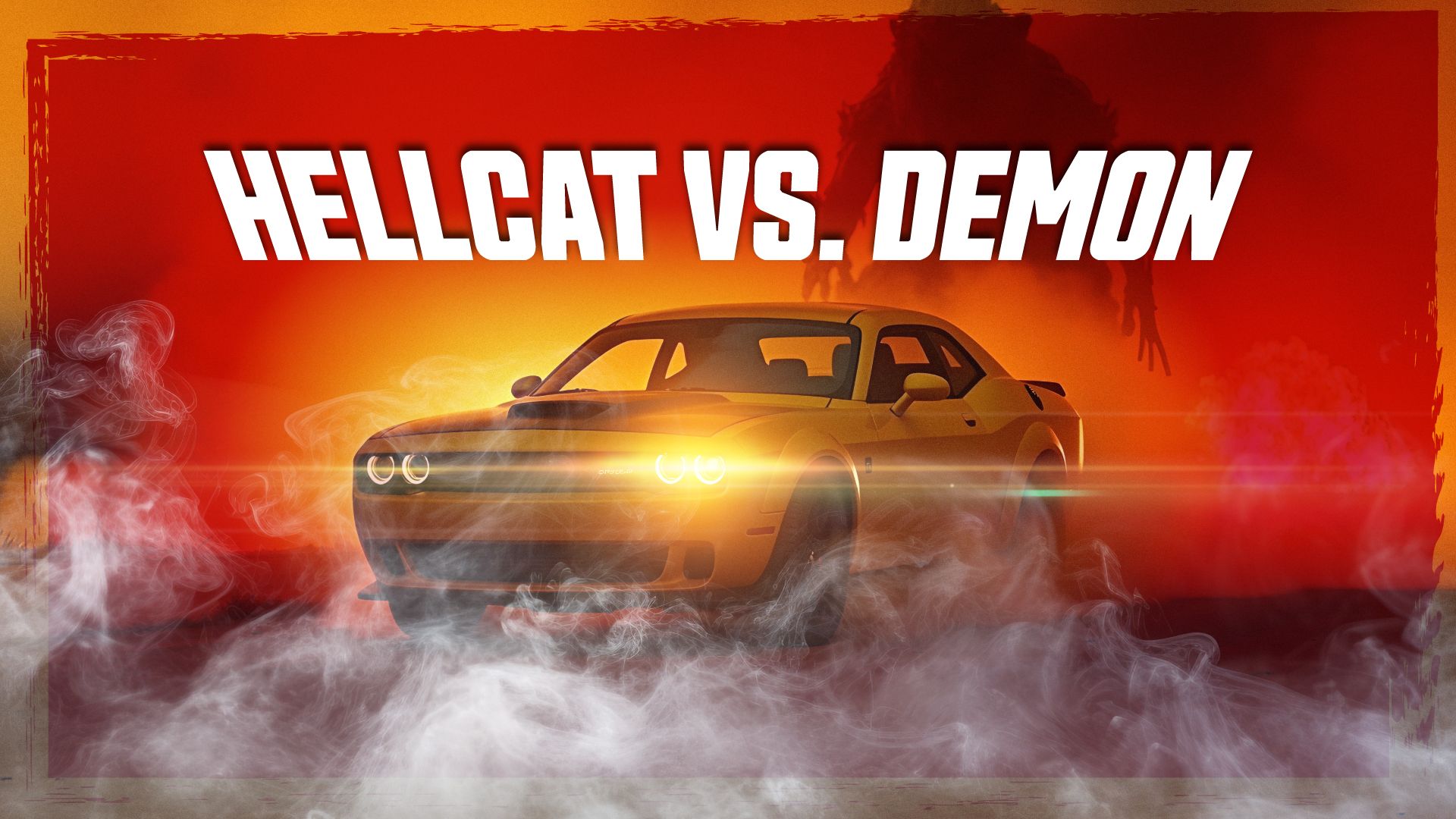
From its modern interpretation in 2008 through to its culling in 2023, the Dodge Challenger stood out as a wild child. It didn’t care about lap times or EV (electric vehicle) mandates; it was Dodge’s way of going the opposite direction to what legislation dictated and required. The pinnacle of this rebellion was the SRT Hellcat vs Demon 170 – two outrageous and unapologetic cars to ever have a number plate stuck to them.
Dodge
- Founded
-
December 14, 1900
- Founder
-
John Francis Dodge & Horace Elgin Dodge
- Headquarters
-
Auburn Hills, Michigan, U.S.A
- Owned By
-
Stellantis North America
- Current CEO
-
Carlos Tavares
Sadly, that era has ended, and the Challenger is dead. What we have left are examples in the used-car market that double as collector’s items and as representations of memories of a brand that embraced chaos as its final act. And if you thought there would be a Hellcat vs Demon nameplate battle because one looks better, maybe we can settle that, too, in the process. Why? Because each badge represents something unique, yet both carry massive cred.
This article dives into the impact Dodge’s Challenger SRT Hellcat and Demon 170 had on the market, and what the differences are between the two.
Tracing The Dodge Challenger Over 15 Years
In 2023, production of the Dodge Challenger came to an end. However, this did not happen without a final show of brute force, as the muscle car went out in a proverbial blaze of fire. The exit was not something environmentalists would throw a party for, because it was unapologetically old-school – in every way. The Hellcat and Demon were the epitomes of what the Challenger could do and what it stood for, and they personified the muscle car trademarks of a long hood with a massive V8 under the bonnet, and enough torque to rearrange your spine.
Overview of the Dodge Challenger’s Final Years
The Dodge Challenger can trace its roots all the way back to the 1970s, when the muscle car wars were in their infancy. However, the Challenger that went out of production in 2023 was in production for 15 years, following its 2008 revival with a retro-inspired design. Even though it was built on Chrysler’s now-defunct LX platform, it did little to deter Dodge from using it as the basis for a car that represented horsepower and drama.
The models powered by the 3.6-liter Pentastar V6 gas engine were the SXT and GT. Power was channeled to the rear wheels, but all-wheel drive (AWD) was also available. Interestingly, the V8 models did not have the option of AWD.
Several V8 models, all gas-powered, contributed to the Dodge Challenger lineup. The R/T came with a 5.7L HEMI V8, followed by the R/T Scat Pack fitted with a 6.4L HEMI V8. This engine offered 485 of pure muscle car horsepower. The big dogs came next, with the SRT Hellcat heralding this group. Various models were spawned from this car, including the Hellcat Redeye, Hellcat Jailbreak, and Black Ghost special edition.
As a final hoorah, the SRT Demon 170 was a proper farewell that smashed records and threw the proverbial middle finger at an electric future.
Hellcat vs Demon
By 2023, as the final curtain call on the Dodge Challenger’s run was called out, the SRT Hellcat had cemented itself in the muscle car hall of fame. In 2015, it debuted with 707 hp as a purebred American alternative to traditional supercars, taking to the drag strip. Still, Dodge didn’t think this was enough, which gave rise to the Demon, and the Demon 170 in its final iteration.
The Hellcat is ridiculously fast, but Dodge aimed for it to be a daily driver. The Challenger SRT Hellcat came in several power outputs and, in its final year, offered between 717 hp and 807 hp in Jailbreak form. On the other hand, the Demon 170 is not a well-rounded performance car. It came to market as a street-legal dragster and offered a ridiculous 1,025 hp to the rear wheels when the engine was fed with E85 ethanol. This thing hates corners, as confirmed by its crushing straight-line performance. When it comes to Dodge Challenger Demon vs Hellcat in corners, the latter is more manageable by far.
Hellcat: Unique Selling Points
- Multiple trims: Standard, Redeye, Jailbreak, and Black Ghost
- Horsepower ranges from 717 hp to 807 hp
- Optional six-speed manual or eight-speed auto (auto only on Redeye/Jailbreak)
- Adaptive suspension and a usable trunk
Demon 170: Unique Selling Points
- 1,025 hp on E85 ethanol (900 hp on E10)
- 0-60 mph in 1.66 seconds; quarter mile in 8.91 sec @ 151 mph
- NHRA violation letter for being too fast without safety equipment
- Standard drag radial tires and revised suspension for weight transfer
- TransBrake 2.0 system for precision drag launches
- Limited to 3,300 units
“A car with high-performance EV capabilities from a V8 combustion motor, the Demon 170 makes up to 1,025 horsepower, can smash the 60-mph sprint in 1.66 seconds, and will need a parachute to bring it to a stop on a drag strip. While the ‘170’ in the name represents the 170-proof E85 ethanol it feeds on, it’s the ‘Demon’ part we find most apt.”
– Belinda Anderson, Deputy Editor, CarBuzz –

Related
Ex-Kevin Hart Dodge Demon 170 Is A Supercharged Slice Of Jailbreak Sunshine
The car’s odometer shows a mere 24 miles, and the muscle machine is in immaculate condition.
Market Position & Why Dodge Offered The Hellcat vs. Demon
For Dodge, the Demon vs Hellcat weren’t just halo cars. They were, in all honesty, Dodge’s way of flipping the bird at automakers obsessed with downsizing and being politically correct (ironic, as the new-gen Challenger is an EV). Dodge doubled down on its V8 offering and created muscle cars designed to capture the imagination and be sought-after offerings in a market going in a completely different direction.
By 2015, when the Hellcat first arrived, Dodge knew that Ford and Chevrolet, with the Mustang and Camaro, respectively, had the full-package sports coupe game in the bag. These rivals were lighter, more dynamic, and a heck of a lot more modern. So, where the Challenger lacked, it upped its game when it came to the theatrics, presence, noise, and an unfiltered character. And the Hellcat’s arrival played that very game.
The Demon, along with the Demon 170 swansong in 2023, was Dodge’s truest representation of what it wanted to do with the Challenger. And what the automaker intended it to be. These muscle cars had no intention of being balanced performance cars, but factory-built bruisers that had the potential to embarrass supercars in a straight line. The Demon 170 took the basis on which it was built to the extreme. For everything it does, one can mistake it for being gimmicky. Only, it wasn’t. This car was built for a purpose and just happened to be road-legal.
While rivals began winding down their V8 projects, Dodge made sure everyone knew it still built some of the best and most powerful eight-cylinder engines in the world.
Notable rivals:
- Mustang Shelby GT500: Supercharged V8 and track-ready setup
- Chevrolet Camaro ZL1: V8 and a well-rounded mix of straight-line speed and cornering grip
- Profession
-
Automotive Journalist
This isn’t just the end of a single car model – it’s the finale to an entire era of performance. Sure, there are still plenty of V8 cars on sale, but the 2023 Dodge Challenger is an icon, a true American muscle car, and no car like it may ever exist again.

Related
Muscle Car Drag Race: Ford Mustang Shelby GT500 Vs. Dodge Challenger Hellcat
There’s almost 12 liters and 1500 horsepower between them.
Powertrains & Performance: Hellcat vs Demon 170
Over the years, the Dodge Challenger lineup didn’t hold back when it came to power. And by 2023, when the car prepared for the end of its road, the Hellcat Redeye and Demon 170 were the headline models. Though these were supercharged monsters, they approached the market differently. The standard SRT Hellcat came with 717 hp, but the Redeye upped it to 797 hp, or 807 hp with the Jailbreak jacket.
Here’s how the SRT Hellcat compares to the Demon 170:
|
Model |
Engine |
Power |
Torque |
0-60 mph |
Transmission |
Drivetrain |
|---|---|---|---|---|---|---|
|
Hellcat |
6.2L Supercharged V8, Gas |
717 hp |
656 lb-ft |
3.6 Seconds |
6-speed Manual 8-speed Auto |
RWD |
|
Hellcat Redeye |
797 hp (807 hp Jailbreak) |
707 lb-ft |
3.4 Seconds |
8-speed Auto |
||
|
Demon 170 (on E85) |
1,025 hp |
945 lb-ft |
1.66 Seconds |
Hellcat vs Demon: Features & Pricing Differences
Of course, we all often wonder what the difference between Hellcat and Demon is other than performance, so let’s break it down.
The Hellcat came to market in standard, Widebody, Redeye, Jailbreak, and Black Ghost trims. Each came with its own degree of performance and style. Despite this, the Hellcat actually came across as a powerful grand tourer, if you want to stretch the car’s capabilities beyond the muscle car box. As such, it was fitted with leather upholstery, dual-zone climate control, an 8.4-inch Uconnect infotainment system with Apple CarPlay/Android Auto, and a decent sound system.
Meanwhile, the Demon 170 threw every expectation out of the window. There was no infotainment screen, unless it was specified with your order. There were no passenger or rear seats, unless specified. However, it came standard with drag radials, low-weight components, including the wheels, and a stripped-out interior. Every Demon 170 got with a serialized plaque, a unique red/yellow instrument badge, and items like a Demon-branded decanter set to commemorate the purchase.
Below are what prospective buyers can expect to pay for the 2023 Hellcat and Demon 170 in 2025, according to AutoTempest:
- 2023 Dodge Challenger SRT Hellcat: $333,132
- 2023 Dodge Challenger SRT Hellcat Redeye: $305,990
- 2023 Dodge Challenger SRT Hellcat Redeye Jailbreak Widebody: $134,900
- 2023 Dodge Challenger SRT Demon: $199,950
- 2023 Dodge Challenger SRT Demon 170: $214,000
Time To Find Out: Do These Cars Make Sense?
Everywhere we look, automakers are downsizing their engines, adopting electrification, and adhering to ever-tightening emissions laws. So, against these, the Dodge Challenger SRT Hellcat and Demon 170 seem like absurd offerings. The massive, supercharged V8 engines have laughable fuel consumption, and the performance borders on overkill. It is completely unnecessary, yet it made sense for both Dodge and the car community as a whole.
Naturally, the Hellcat and Demon 170 have their identities outside of the digital era – outside of the quiet, efficient sphere the motoring landscape has become. These are crude cars, brutally honest about their purposes. These are emotion stirrers beyond what any modern car could ever dream of offering. You don’t get behind the wheel of a Hellcat or Demon 170 to go under the radar. You do so because something awakens inside you every time you hit the throttle. That makes it even harder to choose which is superior, as each is brash and unique in its own way.
Even as used-car offerings, they are still sought-after and their appeal has not diminished or faded. If absence makes the heart grow fonder, then their scarcity makes them more desirable. Now available as used cars only, there is still merit to their existence. These were not cars that aligned with the ‘sensibilities’ that are forced onto automakers, but rather because they stand against it. Proudly.
Sources: Stellantis, AutoTempest