It wasn’t until the early 2000’s when the Honda Insight and Toyota Prius took hybrid tech to the North American mainstream as the first two hybrids on sale in the USA. Fast forward to the 2020s, and it’s becoming increasingly difficult to find a new car or truck that doesn’t offer a hybrid engine as optional or standard equipment – especially in the premium luxury space in cars from brands like Mercedes-Benz and Audi. These days, customers have more choices than ever to reduce or eliminate the use of gasoline from their daily driving, with EVs, hybrids and PHEV models joining traditional ICE vehicles. But which power source depreciates the fastest? Read on for one poignant example – and you’ll learn how to save big bucks on a flagship sedan in the process.
Mercedes-Benz
While its roots trace back to the creation of the Benz Patent Motorwagen in 1885, Mercedes-Benz was officially founded in June 1926 when Daimler Motoren Gesellschaft and Benz & Cie. (the world’s oldest car company) merged to create Daimler-Benz. This German manufacturer of premium cars is historically known for its motorsport pedigree in early Grand Prix racing, its off-road prowess in the creation of military vehicles like the Genadewagen (now G-Class), and its focus on utmost luxury and technological innovation in models like the S-Class and SL. Today, it is one of the world’s largest automakers.
- Founded
-
June 1926
- Founder
-
Karl Benz, Gottlieb Daimler, Wilhelm Maybach, and Emil Jellinek
- Headquarters
-
Stuttgart, Germany
- Owned By
-
Daimler AG
- Current CEO
-
Ola Källenius
Shoppers spending luxury flagship money demand technologies that give them win-win propositions, including the latest mild and plug-in hybrid engines that help save fuel while boosting performance. Others still prefer to switch to fully electric, foregoing gasoline use altogether. Somewhere in between ICE and EV lies the gap-bridging Plug-In Hybrid (PHEV), which provides all-electric driving for your shorter trips, and gas-hybrid backup for longer ones.
In this feature, we’re focusing on the 2023 model year Mercedes S-Class and EQS, with all technical data sourced from Mercedes-Benz.
A Flagship Experience Served Three Ways
To see whether an all-electric, ICE or PHEV depreciates the fastest, we first need to meet a few siblings.
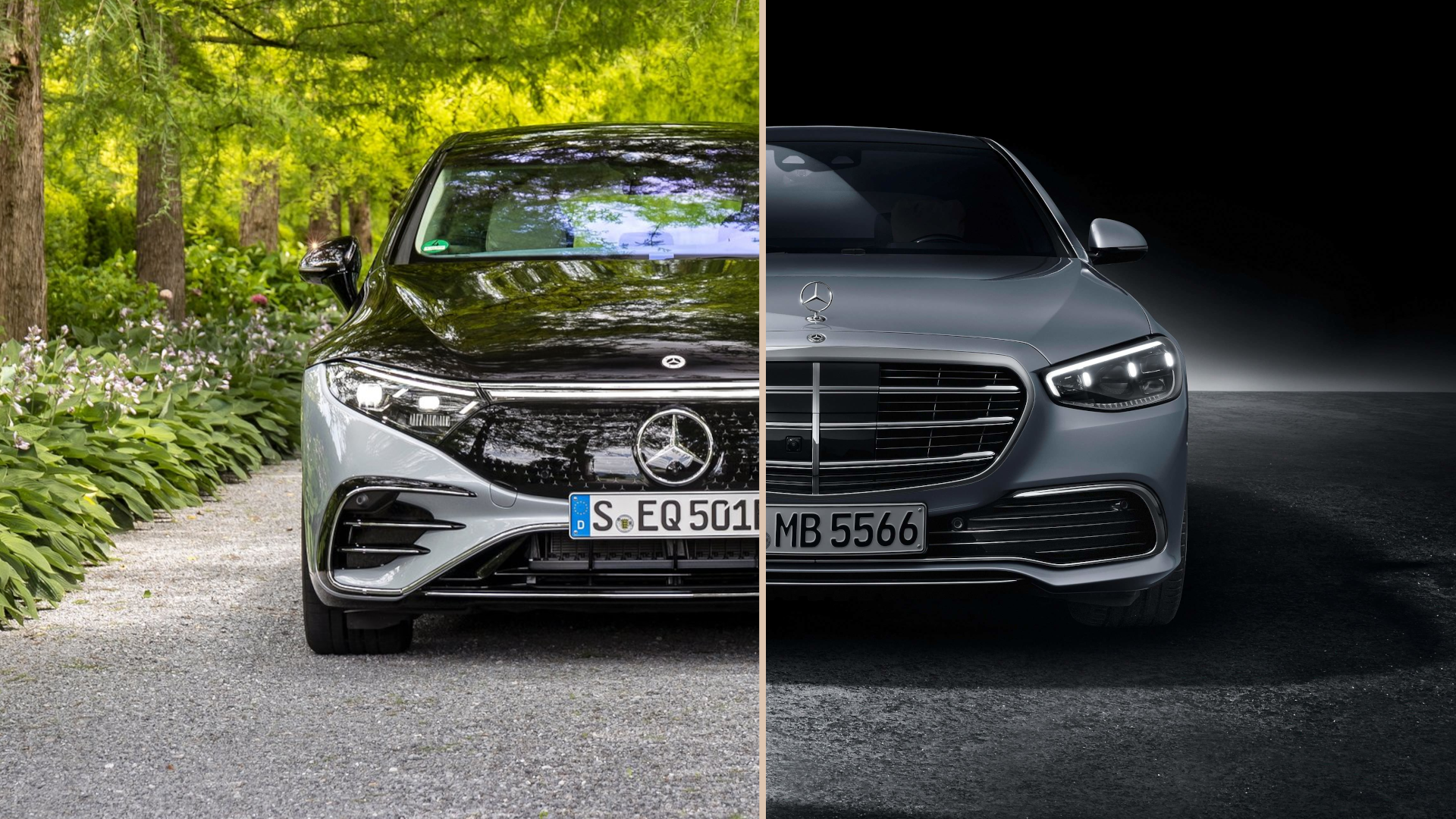
The latest generation S-Class arrived for 2021 on the W223 platform, ditching previous V-12 engines in favor of trendier electrified offerings. At launch for 2021, you’d find a 3-liter straight-six turbo as the base engine and a 4-liter V8 turbo as the upgrade, both came standard with mild-hybrid boost. With hybrid tech now standard on the S-Class’ gas engines, 2022 followed with the introduction of the new EQS – a large, all-electric luxury sedan that joined the S-Class in flagship sedan position on its own unique EV platform.
Some call the EQS the “electric S-Class”, though the two machines are totally different in platform and construction. Each machine amounted to an option for big-dollar shoppers to consider in a top-line Benz: one with mild hybrid ICE power, the other, an all-electric.
|
S500 |
S580 |
S580e PHEV |
EQS 450+ |
EQS 580 |
|
|
Engine / Motor |
3-liter inline 6 turbo mild hybrid |
4-liter v8 turbo mild hybrid |
3-liter inline 6 turbo PHEV |
electric |
electric |
|
Horsepower |
429 |
496 |
510 |
329 |
516 |
|
Torque lb-ft |
384 |
516 |
553 |
417 |
631 |
|
Drive |
AWD |
AWD |
AWD |
AWD |
AWD |
With gas and electric bases covered, 2023 rolls around and Mercedes adds a new Plug-in Hybrid (PHEV) to the S-Class range. Now, shoppers torn between fully electric and fully gas-driven have a choice somewhere in the middle. Shoppers love choices, and these three stacked up as options for shoppers to take in hybrid-boosted performance without the plug on standard S-Class models, extended all-electric driving with full gasoline backup on the S-Class PHEV, or all-electric driving, all the time, with the EQS.
For an apples-to-apples comparison, we’ll check out the original and current used-market pricing of all three models from the first year they became available side by side: 2023. That year, the S500 was the standard S-Class, running the 3-liter straight six mild hybrid turbo engine. The S580 dropped in the 4-liter mild-hybrid turbo V8.
The S 580e PHEV, running the fourth-generation hybrid drive system, had an all-electric range of 46 miles per charge before the fuel pump had to turn on. With nightly recharging at home, this PHEV version of the S-Class gave drivers a green plate, even more power, and enough daily EV range to get off gasoline for most commuting and errands.
In 2023, the all-electric EQS offered two configurations, the 450+ or 580.
Pricing Then Vs. Now
In 2023, the entry-level S500 with mild hybrid straight six would lighten your wallet by $114,500 before options and packages. The 2023 S580e PHEV came next, with a starting ask of $122,550. The V8-powered mild-hybrid S580 had a starting price of $124,000. The all-electric EQS started at $104,400 for the 2023 model year, with the EQS 450+ as the base model and the EQS 580 as the upgrade choice, priced at $125,950. Note that some excellent options overlap on pricing here, again, giving shoppers the power of choice when it came to how they’d spend their dollars.
What’ll you pay today? According to KBB.com, the Fair Purchase Price of a 2023 S500 4Matic today is $67,282, with the S580 coming in at $82,402. So, if you’ve got about $80,000 burning a hole in your pocket, you’ll find plenty of selection here on two-year-old models, many of which haven’t seen their second oil change. With PHEV power in the S580e, expect to pay about $10,000-$12,000 more. Setting your budget for $90,000 is reasonable if you’re after a low-mileage 2023 S580e, complete with charge-at-home PHEV tech and a gas engine for backup.
The all-electric EQS? It’s not even close. A quick scan of various online markets shows plenty of selection on used 2023 EQS sedan models with under 30,000 miles of use from under $40,000 all day long – with about eight years and well over 100,000 miles likely left on its battery warranty – and you’ll never have to stand around pumping gas ever again.
Which One Depreciates The Fastest And Which One Should You Buy?
A point worth considering here is that both the S-Class and EQS were executed as top-line, flagship models designed to flaunt the latest tech and engineering prowess available. Both electric and gas-powered versions have knockout cabins, some of the prettiest after-dark ambient lighting on the road, and a forward dash set off by the extensive use of high-resolution, glossy display screens – including the available Mercedes Hyperscreen, which pretty much turns the entire thing into a giant display interface.
And while the EQS Sedan can’t match the S-Class’ generations of pedigree, the marketing clout of its long-established name, or the glorious growl of its electrified V8 at full workload, it’s a fast, quiet, comfortable electric flagship nonetheless. You’ll likely find the S-Class to have the more comfortable back seat, and the superior styling between the pair by a fair margin.
So, back to our initial question: which one depreciates the fastest? Following the math above, expect a 2023 S500 to be worth about 59% of its original value today, with an S580 worth about 67% of its original value in 2025. The S580e holds onto the most of its original value in this comparison, at 73%. The EQS? In 2023, you’ll find just 35% of its original value remaining. If we just saved you 40 grand, you’re welcome.
Sources: Mercedes, AutoTempest