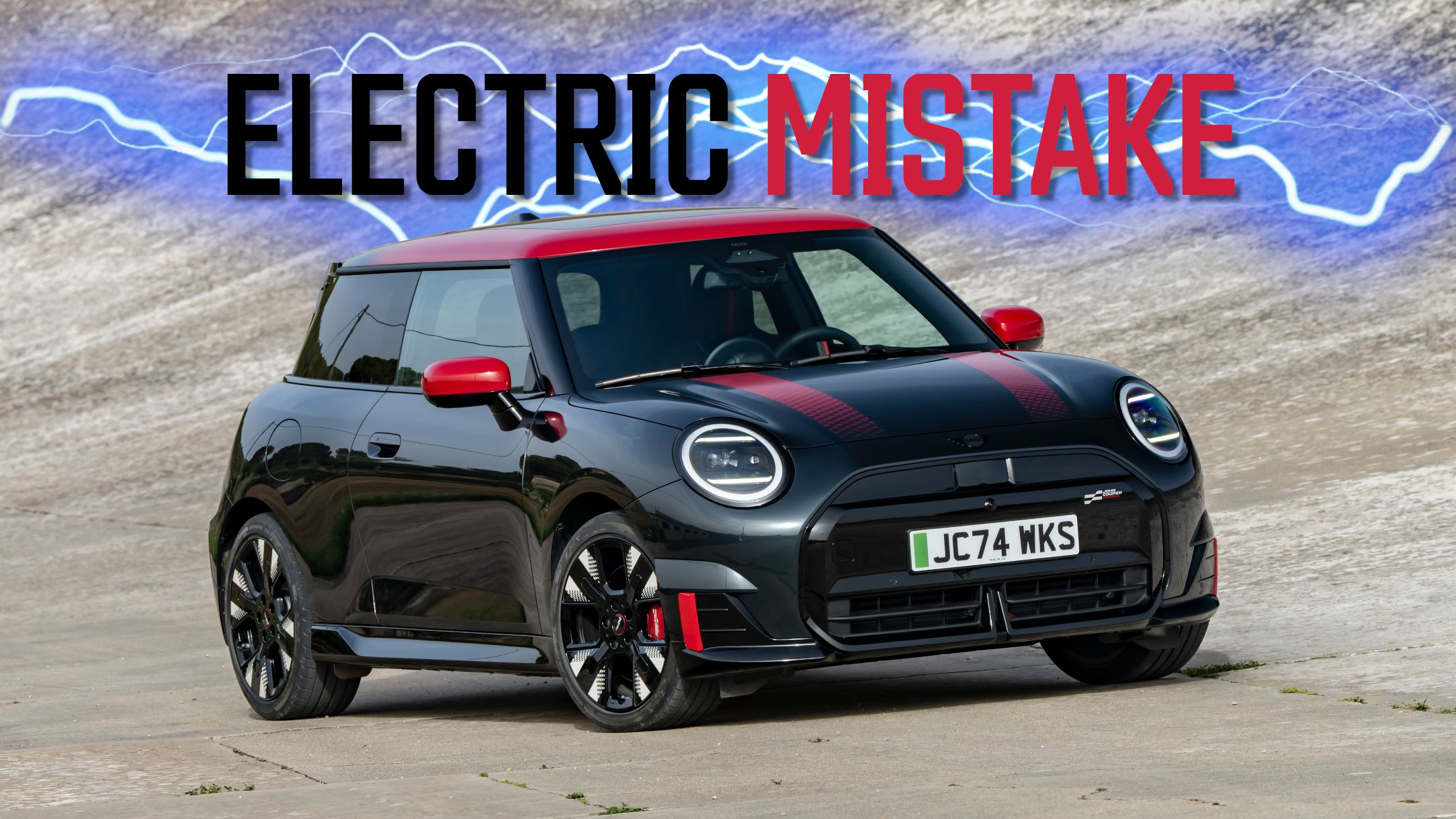
Mini has revealed the first-ever all-electric John Cooper Works models. As a fan of the brand, I was looking forward to Mini leaning hard into the performance provided by electric motors, but the result is disappointing, to say the least. The JCW Electric Hardtop is only good for 255 horsepower and 258 lb-ft of torque, which is only good enough for a 0 to 60 mph time of 5.9 seconds. That’s not even good enough to beat the 2025 Mini Countryman JCW, which is supposed to be the fat kid in the family.
Related
Mini’s First-Ever Electric JCWs Look Sharp But Lack Bite
The first-ever JCW electric vehicles have arrived. Are they any good?
The more I think about it, should Mini have even bothered? I don’t mind electric vehicles, but certain names are too sacred to carry an EV badge. These names are normally found on cars linked to the vision of one man, like Carroll Shelby or John Cooper, which all JCW models are named after. John Cooper was a deeply interesting man, and he alone believed that Minis could be raced successfully. Not even the father of the Mini, Sir Alec Issigonis, believed his tiny car was suited to motorsport, so John Cooper had to go out and show the world what the famous itty-bitty city car could do. As it turns out, the car was so successful that Mini eventually named the Cooper after him.
Why Was Cooper Interested In The Mini?
The first thing you need to know about Mini is that the brand wasn’t actually called Mini. At the height of its success, the automaker behind the Mini was the British Motor Corporation (BMC). The tiny car wasn’t meant to be fast or fun. Like the Citroën 2CV and Volkswagen Beetle, the Mini was born out of necessity. Post WW II, Europe had little raw material to work with, and the population didn’t have much money to spend on cars. Enter the OG Mini, which boasts the kind of smart packaging that even its modern counterparts can’t match. It could easily seat four adults, despite being no bigger than the front seat of the average American car made in the 1960s.
Alec Issigonis was never under any impression that his famous car would ever go racing, but John Cooper knew how to spot a good car. He started the Cooper Car Company in 1947 to go racing. The team started in Formula 3 but eventually worked up to F1, where it competed in 129 races and won 16. The team operated from the very first F1 Grand Prix in 1950 to 1959, when victories were few and far between. Cooper went in search of new racing formulas and set his sights on saloon car and rally racing, both of which required a production car.
Enter the OG Mini. Cooper had a theory that small, light, and nimble could beat big and powerful. This is the same kind of thinking that made Colin Chapman famous. To make the Mini race-ready, Cooper equipped it with disc brakes, upgraded the engine to produce more power, and gave it the famous red livery. These upgrades were remarkably simple. Cooper sold them as a package to existing owners. You’d get the disc brakes, and the engine upgrade was a twin SU carburetor setup instead of the single unit on the standard 1,000 cc engine. These upgrades were so effective that it’s still used to this day. I should know, because I made these changes to my Mini. If you include a more fruity exhaust, you get the same kind of soundtrack from the later 1,275 cc four-cylinder as those originally rally specials.
The formula worked beautifully, but don’t take my word for it. The Mini famously won the Monte Carlo Rally in 1964, 1965, and 1967. The race-prepped Minis had three distinct superpowers. They could brake much later, rotate easier, and had more racing line options than the larger cars in the field. It could not only compete with but beat cars that had four times more power. Just look at the footage of the annual Mini Vs. Muscle Car Race at Goodwood Revival above. The Mustangs have the advantage on the straights, but look at how much later the Minis can brake, and how hard they can be flicked into a corner without upsetting the balance. Imagine getting spanked by a car no larger than your spare tire, equipped with an engine seven times smaller…
How It Became Part Of BMW’s Portfolio
The Cooper Car Company kept on modding Minis, but in 2002 John’s son, Michael, started a new division. It was called John Cooper Works. At first, it sold tuning packages for BMW’s first-generation Mini, a car that is intrinsically tied to its combustion engine, even more so than the classic Mini. As you might know, the first modern Mini Cooper was available with a 1.6-liter naturally aspirated four-cylinder, while the Cooper S has a supercharger bolted on top. The JCW kit for the NA model increased the power output from 115 horsepower to 126 hp, while the supercharged model’s output was increased to 200 hp. The most hardcore package was the John Cooper Works GP Kit, which upgraded the interior, removed a bunch of interior features (like the air-conditioning), and increased the power to 215 hp. While that doesn’t sound like a lot, keep in mind that the first-gen modern Mini only weighed 2,300 pounds.
The supercharger whine and pops from the exhaust were instantly iconic. You can hear it in action below.
JCW wasn’t the only tuner churning out kits for the then-new Mini Cooper, but JCW was the only tuner putting out stuff that was up to BMW’s standards. Instead of trying to compete with JCW when the second generation came rolling in, BMW acquired the rights to the name in 2007 and bought out the company in 2008. It’s kind of how AMG ended up in the hands of Mercedes-Benz. Sadly, BMW chose turbocharging instead of supercharging, but it still built some mega Minis. The second-generation Mini John Cooper Works GP was a masterpiece, and the only flaw in the third-gen was that it was only sold with an automatic gearbox.
What happened to the Coopers? Sadly, John Cooper died in 2000, so he never got to see all the cars carrying his name. His son went back to the Cooper Car Company and started building bicycles.
Why The EV Mini JCWs Are A Fail
Mini, under the ownership of BMW, is quite familiar with failure. The Mini John Cooper Works Roadster and Coupe were stupid cars with a ride quality you couldn’t possibly live with, but at least they were exciting. The two-door Paceman SUV coupe was a disaster. Who thought it was a good idea to make a less practical Countryman?
The electric JCWs are guilty of the biggest sin in the automotive industry. They’re dull. The power output for the Cooper is middling, and even the Countryman JCW, which is supposed to be the grown-up’s Mini of choice, is more powerful and quicker.
It’s disappointing because it didn’t have to be this way. We all know EVs are known for offering blistering acceleration. Why didn’t Mini lean into that? Thanks to the Hyundai Ioniq 5 N, we know simulated gearboxes and fake sounds can be entertaining, so why aren’t they present? An electric Mini with a low-mounted battery pack that can corner like it’s glued to the ground, accompanied by the sounds of a classic Mini with a straight pipe or a first-gen supercharged JCW would have been brilliant, but no.
The first electric JCW models feel like cynical marketing exercises rather than properly thought-out standalone models. The pricing hasn’t been announced yet, but if it’s anywhere near the Tesla Model 3, they’ll be dead in the water. Even the Long Range RWD entry-level model gets to 60 mph in less than five seconds, and it retails for roughly $36k. The Performance will get you to 60 mph in less than three seconds.
|
Mini Cooper John Cooper Works Electric |
Tesla Model 3 Long Range RWD |
|
|
Power |
255 hp |
271 hp |
|
Torque |
258 lb-ft |
310 lb-ft |
|
0-60 |
5.9 seconds |
4.9 seconds |
|
Top Speed |
124 mph |
125 mph |
|
Range |
230 miles (WLTP) |
363 miles (EPA) |
|
Price |
Around $42,000 (Estimated|) |
$34,990 (including tax credit) |
Mini had a perfect opportunity and wasted it. Let’s hope it has plans to build a proper JCW GP that can rescue the nameplate…