The Nürburgring has been around for 97 years, and during that time, it has hosted countless events, from the earliest Grand Prix to 24-hour endurance events and even truck racing.
It is one of the most challenging circuits anywhere in the world, and has been used as a testing ground by manufacturers to test their pre-production cars. This has made it the epicenter of a type of Nürburgring lap record mania, where the bragging rights for achieving the ultimate lap times seem to overshadow any other automotive criteria.
We examine the history of this fascinating track and explore the ramifications Nürburgring lap times have on production car development.
Related
10 Things You Need To Know About The Nurburgring Nordschleife
Equally loved and feared by car enthusiasts all over the world, the Nordschleife is one of the most famous racetracks in history.
All of our lap time data was sourced from the official Nürburgring website, and vehicle data and specs were sourced from the relevant manufacturer.
A Brief History Of The Nürburgring
The plan to create a racing circuit beyond comparison was announced at a 1925 groundbreaking ceremony in a forested area of the Eiffel Mountains. It was to be the longest, most challenging track ever built, and two years later, the Nürburgring was officially opened.
When we came to the newly opened Nürburgring in 1927, we opened our eyes. We had never experienced anything like it. There was a road in the middle of the Eifel mountains, a closed loop with almost 180 bends spread over 22 kilometers. It was a track with gradients that were a sharp blow to the engine, but also with unspeakably beautiful views far across the country, of valleys and villages. –
Rudolf Caracciola, Racing Driver
Carraciola won the first race at the Ring, and the venue soon became a highlight of Grand Prix racing. The first Formula 1 race was held at the track in 1951. It was won by Alberto Ascari in a Ferrari, of course. Endurance events started in 1953 with the 1,000km (600 mile) World Sports Car Championship event.
Since those early years, hundreds of memorable races have taken place at the Nürburgring. 1960s Formula 1 driver Jackie Stewart famously called it the ‘Green Hell’ due to the rain, fog, and generally challenging conditions that were a permanent feature of the track.
By the end of the ’60s, racing drivers’ calls to make the track safer were finally heeded, and some modifications were made to improve safety levels. Safety barriers and emergency lanes were introduced, but it wasn’t quite enough, and the last Formula 1 event was held at the Nürburgring in 1976.
The track remained a popular racing venue for other motorsport events, and 24-hour endurance racing was introduced in 1970. Major changes were carried out on the original track in 1981, which was shortened to its current length as the south loop was no longer part of it.
A completely new and separate racetrack was also built. This new track was completed in 1984, signaling the return of Formula 1 to the Nürburgring—albeit at this much shorter and safer track designed to accommodate modern race cars.
The original Nordschleife (German for North Loop) continued to host other racing events, including the famous Nürburgring 24 Hours. It is also open to the public on certain weekdays and is a popular testing venue for auto manufacturers.
Why Nürburgring Lap Times Are Important
Drag racing and acceleration tests have their place, but nothing tests a vehicle’s dynamic abilities like a racetrack. Some tracks suit fast cars; others have tight corners that benefit compact sports cars. Most have around 15 corners and are about 3 miles long.
The Nürburgring has over 150 corners and is up to 15.77 miles long, depending on the configuration. It has long straights, off-camber bends, sharp corners, and everything in between. Factor in the varying road surfaces along the route and the unpredictable weather, and you have a perfect testing ground.
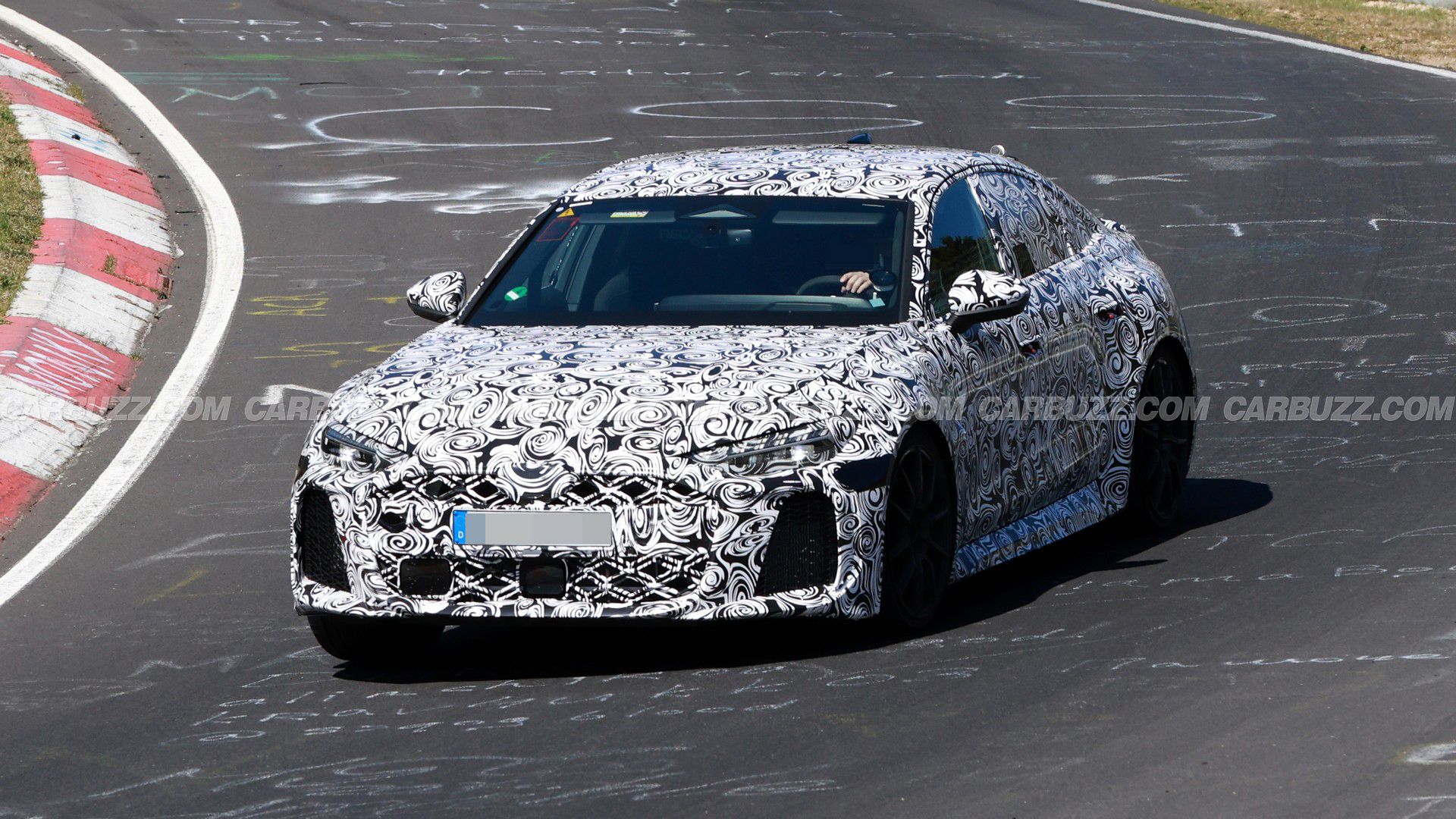
When it comes to production-spec road cars, it’s not the lap times that manufacturers are after. They use the Nürburgring to test their vehicles’ cornering, braking, acceleration, and handling in varying conditions. Automakers also use the ‘Ring to tune basic functions like the ABS and the traction and stability control. You may never push your Mercedes C-Class as hard as a test driver, but it will have that extra layer of dynamic ability if you ever need it.

Add CarBuzz to your Google News feed.
Why Nürburgring Lap Times Can Be Completely Irrelevant
There is no doubt that pre-production testing at the Nürburgring is a net positive for new car development. But it unravels when manufacturers start developing cars for the Nürburgring instead. This results in a vain chase for an ultimate lap time that means little outside a press release.
Pushing the limits of design can be a good thing, but not if it results in a car that is wholly unsuited to driving anywhere but on a racetrack. Some supercars have special ‘track packs’ and limited-edition upgrades that give them an extra tenth of a second around a track. But most mass-production road cars won’t see a racing circuit or even be pushed hard on the way to the shops, so an overly stiff suspension or peaky power delivery makes the driving experience worse. Not better.
Even if you are in the market for a sports car, buying it based solely on its Nürburgring lap time may not be a great idea. Those times are set by experienced racing and test drivers who can handle a car at the limit. And the compromises required for daily usability to achieve those figures may make your sports car a poor daily driver.
What Cars Currently Top The Nürburgring Scoreboard?
|
Production Cars |
Lap Time |
|
Mercedes-AMG ONE |
6:29.09 minutes |
|
Porsche GT2 RS Manthey Performance Kit |
6:43.30 minutes |
|
Mercedes-AMG GT Black Series |
6:48.04 minutes |
|
Porsche GT3 RS 992 |
6:49.32 minutes |
|
Porsche GT3 Manthey Performance Kit |
6:55.74 minutes |
The Mercedes-AMG ONE tops the current leader board for production cars. Of course, it isn’t exactly a mass-production vehicle, but it is road-legal and can be yours if you have a few million dollars stashed in your piggy bank. The Porsche GT3 and GT2 models that fill three of the top five slots are relatively much more affordable. As is the Mercedes-AMG GT Black Series. All are impressive supercars, but remember that a blistering Nürburgring lap time may not always translate into real-world usability.

Related
Cars That Could Beat The Mercedes-AMG One’s Insane Nurburgring Lap Time
The Mercedes-AMG ONE recently broke its own Nürburgring lap record. Here are the hypercars that might be able to beat it.
The fastest front-wheel drive production car is the Honda Civic Type R, with a time of 7:44.8. If you’re wondering about the overall lap record at the Ring, that accolade belongs to the Porsche 919 Hybrid Evo. It achieved a 5:19.55 lap time, which is simply staggering. The quickest electric sports car is currently the Rimac Nevera, with a time of 7:05.29.

Related
Hennessey Venom F5 Thinks It Could Steal The AMG ONE’s Nürburgring Record
Hennessey isn’t making any promises, but it thinks the Venom F5 could take the Nurburgring record from Mercedes-AMG.
Is There A Future For Nürburgring Testing?
Refining pre-production cars on real-world roads that expose dynamic shortcomings is always a good idea. However, when the road itself becomes the focus of development, it can only end badly. Developing race cars on a track makes sense – they are one-dimensional machines with a single purpose: faster lap times.
When that single-mindedness is applied to a road car, the result is a compromised product. After all, who wants a hard-riding SUV that is useless on the school run, but can beat supercars around a racetrack? That’s why auto manufacturers must remember to use the Nürburgring as just one of the tools for car development alongside other testing procedures.
Sources:
Nürburgring Website
,
Porsche
,
Mercedes