It’s just ‘manual’ or ‘automatic’, right? Either you have a stick shift with a clutch pedal and shift the gears manually, or you put it in Drive and off you go, automatically. There’s much more to it than that, though, and most people have no idea what’s going on inside their cars’ transmissions. A manual transmission has helical gears that are moved around by a shifter-actuated selector, with the clutch engaging and disengaging the drive.
2:14
Related
Only 8 Sports Sedans With Manual Transmissions Remain
With only these eight left in the USA, your choice of sport sedan that allows you to row your own gears is limited.
A traditional torque-converter auto with planetary gearsets use clutch packs and brake bands to engage or immobilize certain gearsets, and a torque converter – a type of fluid coupling – allows slip and torque multiplication on the wheels. There’s enough slip to let the engine run in Drive with the wheels stationary, and on the go, a lockup clutch eliminates the slip to save fuel. There are at least ten other transmission designs of neither type, so let’s look at a few interesting ones.

Related
Ranking Every BMW M5 Generation From Worst To Best
All of them excel, but some carry a more special place in enthusiasts’ hearts than others.
10 Automated Manual Transmissions (AMT)
A manual transmission with automatic clutch and shifting
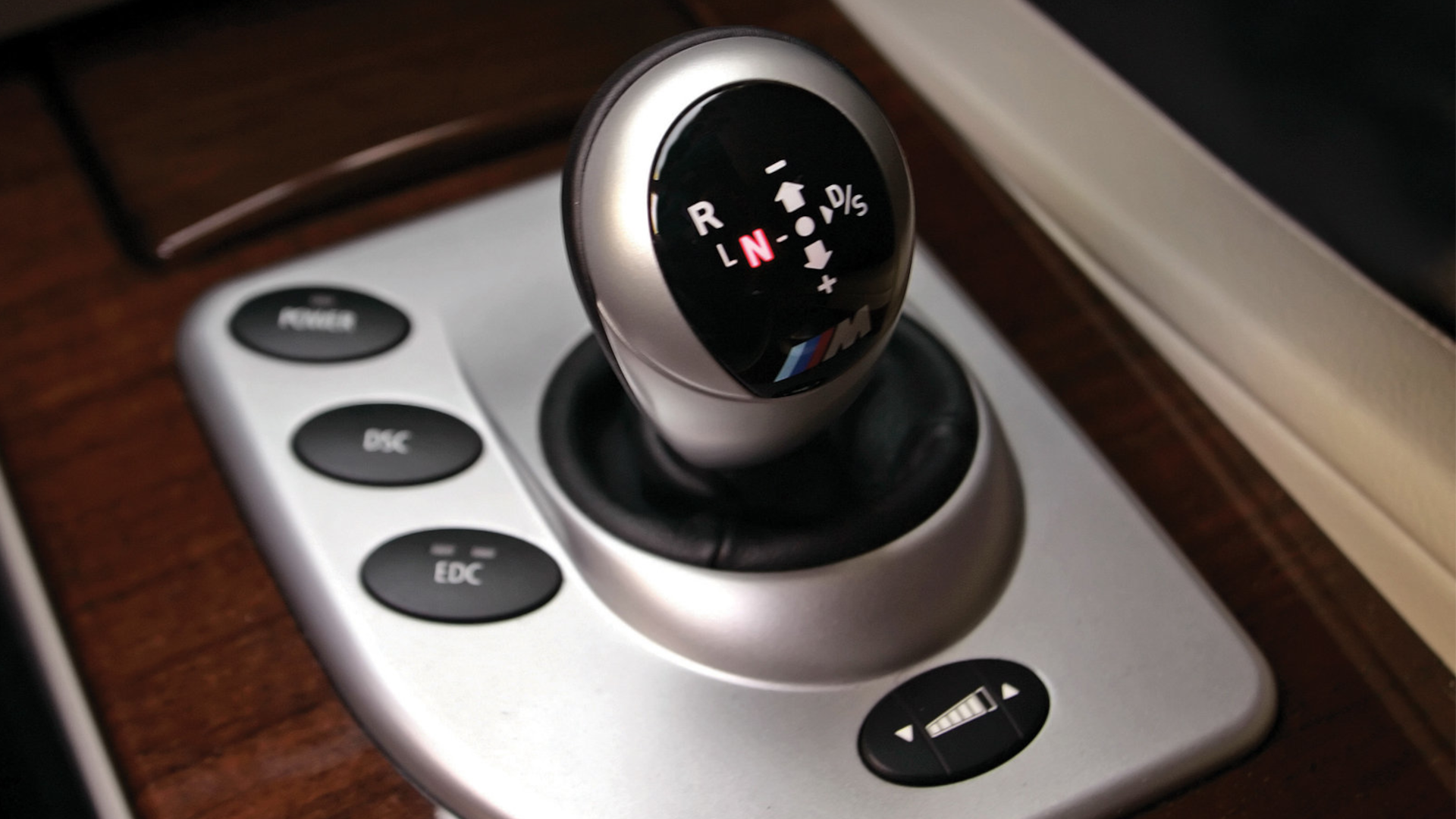
A manumatic is a regular manual transmission, but without a clutch pedal and with automatic gear shifting. A computer and a series of actuators control the clutch and the movement of the selector forks in the gearbox to change the gears, performing all the functions of a regular manual. It doesn’t give the feel of a regular automatic, and pauses momentarily between gearshifts as the clutch is operated, just like a manual would.
Examples:
- 1997+ BMW SMG (E36/E46 M3, E60 M5)
- 2008+ Smart manumatic (ForTwo gas models)
- 1997+ Ferrari “F1” manumatic (F355)
- 2004+ Lamborghini E-gear (Gallardo, Murcielago)
- 2001+ Maserati Cambiocorsa transmission (Maserati Coupe)
Advantages:
- Fully automatic shifting
- Efficient, low-loss drive transmission
- Low price
Disadvantages:
- Nodding-head syndrome from shift pauses
- Accelerated clutch wear
- Slow, smooth shifts or fast, jerky shifts

Related
Smart Car Weight: How Light Is This Innovative Microcar?
Explore the quirky, featherlight microcar and see how it stacks up against other tiny subcompact vehicles.
9 Semi-Automated Manual Transmissions
An automated clutch but manual shifting
A semi-automated manual transmission works almost exactly like an AMT, with the exception that the gears have to be shifted manually by the driver. The clutch is automatically operated when the driver operates the shift lever by a quick-acting actuator or servo. This type of transmission has now mostly fallen out of favor.
Examples:
- 1967+ Porsche Sportomatic (911
- 1968+ VW Autostick (Beetle, Karmann Ghia)
- 1994+ Saab Sensonic (900)
- 1992+ Valeo semi-automatic (Ferrari Mondial T)
Advantages:
- Manual control but no need to operate a clutch pedal
- Efficient, low-loss drive transmission
Disadvantages:
- Slow responses
- Jerky shifts under some conditions

Add CarBuzz to your Google News feed.
8 Honda’s Multi-Shaft Helical Automatic Transmissions
Essentially an automated helical multi-shaft manual transmission
Up until its six-speed automatic, Honda’s in-house automatics resembled manual gearboxes, with helical constant-mesh gears, multiple shafts (up to five for a six-speed), and clutch packs, not planetary gearsets like traditional autos. The five-speed auto was the design’s limit before it became too bulky, so to increase gears, Honda had to revert to the traditional planetary design for their in-house ten-speed. But while they were getting that ready, they fitted some of their cars such as the Pilot and Passport with the ZF 9HP.
Examples:
- 2013+ Acura ILX
- 2009+ Acura TSX
- 2008+ Honda Fit
- 1998+ Honda Accord
Advantages:
- Quick, smooth operation
- More efficient
- Quieter operation
Disadvantages:
- Weight
- Size
- No more than six gears can realistically be accommodated
16:50

Related
2023 Dodge Hornet First Drive Review: American Recipe, Italian Ingredients
Dodge borrows from the Italians to create something interesting.
7 ZF 9HP 9-Speed Automatic
Super-compact design calls for precisely controlled dog clutches
The 9HP doesn’t seem unusual nowadays, but it was the first-ever nine-speed transverse transmission in 2013, and it’s about the same size as the preceding six-speed auto, but lighter, achieved by using a nested gearset and two dog clutches instead of clutch packs to save space. A shift that requires one of the dog clutches to be engaged requires precise synchronizing of the splined components, as they allow no slip, and the transmission control unit requests the exact engine rpm to achieve this. The inconsistent shift feel of this transmission has been widely criticized and Jeep recalled vehicles fitted with it several times for software updates. You’ll find it in cars such as the Dodge Hornet and Infiniti QX60.
Examples:
- 2014 Land Rover Discovery Sport
- 2016 Honda MDX
- 2023 Dodge Hornet
- 2022 Infiniti QX60
- 2014 KL Jeep Cherokee
Advantages:
- Nine gears in a compact housing
- Fewer clutch packs
Disadvantages:
- Inconsistent shift quality
- Can be difficult to calibrate
6 Honda DCTs With Torque Converter
Two clutches AND a torque converter
Dual-clutch transmissions (DCTs) are commonplace. While driving with one clutch closed, the next gear is pre-engaged on the second clutch, so a gear change is just a swapping of clutches. But they’re still subject to clutch wear and sometimes overheating, especially with lots of clutch slip in slow-moving traffic, while the clutches can be jerky and grabby at low speeds. Acura’s DCTs are different and use a torque converter – a fluid coupling – to pull away, not one of the clutches, so they’re silky smooth at crawling speeds, and you don’t wear out your start clutch in slow-moving traffic.
Examples:
- 2016+ Acura ILX
- 2015+ Acura TLX
- 2016+ Acura NSX
Advantages:
- Smoother operation
- Less wear
Disadvantages:
- More components and weight
- More complex
- Higher cost

Related
Acura TLX Generations: Everything You Need To Know In One Place
The Acura TLX continues to provide an interesting alternative to premium compacts with sharp looks and strong powertrains.
5 Toyota K120 Direct Shift CVT
It’s a CVT, but with a torque converter and physical first gear
A continuously variable transmission (CVT) uses a clutch pack or torque converter to pull away, but always drives the wheels via a chain or belt running on a set of cones. CVTs have no gears; infinite ratios are possible as the belt slides up and down the cones. This makes them very efficient, but they’re at their most efficient in the center and large-diameter regions of the cones, not at small radii, where the tight turn robs some efficiency. Toyota fixes that with theK120, which uses a torque converter to pull away – so no clutch wear in traffic – and has a physical first gear for smooth and refined slow-speed driving before first gear hands over to the CVT, which only runs in its most efficient range. Genius.
Examples:
Advantages:
- No clutch wear
- Smooth low-speed operation
- Excellent efficiency
Disadvantages:
- More complexity
- Higher weight
- Higher cost

Related
Ranking Every Toyota RAV4 Generation From Worst To Best
Every generation Toyota RAV4 ranked.
4 ZF 2-Speed Electric Drive
It’s a 2-speed transmission for EVs
Electric vehicles don’t have transmissions. The manufacturer selects an appropriate one-speed gear ratio through which the motors drive the wheels, making sure of a sound blend of launch torque and highway gearing. An electric motor generates maximum torque the moment it starts turning, and can spin to well over 10,000 rpm, so a transmission is an unnecessary complexity. But in sports cars like the Porsche Taycan, a two-speed transmission like ZF’s for EVs increases launch torque and lowers motor revolutions at high speeds, making for better performance and efficiency, extending range by up to 5%. It usually shifts into second at just over 40 mph.
Examples:
Advantages:
- Better performance
- Better efficiency
Disadvantages:
- More complexity
- More weight
- Higher cost

Related
2025 Porsche Taycan Turbo GT First Ride Review: So Fast It Hurts
The Taycan redefines what electric performance can be.
3 Honda 2-Motor Hybrid Powertrain
The ICE is a power generator most of the time
In Honda’s latest hybrids, such as the Accord, Civic, and CR-V, the gas engine acts as a power generator for the electric motor, which drives the wheels most of the time. Engine revs are varied to simulate virtual gear shifts, so it feels natural and avoids the typical CVT drone. A second electric motor acts as a starter/generator. However, the engine can be directly connected to the wheels via gears under certain conditions, such as highway cruising.
Examples:
Advantages:
- Feels like a regular automatic
- Fun to drive
Disadvantages:
- Not quite as efficient as other hybrids
- Cost

Related
Every Honda Hybrid Model Ranked By Efficiency
We rank every Honda Hybrid model on sale today, from least to most fuel efficient.
2 Lexus Multi-Stage Hybrid System
Price/0-60/Quarter-Mile Time
The Multi-Stage Hybrid System in the Lexus LS and LC hybrids combines a 3.4L twin-turbo V6 with a ten-speed transmission, but it’s no ordinary one. The planetary torque-split device, resembling a traditional auto ’box has four ratios, but works in conjunction with a three-speed final drive. The first three ratios of the former are used along with the three final-drive ratios to create nine gear ratios, with the fourth ratio of the former used with the last final-drive ratio to create the tenth gear. Unlike previous Lexus hybrids, this system can use the combustion engine for launches, and can use electric drive at much higher road speeds.
Examples:
- Lexus LS500h
- Lexus LC500h
Advantages:
- Big ratio spread
- High efficiency
Disadvantages:

Related
Lexus Confirms Manual Transmission For Future Electric Cars
“From the outside, this vehicle is as quiet as any other BEV. But the driver is able to experience all the sensations of a manual transmission vehicle.”
1 Toyota Manual EV Transmission
It’s all a simulation, but it feels real
Toyota previewed their manual EV transmission in a Lexus UX300e in 2023 and wants to put it into a production car. With it, the Japanese automaker is keen to preserve the stick shift and ease the transition to EVs by adding some driver engagement. The six-speed manual shifter just activates microswitches and the clutch is connected to a potentiometer, so the driver’s inputs can be converted to feel like an ICE car to drive, complete with a fake rev counter and engine sound. Drive-motor output is matched to a regular engine’s feel, and it can even “hit the rev limiter”, provide “engine braking” in lower gears, jerk when you let out the “clutch” clumsily, and virtually stall if you don’t ace your pull-away.
Examples:
Advantages:
- Feels like a manual EV
- Driver is part of the action
Disadvantages:
- It’s all synthesized illusion
- Defeats the EV purpose
Sources:
Acura
,
Lexus Enthusiast
,
Honda
,
Wikipedia
,
ZF Press Center
,
Gears Magazine
,
Car and Driver
.