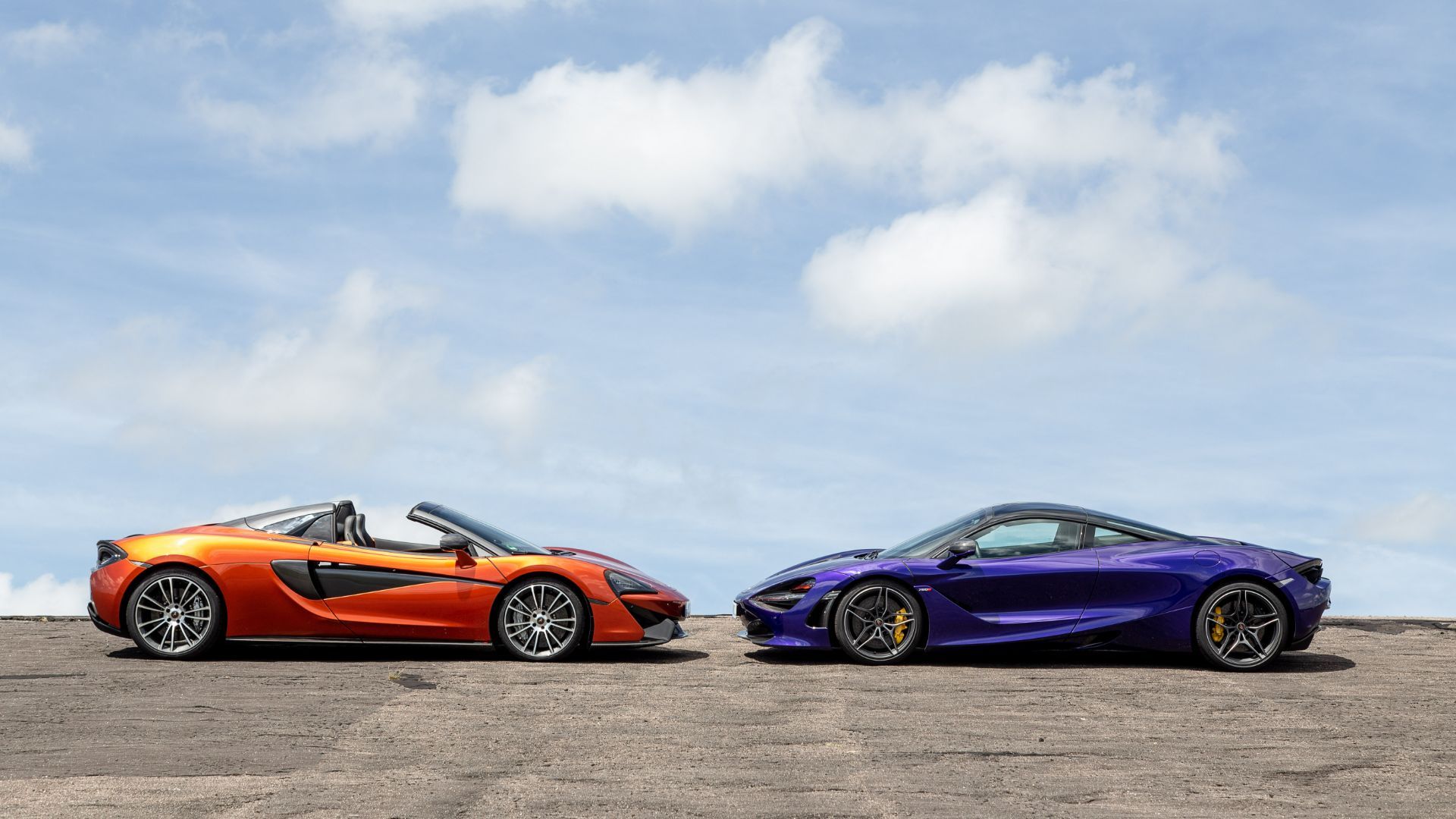
When McLaren Cars became McLaren Automotive, and released the MP4-12C, it was back with a vengeance. Putting its decades of F1 experience into road cars, McLaren has been building cars since 1992 with the F1, but the brand was relaunched in 2011 with a more production mindset. Since the relaunch, the automaker has gone on to produce a dizzying number of super and hypercars, all capable of reaching mind-melting top speeds. But which McLaren models are fastest?
McLaren
- Founded
-
2 December 1985 (as McLaren Cars), revived in 2010 as McLaren Automotive
- Founder
-
Bruce McLaren/Ron Dennis
- Headquarters
-
Woking, England
- Current CEO
-
Michael Leiters
This list looks at the top ten fastest McLaren models produced in terms of top speed. We rank them from slowest top speed, to fastest.
10
2011 McLaren MP4-12C
Top Speed: 207 MPH
|
2011 McLaren MP4-12C Specs |
||
|---|---|---|
|
Engine |
M838T 3.8L V8 |
|
|
Horsepower |
616 hp |
|
|
Torque |
443 lb-ft |
|
|
Transmission |
7-speed Automatic |
|
|
0-60 |
3.1 seconds |
|
|
Top Speed |
207 mph (Coupe) |
204 mph (Spider) |
It is fitting that we start this list off with the model that brought McLaren back into the world of supercars. The MP4-12C, also referred to just as the 12C, was the first car to go toe to toe with the legendary Ferrari 458 Italia, and would instantly cement McLaren as a real player in this space. It was the first McLaren to use the MonoCell structural design, being built out of carbon fiber, and would also be the first to feature McLaren’s ProActive Chassis Control. It would be produced over just three years, and in the time since then, it has suffered a fall from grace, being a fraction of the cost of its Modena-made chief rival on the used market. While we look at it now as one of many cheap used McLarens, it is hard to overstate the hype and anticipation for the 12C leading up to and during its launch.
9
2015 McLaren 650S
Top Speed: 207 MPH
|
2015 McLaren 650S Specs |
||
|---|---|---|
|
Engine |
M838T 3.8L V8 |
|
|
Horsepower |
641 hp |
|
|
Torque |
500 lb-ft |
|
|
Transmission |
7-speed Automatic |
|
|
0-60 |
3.0 seconds |
|
|
Top Speed |
207 mph (Coupe) |
204 mph (Spider) |
Being a heavily updated version of the MP4-12C, the 650S would launch in 2014, taking the lessons learned from the McLaren P1 and applying them to a more “ordinary” road car. It shares alot of its underpinnings with the MP4-12C, with roughly 75% of its parts carrying over from the older model. The 650S is named for its power figure in PS, being 25 hp more powerful than its predecessor. This increase in power came courtesy of a freer flowing exhaust, revised cylinder heads and camshaft, allowing for an increased redline to 8,500 rpm. Other incremental updates from the MP4-12C also meant for 24% more downforce, and improved breaking feel compared to its predecessor. The 650S would go GT3 racing, with its best achievement being a win in the 2016 Liqui Moly Bathurst 12 Hour.
1:08

Related
Video: McLaren Is About To Follow Ferrari Into The Super SUV Niche
McLaren suggested its four-seater might not be an SUV, but alas.
8
2018 McLaren Senna
Top Speed: 208 mph
|
2020 McLaren Senna Specs |
|
|---|---|
|
Engine |
M840TR 4.0L V8 |
|
Horsepower |
789 hp |
|
Torque |
590 lb-ft |
|
Transmission |
7-speed Automatic |
|
0-60 |
2.8 seconds |
|
Top Speed |
208 mph |
Internally named the P15, the Senna was launched in 2018 as a track-focused model from the brand’s Ultimate series. It is named after Aryton Senna, who won three world championships for the company between 1988 and 1993. Based on the 720S, the Senna was powered by a modified version of its 4.0-liter V8, named the M840TR. It pushes out 789 hp, but due to the aerodynamics, the Senna has a lower top speed than its stablemates. Obviously, with its large double-level spoilers and huge splitters, the Senna doesn’t set out to break top speed records; instead, it was made for destroying track records. It was the first McLaren to use MonoCage III, the next generation of McLarens carbon fiber monocoque, and featured a huge number of performance-orientated weight-saving measures. These measures allow for a bonkers power to weight ratio of 668 hp per ton.
7
2017 McLaren 720S
Top Speed: 212 MPH
|
2023 McLaren 720S Specs |
||
|---|---|---|
|
Engine |
M840T 4.0L V8 |
|
|
Horsepower |
710 hp |
|
|
Torque |
568 lb-ft |
|
|
Transmission |
7-Speed Automatic |
|
|
0-60 |
2.9 seconds |
|
|
Top Speed |
212 mph (Coupe) |
202 mph (Spider) |
Replacing the 650S as the second model in McLaren’s Super Series, the 720S brought the Super Series bang up to date with competitors. It featured 91% new parts over the 650S, which made it stiffer, faster and more aerodynamic. It was the first car in a proposed 15 new products from McLaren, and would go on to define the brand as the flagship McLaren production supercar of its era. It would be replaced by the updated 750S, but would end up having a higher top speed than its successor.

Related
Driven: 2024 McLaren 750S Spider Is Reaching For Supercar Nirvana
I thought the 720S Spider was a perfect supercar, and then I drove the drop-top 750S.
6
2013 McLaren P1
Top Speed: 217 MPH
|
2013 McLaren P1 Specs |
|
|---|---|
|
Engine |
M838TQ 3.8L V8 |
|
Horsepower |
903 hp |
|
Torque |
664 lb-ft |
|
Transmission |
7-speed Automatic |
|
0-60 |
2.8 seconds |
|
Top Speed |
217 mph |
The P1 is one of the most iconic McLarens ever made, and is arguably the most iconic car of the 2010s. As a part of the holy trinity, along with the Porsche 918 and Ferrari LaFerrari, it sent a message to the car industry that McLaren was back to stay. Making an earth-shattering 903 hp, the P1 featured the Instant Power Assist System, an F1-derived feature that allows for a boost of electric power for an overtake. Another piece of F1 technology the P1 featured was DRS, modifying the rear wing to allow for the highest top speed possible. And what a top speed it is, tied with the LaFerrari at 217 mph.
5
2026 McLaren W1
Top Speed: 217 MPH
|
2013 McLaren P1 Specs |
|
|---|---|
|
Engine |
MMHP-8 V8 Hybrid |
|
Horsepower |
1,258 hp |
|
Torque |
988 lb⋅ft |
|
Transmission |
8-Speed Dual-Clutch + Electric Reverse |
|
0-60 |
2.7 seconds |
|
Top Speed |
217 mph |
The latest in McLaren’s Ultimate Series, the W1 is the third in the line of the flagship McLaren, following on from the P1 and F1. It shares the P1’s top speed but gets there quicker with a shorter 0-60 mph sprint time. It is the first of these to have electric hybrid assist, that makes 342 hp on its own. It is capable of charging to 80% in 22 minutes, and going a comical 1.6 miles on electric power alone. Obviously, the EV characteristics of a multi-million-dollar hypercar are not much of a concern, with the 2,205 lbs of downforce produced, 88.2 lbs lost over its P1 older brother, and F1-derived technology being the main selling points. Cooling this monstrous power is no small feat, with the W1 having 10 heat exchangers.
4
2021 McLaren Sabre
Top Speed: 218 MPH
|
2020 McLaren Sabre Specs |
|
|---|---|
|
Engine |
M840TR 4.0L V8 |
|
Horsepower |
824 hp |
|
Torque |
590 lb-ft |
|
Transmission |
7-Speed Dual-clutch |
|
0-60 |
2.8 seconds |
|
Top Speed |
218 mph |
It is hard to believe that you could take something as truly insane as the McLaren Senna and crank it ever closer to 11, but MSO found a way. Sold exclusively to the US market, the Sabre is an even more extreme version of the Senna, forgoing what little creature comforts the Senna had in pursuit of the true ultimate in road-legal track cars. You really did have to “know a guy” to get one at launch, with just 15 being offered to only the most die-hard McLaren customers. A carbon fiber monocage chassis, track-ready carbon ceramic brakes, and Inconel alloy F1-style exhaust mean you will always be the king of cars and coffee, even if you won’t be able to get over the gradient at the car park entrance.

Related
Hypercar Comparison: McLaren Senna Vs. McLaren Sabre
McLaren’s hardcore hypercars battle it out.
3
1995 McLaren LM
Top Speed: 225 MPH
|
1995 McLaren F1 LM Specs |
|
|---|---|
|
Engine |
S70/2 6.1L V12 |
|
Horsepower |
671 hp |
|
Torque |
520 lb-ft |
|
Transmission |
6-speed Manual |
|
0-60 |
3.9 seconds |
|
Top Speed |
225 mph |
This is one of the most expensive pieces of automotive royalty to ever exist. Built to celebrate the success of the McLaren F1 GTR at Le Mans, the F1 LM was limited to a mere five units. It would be the most powerful road-going version of the F1 thanks to the lack of restrictor plates needed by Le Mans regulations. It sacrifices some of its top speed compared to the regular F1 for more aerodynamic bodywork and handling prowess. A fun fact is that the F1 LM and P1 share the exact same power to weight ratio, at 3.4 lb/hp.
2
1993 McLaren F1
Top Speed: 240 MPH
|
1995 McLaren F1 Specs |
|
|---|---|
|
Engine |
S70/2 6.1L V12 |
|
Horsepower |
618 hp |
|
Torque |
479 lb⋅ft |
|
Transmission |
6-speed Manual |
|
0-60 |
3.2 seconds |
|
Top Speed |
240 mph |
The last series-produced vehicle to win Le Mans, the fastest car on earth for 12 years, and still the fastest naturally aspirated production car is the McLaren F1. The brain child of a man you may know called Gordon Murray, the F1 is a masterpiece of power and drivability. For the time, it was a surprisingly livable supercar, with luggage space, air conditioning, a CD changer and even remote central locking. This stemmed from Gordon Murray’s love for another daily-drivable yet fun supercar of the time – the Acura NSX. For a long time, the F1 stood as the fastest car in the world, and would only be toppled by the might of the Volkswagen Group with its Bugatti Veyron. Even so, the values of what many consider the greatest driver’s car ever made have only risen as the legend of F1 grows ever more illusive.

Related
BMW’s Forgotten McLaren F1 Rival
The story of the little-known Nazca M12: a V12-powered, German-Italian concept supercar.
1
2020 McLaren Speedtail
Top Speed: 250 MPH
|
2020 McLaren Speedtail Specs |
|
|---|---|
|
Engine |
M840TR 4.0L V8 Hybrid |
|
Horsepower |
1,036 hp |
|
Torque |
848 lb-ft |
|
Transmission |
7-speed Dual-clutch |
|
0-60 |
3.0 seconds |
|
Top Speed |
250 mph |
In an era where McLaren has been ridiculed for the amount of special cars it has been building, the Speedtail stands out with a ludicrous 250 mph top speed. It currently sits as the sixth-fastest production car ever made, and uses some truly bonkers technology to do so. Instead of a spoiler or lip on the rear of the car for downforce, the Speedtail uses flexible carbon fiber that means the rear of the car actually bends and flexes depending on drive mode. This was done for ultimate control over the aerodynamics and helps reduce drag. Another piece of rare technology that features in the Speedtail is its use of a charging pad that you drive over to charge the hybrid battery. It also has the added benefit of acting as a trickle charger for the car when it is inevitably parked up in a multi-million-dollar collection. This will sound crazy, but the last piece of technology we feel the need to highlight is the leather seats. McLaren used a directional leather finish, which is supposed to make it very easy to slide into the center-positioned driver’s seat, but will keep you from sliding forward when breaking heavily. This is something you may need if you plan on stopping the Speedtail once it hits its 250 mph top speed.
Sources: McLaren