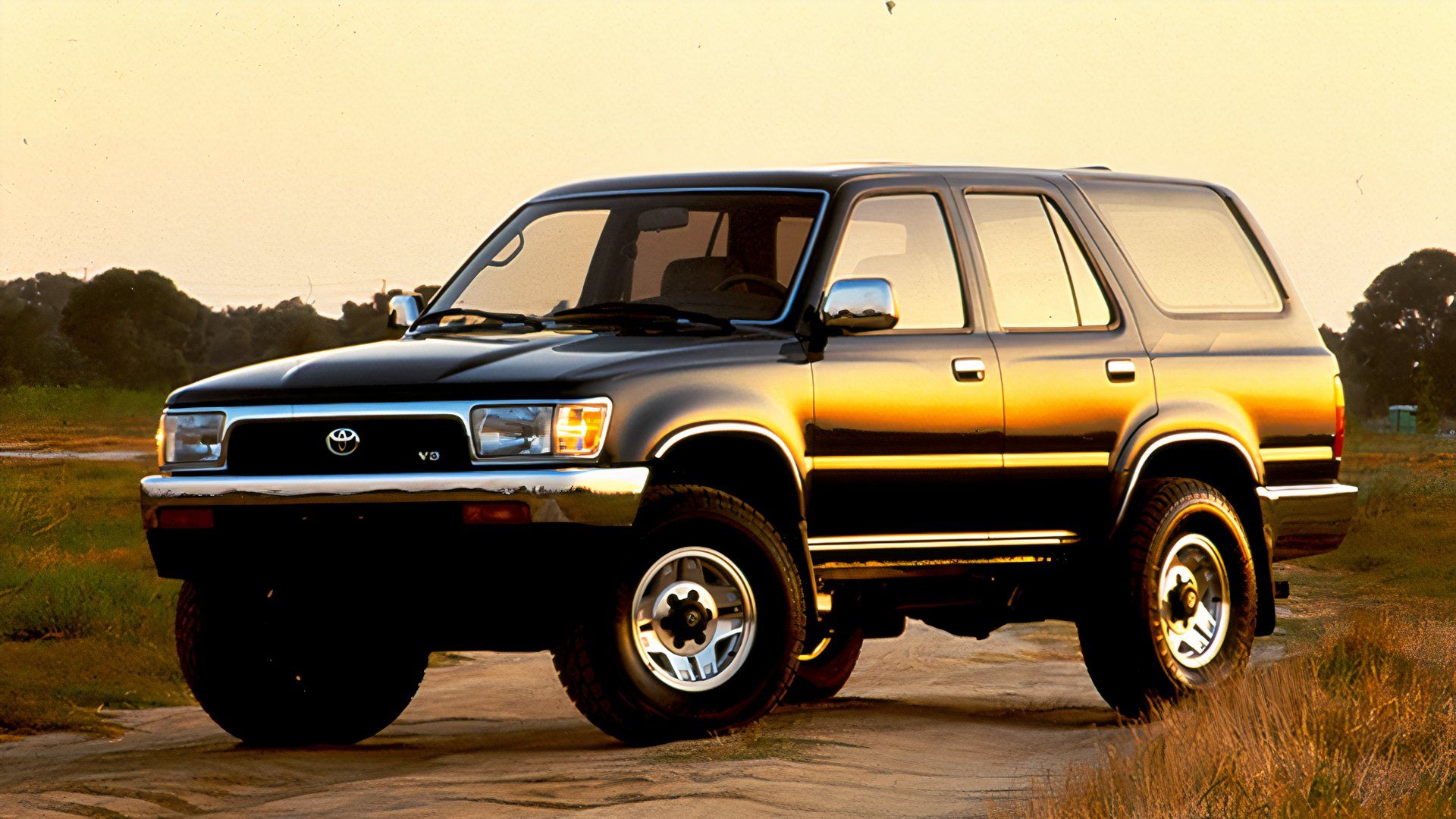
Few nameplates command the reverence that the Toyota 4Runner’s does. An icon 40 years in the making, it’s a vehicle that’s built the trust of millions around the world due to its no-nonsense design, legendary reliability, and proven capability. It’s a model that’s loved being decidedly old school, but there have been a few times when it took massive leaps forward, and the second generation was the first.
Toyota
- Founded
-
August 28, 1937
- Founder
-
Kiichiro Toyoda
- Headquarters
-
Aichi, Japan
- Owned By
-
Publicly Traded
- Current CEO
-
Koji Sato
Introduced in 1990, the second-generation 4Runner built upon the success of the original with a design that was purpose-built for the task at hand, instead of one thrown together in the hopes of capturing sales. It was a critical transformation for the nameplate, one that opened the 4Runner floodgates for a new generation of buyers that weren’t willing to compromise their comfort for rugged freedom. One of the highlights of the 4Runner generation today, it’s a highly approachable route to 4Runner style and performance. That is, if you’re willing to brave the miles.
We take a look at the creation of the second generation 4Runner, the powerplants and off-road capability that made it so famous, and what it will take to make your way into one today.
The 4Runner Grew Up For Its Second Generation
In the 1980s, car companies realized that a lifted wagon with room for the entire family and available AWD systems was the key to a consumer’s heart. The phrase “Sport Utility Vehicle” had been coined some years prior by the Jeep Cherokee, and some competitors were slow to adopt the idea. However, once they were on board, SUV mania very quickly swept the nation, and the better part of the world.
The first-generation 4Runner arrived in 1983 as little more than a Toyota Hilux with a rear bench, roll bar, and removable fiberglass top. It offered buyers the capability of the HIlux, with the room to transport a family’s worth of people, all while no longer having to give up room for a bed many were likely to barely use. Offered with a variety of four and six-cylinder engines (not to mention 4WD), it was a great first step, but there was no denying it was a hobbled-together offering lacking the refinement and comfort necessary to attract more than a niche audience.

Related
Toyota 4Runner Generations: Everything You Need To Know In One Place
The Toyota 4Runner has been with us for four decades and across five generations. Here’s what changed in that time.
The second generation arrived to fix the problems of the first, the largest being that it now offers an integrated steel body to fully protect customers and offers significantly improved NVH levels. Additionally, the nameplate was no longer stuck with two doors, as a four-door option was now introduced that would very quickly take over as the preferred option. With four doors and a permanent roof, the model no longer felt like a converted work truck, making it a much more approachable option for those not dedicated to the hardcore SUV lifestyle.
However, the model didn’t just shelve all the aspects that made it great in the first place. It was still a body-on-frame SUV derived from the Hilux, a model that was still nearly identical to the B-pillar forward, and it offered a solid rear axle with independent front suspension. However, the addition of options like power windows, cruise control, and even leather seats on higher trims were welcome ones, as was improved leg space in the rear.

Related
The Beloved 4Runner: A History Of Toyota’s Iconic Off-Roader
The Toyota 4Runner is 40 years old, so it’s time to look back at the history of this beloved model.
However, one aspect that didn’t change was the engines, and the two offered in the US proved to be legends in the making.
Bulletproof Powertrains Were A Highlight
One of the biggest reasons the second-generation 4Runner is so well respected is the two different engines you can find under the hood: the tried-and-true 2.4-liter 22RE inline-four and the more powerful 3.0-liter 3VZ-E V6.
|
Specification |
2.4L I4 (22RE) |
3.0L V6 (3VZ-E) |
|---|---|---|
|
Valvetrain |
SOHC, 2 valves per cylinder |
SOHC, 2 valves per cylinder |
|
Fuel System |
Electronic Fuel Injection |
Electronic Fuel Injection |
|
Horsepower |
116 hp @ 4,800 rpm |
150 hp @ 4,800 rpm |
|
Torque |
140 lb-ft @ 2,800 rpm |
180 lb-ft @ 3,400 rpm |
|
Transmission Options |
5-speed manual, 4-speed auto |
5-speed manual, 4-speed auto |
|
2WD Fuel Economy (City/Hwy) |
17 / 21 mpg (manual) |
15 / 18 mpg (manual) |
|
Known Issues |
Extremely durable; low maintenance |
Head gasket failure common on early models |
The 22RE was, unsurprisingly, standard, and is widely considered to be one of the most reliable Toyota engines of all time. Its reliability came down to its relatively simple design, with a single overhead camshaft, a timing chain instead of a timing belt, and a cast-iron block with aluminum heads. While it wasn’t particularly powerful, only producing a max of 116 horsepower, it was decently fuel-efficient for the time, allowing you to have the rest of the 4Runner package without worrying about constantly stopping at the pump.

Related
10 Best Off-Roaders Made In The 90s
The 90s gave us Forrest Gump, Friends, CDs and a televised car chase. It also gave us some of the most amazing 4WDs of all time. Here are 10 of them.
However, it seems most buyers weren’t too worried about that problem, because a quick search of the 2nd-gen 4Runner classifieds will yield many V6 versions and very few four-cylinders. This was the engine to get if you wanted any semblance of power in your SUV, despite its increase to 150 horsepower being considered seriously sub-par today. When optioned with 2WD, the pair could net you a towing capacity of 3,500 lbs, which may only be a little more than half what the model could do today, but was enough to transport you and the entire family on a weekend trip away without any fuss.
So the 4Runner wasn’t a speed demon, but what the engines lacked in performance, they made up for in their longevity and robustness. This was paramount in a model that was marketed as a capable off-road vehicle, and one of the many reasons buyers purchase it to this day.
A Real Off-Roader Masquerading As A Crossover
The 2nd-gen 4Runner wasn’t just supposed to be a sleek SUV, it was also supposed to continue Toyota’s tradition of off-roading excellence. This is why it continued to offer exceptional ground clearance – up to 10.2 inches – and impressive approach and departure angles, especially when fitted with the optional 31-inch tires.

Related
10 Japanese SUVs That Are Off-Road Legends
The Japanese may not have invented the 4WD but they sure went a long way in making it hugely capable, reliable and iconic. Here are 10 of the best.
This made the most of the rugged body-on-frame design and suspension system, which utilized an independent double-wishbone design with gas-filled shocks and torsion bars, and a stabilizer bar. The rear was a solid axle with 4-link coils, gas-filled shocks, and a stabilizer bar as well. This meant respectable articulation, but we never received the optional limited-slip differential that was available in Japan and Europe, which was a shame.
The 4WD system was dubbed 4WDemand, and allowed you to engage all four wheels at speeds up to 50 mph, while offering three steel skid plates on the front suspension, transfer case, and fuel tank. 4WD was standard with the V6, but optional with the four cylinder, but no matter which you chose, you’d want to pair it with the 5-speed manual to make the most of it off-road. The 4-speed auto was made for comfortable cruising over anything else, and wasn’t great at keeping the engines in their powerband.

Related
The 5 Models That Cemented Toyota’s Excellent Off-Road Reputation
Off-road drivers who value consistency and reliability above all are often found behind the wheel of a Toyota.
Very quickly owners realized just how mod-able the SUVs were too, as they readily accepted lift kits, larger tires, limited-slip differentials, and winch-ready bumpers that would help you tackle trails you never even thought possible.
However, don’t forget the SUV was anything but harsh, with reviewers of the time pointing out that it was a serene and quiet place to spend some time. The NVH levels were so good that Car & Driver even noted in 1990 that the vehicle could feel a bit disconnected from the outside world; an amusing perspective given what SUVs have turned into today.
Prices Are Still Reasonable, If You Can Stomach The Mileage
In the end, the second-generation 4Runner presents incredible value whether you’re frequently going off-road or not, and you can find your way into one if you’re willing to face your high-mileage fears. It probably won’t surprise you to hear that these early 1990s Toyotas are known for packing on the miles and asking for more. Owners have been happy to oblige since the beginning, and, coupled with a resurgence in interest in 90s 4x4s, leads to a vehicle that demands an investment.
|
Model & Year |
Price |
Mileage |
Location |
|---|---|---|---|
|
1993 Toyota 4Runner SR5 V6 4WD |
$10,000 |
~145,000 |
Huntington Beach, CA |
|
1995 Toyota 4Runner SR5 V6 |
$5,225 |
146,635 mi. |
Carson, CA |
|
1993 Toyota 4Runner SR5 |
$14,999 |
144,725 mi. |
Rainbow City, AL |
|
1995 Toyota 4Runner SR5 V6 |
$4,500 |
160,000 mi. |
Santa Fe, NM |
|
1991 Toyota 4Runner V6 |
$16,500 |
166,339 mi. |
Houston, TX |
|
1994 Toyota 4Runner SR5 V6 |
$10,995 |
173,695 mi. |
Woodinville, WA |
|
1994 Toyota 4Runner SR5 V6 |
$5,995 |
268,459 mi. |
Eugene, OR |
|
1995 Toyota 4Runner SR5 V6 |
$4,488 |
253,458 mi. |
Cheyenne, WY |
We used AutoTempest to see just what prices look like on the open market, and there weren’t a ton to choose from. As you can see, if you want something for less than $10,000, it’s likely pushing, or well past 200,000. Something closer to 100,000 miles will land you in the low $10,000 range, and anything less than that will push you to $20,000 and above. However, the bigger challenge is finding something without many modifications, and in the right spec. Four-door V6 models are a dime a dozen, but if you want a two-door, you’ll spend quite some time looking.

Related
A Mint Used V6 Toyota 4Runner Will Cost You More Than A Brand-New Model
As if the world wasn’t upside-down enough, you’ll now have to pay more for a used Toyota 4Runner than a new one.
However, mileage isn’t necessarily a dealbreaker with SUVs like this. These vehicles were built to last, and any problem they’ll have has been well-documented at this point. If you’re up for the challenge and willing to pony up the cash, there’s no good reason you can’t spring for one, and live out your classic Toyota dreams in style.
Sources: Toyota, AutoTempest, Car And Driver