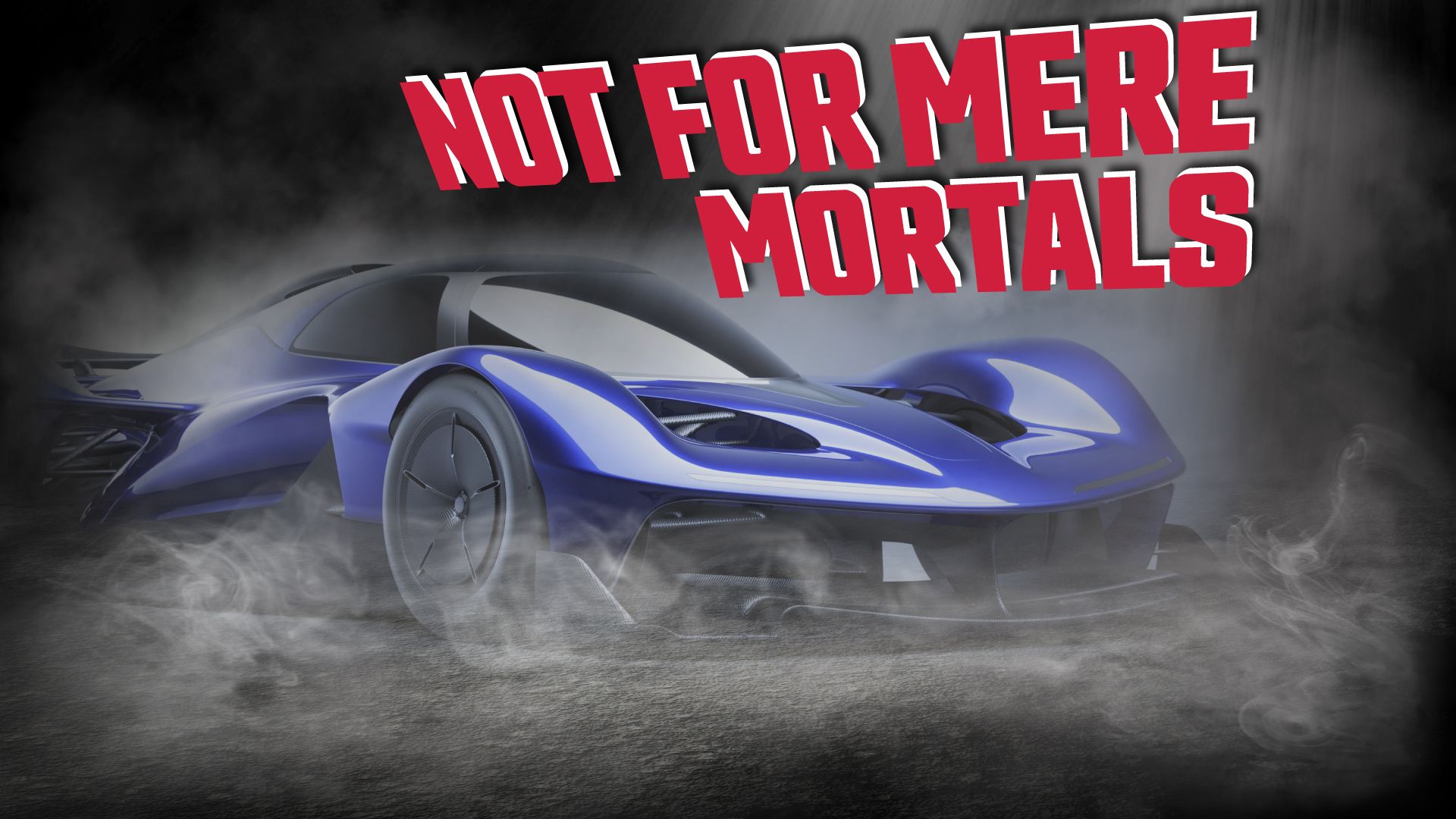
When talking about hypercars, hyperbole frequently makes an appearance: tales of cars with “fighter-jet-like” G-forces, claims of aerospace-inspired technology, and descriptions more fitting for a rocket ship abound. There is, however, one model in the hypercar world that can, without a hint of hyperbole, claim to have the ability to make its occupants fall unconscious.
- Base Trim Engine
-
6.5L V12 Hybrid
- Base Trim Transmission
-
7-speed Sequential
- Base Trim Drivetrain
-
Rear-Wheel Drive
We’re talking about the Red Bull RB17, the F1-inspired Adrian Newey creation revealed at Goodwood last year. This state-of-the-art hypercar is packed with exciting design features, and despite its track-only nature, some have already set out to work on a road-legal version, bringing the thrills outside the track. Let’s take a closer look at this V10-powered hybrid monster, and another model that shares many traits with it – the Aston Martin Valkyrie.
This feature focuses on Red Bull’s RB17 hypercar and its closest relative in the automotive world, the Aston Martin Valkyrie.
Meet The RB17
|
Red Bull RB17 Specs |
|
|---|---|
|
Engine |
4.5L NA V10 + one electric motor |
|
Horsepower |
1,200 hp (combined) |
|
Torque |
811 lb-ft |
|
Transmission |
6-speed sequential |
|
Top Speed |
Over 217 mph |
In case you’re wondering whether the RB17 takes its name from a Formula 1 car, the answer is yes and no. The hypercar does use the naming convention typically employed by Red Bull for its F1 cars; however, since the F1 car that succeeded the RB16 was partially based on the previous year’s model, the team chose to call it the RB16B instead. The following year, Red Bull skipped straight to RB18, meaning there is no Formula 1 car called the RB17- that name became exclusive to this unique model. The RB17 is Red Bull’s very first production car, even if the production run itself is very limited, with only 50 units being built in total.

Related
Red Bull’s $7.7 Million RB17 Hypercar Almost Had A Ford Badge
We heard from Christian Newey at Goodwood, and he’s told us the price and several other juicy details, including Ford turning down a big opportunity.
The world of Formula 1 did, however, provide the inspiration for several elements of the RB17, which also includes features now banned in actual Formula 1 cars (such as an active suspension). Adrian Newey drew on his long experience working in Formula 1 as a designer and aerodynamicist, creating a car that is built for the track and combines style with performance; Christian Horner, Red Bull CEO, has described the RB17 as “Adrian Newey unleashed”.
Performance And Art: The RB17’s Design
The RB17 is designed around aerodynamics and performance while still keeping an eye on the aesthetic aspect, with form and function in perfect balance. Its flowing lines create the illusion of movement, even when the car is standing still.
The RB17’s powertrain is as unique as the rest of the car; while initial plans included a twin-turbo V8 inspired by the world of Formula 1, Red Bull ultimately ended up choosing a 4.5-liter V10 (developed by Cosworth) as the powertrain’s combustion element instead. This engine already reaches a four-figure power output all on its own, however it is further assisted by an electric motor producing an additional 200 hp. A six-speed sequential transmission, developed by British engineering company Xtrac, completes the picture. The large size of the fuel tank (18.5 gallons) and Red Bull’s statement regarding it being built “in line with current Le Mans safety regulations” suggests the RB17 may even find a place in the world of endurance racing at some point in the not-too-distant future.

Related
Aston Martin Just Can’t Catch A Break
The company’s sales of ‘Special’ vehicles have fallen, plus you might have to wait for new Astons to arrive on American soil.
One of the key characteristics of the RB17 is its ability to make an untrained occupant lose consciousness. Its capabilities are on par and, in certain cases, beyond that of Formula 1 cars, and beyond what the human body can normally tolerate. The RB can reportedly achieve over 5 g of lateral acceleration during cornering, and about the same amount longitudinally during braking. This was revealed in an interview Road & Track had with Red Bull’s engineers. This car goes so hard, there’s a real possibility the driver and passenger can black out.
This means that people who aren’t professional racing drivers or fighter pilots will struggle to cope with the experience of driving or riding in the RB17. Red Bull, however, has found a solution to this problem: the company has created dedicated training resources for prospective RB17 owners, which allow them to achieve the level of skill and fitness required to take advantage of their car’s full capabilities. Every RB17 owner will be able to spend time coming to grips with their cars, thanks to simulator sessions and dedicated track days at racetracks all over the world.
From The Track To The Road: The Lanzante RB17
The RB17 may not be a road-legal car, but as soon as it was released someone started to think of a way to fix that. For a few lucky people who want to experience the RB17’s capabilities outside of a racetrack, British automotive firm Lanzante is working on a road legal version. Some of the customers who have placed an order for the RB17 have reached out to Lanzante about a conversion project, which would turn the hypercar into a fully road-legal vehicle.
This would not be the first time Lanzante has taken a track-only car and turned it into something a little more manageable (and legal) on public roads: the company has lots of similar projects in its portfolio, including a McLaren F1 GTR, a Pagani Huayra R, a Pagani Zonda Revolucion, and a Porsche 935.

Related
Someone Is Fixing Our Biggest Problem With The New Red Bull Hypercar
Unveiled at the Goodwood Festival of Speed, the ultra-limited hypercar will be made road-legal by Lanzante – for a price, of course.
The firm also has some connections with Adrian Newey himself; at the 2024 Goodwood Festival of Speed, he was spotted wearing one of the firm’s branded t-shirts. He is also known to own at least one car built by Lanzante, which also looks after two other members of the Newey garage: a Ford GT-40 and Jaguar E-Type.
Of course, the project is going to involve a large amount of work and engineering expertise: the RB17 is a powerful beast, which takes a lot of driving skill to control even on a racetrack. In order to make it suitable for public roads, Lanzante will have to carry out plenty of modifications. The price tag for the conversion job has not been confirmed, but it’s estimated to be somewhere in the region of $650,000 (on top of the RB17’s own hefty price of around $7.7 million, of course).
The RB17’s Spiritual Sibling: The Aston Martin Valkyrie
The RB17 does not just take cues from Formula 1, but also from another Adrian Newey hypercar which it bears some degree of resemblance to: the Aston Martin Valkyrie, which had been introduced only a few years earlier at the 2017 Geneva Motor Show. The Valkyrie was the result of a collaborative design and engineering effort on the part of Aston Martin and Red Bull; unlike the RB17, it was intended to be a hybrid hypercar which could be enjoyed on both the track and the road.
There are several similarities between the Valkyrie and the RB17, most notably in terms of design; both cars were imagined with aerodynamics in mind, which is reflected in their sweeping lines and fast, aggressive looks. The Valkyrie’s underfloor is built to produce a high level of downforce (as much as 18,000 pounds) thanks to the “ground effect” principle.
A track-only version of the Valkyrie, called the Valkyrie Pro, was unveiled at Geneva a year after the standard car; this variant is even rarer, with only 40 units produced (out of a total of 275). An open-top Spider version, with a removable carbon fiber roof and butterfly doors replacing the original’s gullwing doors, arrived in 2021.

Related
Aston Martin Valkyrie SHATTERS Silverstone Lap Record By 10 Seconds
Aston Martin’s Valkyrie is ridiculously quick, but we need to see more.
In an effort to protect the Valkyrie from being “flipped” or resold quickly after initial purchase, Aston Martin adopted a similar policy to that used by Ford with the GT, preventing customers from being able to buy another special edition Aston Martin model if they had sold their Valkyrie too soon after their purchase.
While the Valkyrie and RB17 share many elements of their design and character, they retain distinct personalities and features, and we can’t wait to see more of the RB17 once production begins and the first lucky customers start having their cars delivered.
Sources: Red Bull, Aston Martin. Road & Track